
Mumbai, August 18, 2026
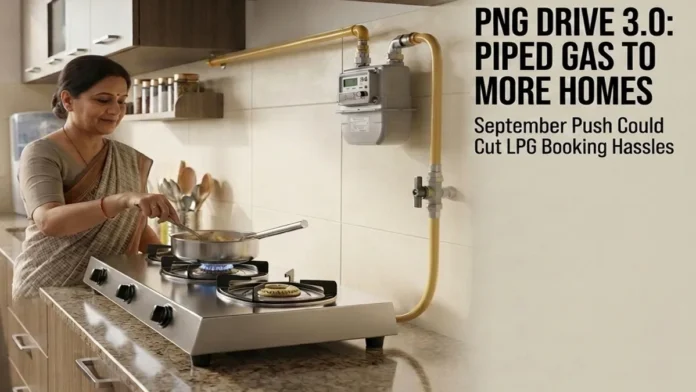
PNG Drive 3.0 could become the next major step in expanding household piped natural gas access in India, with a broader rollout expected from September. The proposed campaign is aimed at taking PNG connections to more homes, especially in locations where pipelines are already present in the area but many households are still dependent on LPG cylinders.
The move, if launched as expected, would be significant for both urban and semi-urban consumers. While LPG cylinders have already reached a large number of homes, including remote and rural areas, many cities also have access to PNG for daily cooking needs. In those locations, households connected to PNG do not need to worry about cylinder refills, delivery schedules, or booking delays.
The expected PNG Drive 3.0 campaign is being seen as a push to close that gap.
What Is PNG Drive 3.0?
PNG Drive 3.0 is expected to be a nationwide campaign designed to increase the reach and use of piped natural gas in residential areas. The focus is likely to be on places where the local gas network or society-level connectivity already exists, but individual homes have not yet taken a PNG connection.
That means the drive may not necessarily start from scratch in completely uncovered regions. Instead, it may first target neighborhoods, apartment complexes, and localities where infrastructure is available but household-level adoption remains incomplete.
When Could the Drive Start?
According to the information currently circulating, PNG Drive 3.0 could begin in September. The broader goal appears to be to expand household access to piped gas and make cooking fuel supply more dependable for consumers.
An official rollout timeline and execution details will ultimately determine how quickly the benefits reach households, but the proposal has already drawn attention because of its potential to reduce dependence on LPG cylinder booking.
Who Is Likely to Benefit?
The biggest beneficiaries are expected to be households in areas where PNG lines are already available nearby but no direct home connection has been activated.
This may include:
- Apartment societies where the gas network is installed but not every home is connected
- Residential colonies that fall under an existing city gas distribution zone
- Urban and semi-urban households looking for a more continuous cooking gas supply
- Families that want to avoid repeated LPG booking and refill management
For such households, the transition to PNG could make daily cooking more convenient and predictable.
How Could This Help Consumers?
One of the main advantages of PNG is convenience. Unlike LPG, which requires households to book a cylinder refill and wait for delivery, PNG is supplied through a pipeline network. That reduces the need for repeated booking and minimizes the risk of running out of cooking gas unexpectedly.
The expected benefits include:
1. Relief From Cylinder Booking Hassles
Consumers may no longer need to track refill dates, place booking requests, or wait for delivery once a PNG connection is active.
2. Continuous Supply
PNG typically offers a more regular gas supply, which can be especially useful during periods of delivery disruption or high demand.
3. Less Disruption During Supply Stress
Recent concerns around fuel logistics and regional tensions have highlighted how disruptions can affect cylinder availability. A wider PNG network could help reduce inconvenience for households in connected areas.
4. More Convenient Urban Cooking Fuel Access
For many consumers, PNG simplifies household fuel management by providing cooking gas directly through a fixed pipeline system.
Why Is This Expansion Important?
India’s household cooking fuel network has expanded substantially over the years, and LPG remains essential in large parts of the country. But in cities and developed gas-distribution zones, PNG is increasingly viewed as a practical alternative because it offers steady access without the operational burden of cylinder replacement.
If PNG Drive 3.0 moves ahead as expected, it could strengthen city gas distribution, improve consumer convenience, and encourage broader household adoption of piped cooking fuel where infrastructure is already in place.
Still, the actual impact will depend on local pipeline readiness, connection speed, and how effectively the campaign is implemented on the ground.
Bottom Line
For households that still rely on LPG despite having PNG access in their area, PNG Drive 3.0 could be an important development. If the campaign starts in September as expected, it may make piped gas available to more homes and reduce the everyday hassle of LPG cylinder booking.
For consumers, the biggest attraction is simple: a more reliable cooking fuel supply with less effort.








Comments are closed.