
NEW DELHI, INDIA | AUGUST 26, 2026 —
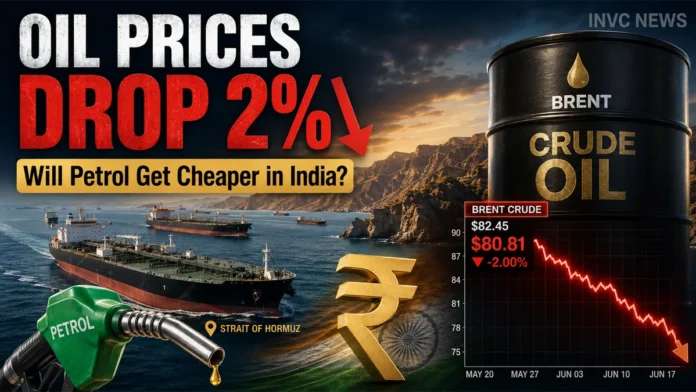
Oil prices drop on Hormuz reopening hopes has emerged as a major global economic development Wednesday, with Brent crude falling more than 2% as Iran and Oman resumed discussions over a temporary navigation corridor through the Strait of Hormuz.
Brent crude slipped to around $86–87 a barrel, while U.S. West Texas Intermediate crude fell toward $81.
For India, which imports close to 90% of its crude oil requirements, cheaper global oil is potentially good news for inflation, the rupee, fuel-marketing companies and the broader stock market.
But one important question remains:
Will petrol and diesel prices in India fall immediately?
The answer is not necessarily.
Why Are Crude Oil Prices Falling Today?
The immediate trigger is renewed diplomacy between Iran and Oman.
The two countries are discussing a temporary navigational corridor through the Strait of Hormuz, one of the world’s most important energy-shipping routes.
The proposal includes efforts to improve safe passage and address mines and other security risks in the waterway.
Before the Middle East conflict intensified, the Strait of Hormuz handled roughly 20% of global oil and LNG shipments.
Any credible movement toward reopening or normalizing the route can therefore have an outsized impact on global energy prices.
Markets are now pricing in the possibility that more oil could move through the strait if navigation conditions improve.
Strait of Hormuz Is Still Far From Normal
The fall in crude should not be interpreted as confirmation that the crisis is over.
Shipping traffic through Hormuz remains dramatically below normal levels.
Preliminary ship-tracking data showed only five commodity vessels crossed the strait on Tuesday, compared with a recent 10-day average of about 15 vessels.
Before the conflict, traffic was substantially higher.
A tanker was also recently struck near Oman, underscoring the continuing security risk.
That means crude prices could reverse sharply if negotiations fail or maritime tensions escalate again.
Why Falling Oil Matters So Much for India
Few major economies are as sensitive to international crude prices as India.
India depends heavily on overseas suppliers for its energy requirements. When global oil becomes expensive, the country has to spend more dollars on crude imports.
That can affect several parts of the economy.
1. Rupee Could Get Some Relief
Oil importers need dollars to pay overseas suppliers.
When crude prices rise sharply, demand for dollars can increase and put pressure on the Indian rupee.
A sustained fall in crude can ease that pressure.
The rupee has recently traded around the ₹95–96 per dollar region while the Reserve Bank of India has been active in limiting excessive volatility.
INVC NEWS previously examined the longer-term currency risk in our report: Indian Rupee Could Slide Toward 99 per Dollar by 2028.
2. Inflation Pressure Could Ease
Oil affects much more than petrol and diesel.
Higher fuel costs can increase expenses for:
- Transportation
- Airlines
- Logistics
- Agriculture
- Manufacturing
- Chemicals
- Consumer goods
Companies can eventually pass part of those higher costs to consumers.
Therefore, sustained lower crude prices can help reduce inflationary pressure across the economy.
3. Stock Market Gets a Positive Trigger
Indian equities responded positively Wednesday as crude prices retreated.
The Sensex and Nifty moved higher during the session, while oil-marketing companies such as BPCL, HPCL and Indian Oil gained as falling crude improved sentiment around refining and marketing margins.
Read our latest market coverage: Stock Market Today: Sensex, Nifty Rise as Crude Oil Falls.
Banks and other domestic sectors also benefited from improving risk sentiment.
Will Petrol and Diesel Become Cheaper Now?
This is the part consumers should watch carefully.
A one-day or two-day decline in crude prices does not automatically translate into an immediate reduction in petrol or diesel prices.
Retail fuel prices depend on several factors, including:
- International crude prices
- Refining costs
- Rupee-dollar exchange rate
- Freight
- Dealer margins
- Central taxes
- State taxes
- Pricing decisions by oil-marketing companies
Therefore, crude needs to remain lower for a meaningful period before consumers can confidently expect the international decline to influence retail fuel prices.
According to the Petroleum Planning and Analysis Cell, petrol in Delhi was listed at ₹102.12 per liter as of July 31, 2026.
Official petroleum-price and import data can be checked on the Petroleum Planning and Analysis Cell website.
India Has Already Changed Where It Buys Oil
The Hormuz crisis has significantly altered India’s crude-import strategy.
Indian refiners have increased purchases from Russia and Latin America as Middle Eastern supplies became more difficult.
Russia’s share of India’s crude imports reached a record 50.83% in July 2026, according to shipping and trade data.
India imported about 2.47 million barrels per day of Russian crude during the month.
Meanwhile, Middle Eastern suppliers lost market share as the conflict disrupted traditional shipping routes.
This diversification has helped India reduce some exposure to the Strait of Hormuz, but it has not eliminated the risk.
Why Hormuz Still Matters Even If India Buys More Russian Oil
Oil is a global commodity.
Even if a barrel purchased by India does not physically pass through the Strait of Hormuz, a major disruption in Gulf supply can raise global benchmark prices.
Russian, Brazilian or American crude can become more expensive simply because buyers worldwide begin competing for alternative supplies.
Shipping costs can also rise.
This is why a reopening of Hormuz matters to Indian consumers even when India’s crude sources are diversified.
Could Crude Fall Further?
Yes—but the path remains highly uncertain.
If Iran and Oman establish a functioning temporary corridor and more tankers begin moving safely through Hormuz, the geopolitical risk premium embedded in crude prices could fall further.
Additional U.S. crude inventories may also put downward pressure on prices.
However, the reverse is equally possible.
Fresh attacks, tougher U.S. sanctions, renewed U.S.-Iran confrontation or another tanker incident could quickly push oil higher again.
What Indians Should Watch Next
Three developments now matter most:
First: whether Iran and Oman actually announce a navigation agreement.
Second: whether tanker traffic through Hormuz starts rising materially.
Third: whether Brent crude remains below $90 rather than bouncing back after a short-term fall.
For Indian consumers, the most favorable scenario would be a sustained decline in crude combined with stability in the rupee.
That could ease inflation pressure and eventually strengthen the case for lower domestic fuel prices.
For now, however, Wednesday’s crude decline is best viewed as a significant relief signal—not yet a guarantee of cheaper petrol and diesel at Indian pumps.











Comments are closed.