Saudi Authorities Report Heavy Casualties at King Khalid International Airport; Fighting Intensifies Across Yemen, Including Taiz and the Bab al-Mandab Region
By Team INVC | INVC News
RIYADH, SAUDI ARABIA | October 11, 2026
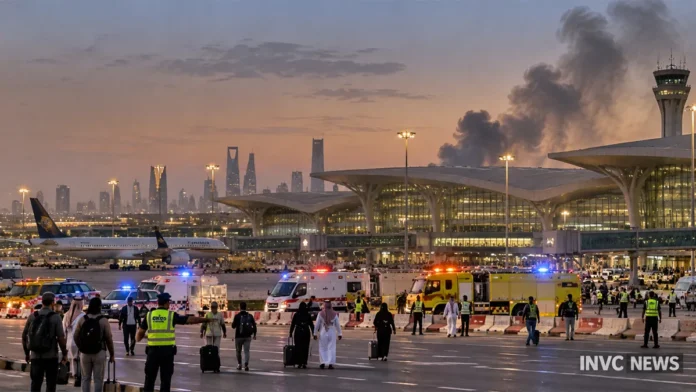
A deadly attack on Riyadh’s King Khalid International Airport has left 12 people dead and 309 injured, according to Saudi Arabia’s General Authority of Civil Aviation, as escalating hostilities between Saudi Arabia and Yemen’s Houthi movement raise fresh concerns over civilian safety and critical infrastructure across the region.
In a statement issued early Sunday, the Saudi aviation authority said the victims included four Saudi citizens and eight foreign nationals. The foreign victims comprised two Bangladeshi citizens and one citizen each of the United States, Egypt, Jordan, Syria, Palestine and Sudan. Several of the injured were reported to be in critical condition and were receiving treatment at hospitals.
Airport operations were temporarily suspended while authorities assessed the damage and carried out security inspections, the aviation authority said.
The attack marks a serious escalation in a conflict that has increasingly threatened airports, transport links and other civilian infrastructure in Saudi Arabia and Yemen.
Saudi Arabia and Houthis Exchange Military Strikes
The airport attack comes amid intensifying military operations involving Saudi Arabia and Houthi forces in Yemen.
The Houthi movement said it was prepared to take reciprocal steps to keep airports, seaports and other humanitarian facilities outside the expanding military confrontation. The statement followed the deadly strike on Riyadh’s airport.
Meanwhile, Houthi-affiliated Al-Masirah television reported a new wave of Saudi air and missile strikes against areas under Houthi control in Yemen. The reported targets included Sanaa International Airport, areas near the Bab al-Mandab Strait and several northern provinces.
The accounts of military operations and their effects have not all been independently verified.
Yemen Government Reports Heavy Houthi Casualties
Yemen’s government military said more than 1,900 attacks or military operations had been carried out across several fronts over the preceding 24 hours, claiming that more than 1,150 Houthi fighters had been killed or taken out of combat.
The military also claimed that more than 180 military and logistics vehicles had been destroyed or damaged.
These figures are claims by the government side and could not be independently confirmed. They should not be treated as verified casualty or equipment-loss totals.
Fighting Intensifies Around Taiz
Military sources cited in the report said fighting had intensified around Taiz in southwestern Yemen, placing additional pressure on government forces defending the city.
The reported Houthi advances have also affected key roads connecting Taiz with government-controlled areas in southern Yemen. Heavy clashes were said to be continuing south of the city.
Taiz has long been a strategically important battleground because of its location and its road connections to other parts of the country.
Bab al-Mandab Emerges as a Key Flashpoint
The Bab al-Mandab Strait, a strategic maritime passage linking the Red Sea with the Gulf of Aden, has become another major focus of the fighting.
Yemen’s internationally recognized government launched a major military campaign on Monday, with Saudi air support, to regain territory held by the Houthis, according to the supplied report.
The intensifying confrontation around the strait has raised concerns about the security of regional transport routes and the potential consequences for civilian and humanitarian operations.
A Conflict With Deep Roots
Yemen’s conflict escalated in late 2014, when Houthi forces seized Sanaa and large parts of the country’s north. In 2015, a Saudi-led coalition intervened in support of Yemen’s internationally recognized government, which now operates from the southern port city of Aden.
A United Nations-mediated truce in 2022 helped reduce large-scale fighting for a period, although the conflict remained unresolved. The renewed military escalation represents a significant deterioration in an already fragile security environment.
What Comes Next?
The immediate priorities are the treatment of those injured in Riyadh, the assessment of damage to the airport and the safety of civilian aviation. The wider conflict also raises questions about the protection of ports, humanitarian facilities and strategic maritime routes.
With military operations intensifying on multiple fronts, the risk of further disruption remains a major concern. The scale and duration of the escalation will depend on developments on the ground and whether the parties take steps to protect civilian infrastructure.
INVC News will continue to follow developments in Saudi Arabia and Yemen, with particular attention to civilian casualties, airport operations and the regional security situation.