
MUMBAI, Aug. 16, 2026
Moto G Max vs Redmi Note 17 5G: The Short Verdict
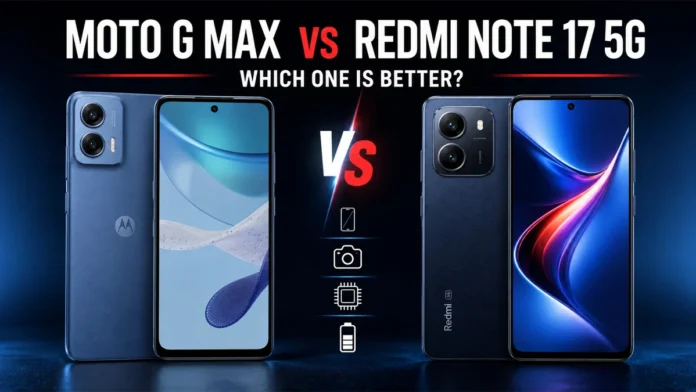
Moto G Max vs Redmi Note 17 5G is a closely contested comparison between two ₹27,999 Android phones with very different strengths. The Redmi is the better choice for most buyers who prioritize an AMOLED display, battery capacity, faster charging and long-term software support. The Moto, however, offers the stronger performance-and-camera package.
Both smartphones include Android 16, 5G connectivity, Full HD+ displays and a refresh rate of up to 120Hz. Their similarities largely end there.
The Redmi Note 17 5G features a brighter AMOLED display, an 8,000mAh battery, 45W charging and up to six years of security updates. The Moto G Max counters with a faster Snapdragon 6s Gen 4 processor, LPDDR5X memory, UFS 3.1 storage, an ultrawide camera and a significantly sharper selfie camera.
Moto G Max vs Redmi Note 17 5G Specifications
| Feature | Moto G Max | Redmi Note 17 5G |
|---|---|---|
| Starting price | ₹27,999 | ₹27,999 |
| Base configuration | 6GB + 128GB | 6GB + 128GB |
| Display | 6.72-inch FHD+ LCD | 6.9-inch FHD+ AMOLED |
| Refresh rate | 120Hz | 120Hz |
| Peak brightness | 1,050 nits | 1,800 nits |
| Processor | Snapdragon 6s Gen 4 | Snapdragon 4 Gen 4 |
| RAM | 6GB LPDDR5X | 6GB or 8GB LPDDR4X |
| Storage | 128GB UFS 3.1 | 128GB UFS 2.2 |
| Main camera | 50MP Sony LYTIA 600 | 50MP |
| Secondary camera | 8MP ultrawide | Auxiliary AI camera |
| Selfie camera | 32MP | 8MP |
| Battery | 7,000mAh | 8,000mAh |
| Charging | 30W wired | 45W wired |
| Reverse charging | Not highlighted | 22.5W wired |
| Water resistance | IP64 | IP65 |
| Durability | MIL-STD-810H tested | Reinforced chassis |
| Operating system | Android 16 with Hello UI | Android 16 with HyperOS 3 |
| Update policy | Two OS upgrades; three years of security updates | Four OS upgrades; six years of security updates |
Design and Durability
Both smartphones use relatively practical designs aimed at the midrange market. The Redmi Note 17 5G has a plastic frame and rear panel, with Corning Gorilla Glass 7i protecting the front.
It carries an IP65 rating, offering dust protection and resistance against low-pressure water jets. Xiaomi also includes HydroTouch 2.0, which is designed to keep the touchscreen responsive when a user’s fingers are wet or oily.
The Moto G Max has Gorilla Glass 7i on the front and an IP64 rating, which means its formal protection against water is slightly lower. Motorola adds MIL-STD-810H durability testing, however, giving the device an advantage for buyers concerned about everyday knocks, temperature changes and demanding environmental conditions.
MIL-STD certification should not be interpreted as a guarantee against all drops or damage. Neither phone should be intentionally submerged.
Design and durability winner: Tie. Redmi has the stronger IP rating, while Moto emphasizes structural durability.
Which Phone Has the Better Display?
The Redmi Note 17 5G wins the display comparison decisively.
It features a 6.9-inch Full HD+ TrueColour AMOLED display with a refresh rate of up to 120Hz, touch sampling of up to 240Hz and multi-scenario peak brightness of 1,800 nits. AMOLED technology can produce deeper blacks, stronger contrast and more vibrant colors than a conventional LCD.
The Moto G Max has a smaller 6.72-inch Full HD+ LCD panel with a 120Hz refresh rate and brightness of up to 1,050 nits.
Both displays should feel smooth while scrolling, but the Redmi screen is likely to provide a better experience for movies, gaming and outdoor use. Xiaomi also includes an optical in-display fingerprint sensor, while the Moto uses a side-mounted reader.
Display winner: Redmi Note 17 5G.
Performance: Snapdragon 6s Gen 4 vs Snapdragon 4 Gen 4
The Moto G Max has the stronger performance hardware.
Motorola uses the Snapdragon 6s Gen 4, a 4nm 5G processor with CPU speeds reaching 2.4GHz. The phone also includes 6GB of LPDDR5X RAM and 128GB of UFS 3.1 storage.
The Redmi Note 17 5G runs on the Snapdragon 4 Gen 4, another 4nm chip, with CPU speeds of up to 2.3GHz. It has LPDDR4X RAM and UFS 2.2 storage.
The Moto’s newer memory and faster storage should help with application loading, file transfers and sustained multitasking. Its 6-series processor also gives it a stronger foundation for demanding applications and gaming.
Motorola advertises RAM Boost that can expand the available memory figure to as much as 18GB by using part of the internal storage. Virtual RAM is not as fast as physical LPDDR5X memory and should not be treated as an equivalent replacement.
The supplied claim that the Moto G Max offers 8GB RAM and 256GB storage is incorrect for the verified India configuration. Motorola lists 6GB RAM and 128GB storage. (Official Moto G Max details)
Performance winner: Moto G Max.
Storage and Expandability
The Moto G Max provides faster UFS 3.1 storage, while the Redmi uses UFS 2.2. That gives Motorola an advantage in storage speed.
The Redmi includes a microSD slot, making it more convenient for buyers who need additional space for photos, videos and offline media. Buyers should confirm the supported card capacity in the official documentation before purchasing a high-capacity card.
Storage winner: Moto for speed; Redmi for convenient expansion.
Which Phone Has Better Cameras?
The Moto G Max offers the more versatile camera system on paper.
Its rear camera setup includes a 50MP Sony LYTIA 600 primary camera and an 8MP ultrawide camera with a 120-degree field of view. A 32MP front camera handles selfies and video calls.
The Redmi Note 17 5G has a 50MP primary rear camera accompanied by an auxiliary AI camera. Its front-facing camera has an 8MP resolution.
Xiaomi supplies software features such as Night Mode, AI HDR, portrait photography, dynamic shots and 2x in-sensor zoom. However, it does not offer the same dedicated ultrawide option as the Moto.
Megapixel counts alone do not determine image quality. Image processing, stabilization, color accuracy and low-light performance also matter. Based strictly on hardware flexibility, the Moto is ahead.
Camera winner: Moto G Max.
Battery and Charging
The Redmi Note 17 5G has an 8,000mAh silicon-carbon battery, compared with the Moto G Max’s 7,000mAh unit.
Xiaomi supports 45W wired fast charging and includes a compatible charger in the box. Motorola provides 30W TurboPower charging.
The Redmi also offers 22.5W wired reverse charging, allowing it to supply power to supported accessories or another phone through a cable.
The supplied material incorrectly describes this as wireless charging. The Redmi Note 17 5G does not list 22.5W wireless charging; it lists 22.5W wired reverse charging.
The larger battery does not automatically guarantee proportionately longer real-world endurance. Display efficiency, network conditions, brightness and application use will affect results. Nevertheless, Redmi has the stronger specifications.
Battery winner: Redmi Note 17 5G.
Software and Update Support
Both phones ship with Android 16.
The Redmi Note 17 5G runs HyperOS 3. Xiaomi promises four Android operating-system upgrades and six years of security updates.
The Moto G Max uses Motorola’s Hello UI, which generally stays visually closer to standard Android. Motorola promises two Android upgrades and three years of security updates.
Buyers who prefer a relatively clean interface may favor the Moto. Those planning to keep their phone for four or five years will receive substantially longer support from Xiaomi.
Software-support winner: Redmi Note 17 5G.
Prices in India
The verified prices are:
- Moto G Max, 6GB + 128GB: ₹27,999
- Redmi Note 17 5G, 6GB + 128GB: ₹27,999
- Redmi Note 17 5G, 8GB + 128GB: ₹30,999
Only the Redmi base model falls below the ₹30,000 ceiling without a discount. The 8GB model exceeds that budget at its listed price.
Temporary card discounts and exchange bonuses may lower the effective price, but they are subject to eligibility and can change. Xiaomi’s official August offer terms list the two variants at ₹27,999 and ₹30,999.
Moto G Max vs Redmi Note 17 5G: Which Should You Buy?
Choose the Redmi Note 17 5G if you prioritize:
- A larger and brighter AMOLED display
- Longer software and security support
- An 8,000mAh battery
- Faster 45W charging
- 22.5W wired reverse charging
- An IP65 rating
Choose the Moto G Max if you prioritize:
- Stronger processor performance
- Faster LPDDR5X RAM and UFS 3.1 storage
- A dedicated ultrawide rear camera
- A 32MP selfie camera
- MIL-STD-810H durability testing
- A cleaner-looking Android interface
Final Verdict
At the same ₹27,999 starting price, the Redmi Note 17 5G is the better all-round choice for most buyers. Its AMOLED screen, larger battery, faster charging and much longer update policy provide more practical value over several years.
The Moto G Max is the better specialist choice for performance and cameras. Its Snapdragon 6s Gen 4 processor, faster memory and storage, ultrawide camera and 32MP front camera make it more appealing to gamers, multitaskers and content creators.
Overall winner: Redmi Note 17 5G
Performance and camera winner: Moto G Max