Nagpur, August 15, 2026
Mohan Bhagwat’s Independence Day speech called on citizens to strengthen India’s freedom by helping build a prosperous, secure and united nation capable of making a meaningful contribution to the world.
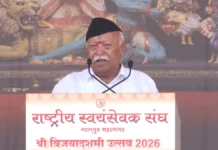
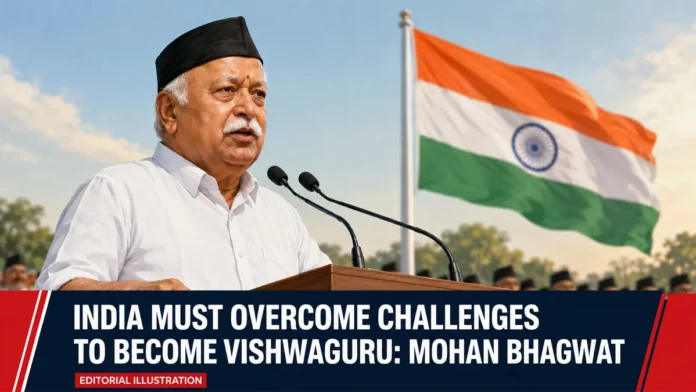
Addressing a gathering after hoisting the national flag at the Rashtriya Swayamsevak Sangh headquarters in Nagpur on Saturday, the RSS chief said India must confront forces working against its progress without abandoning its fundamental principles.
Bhagwat said the country should aspire to become a “Vishwaguru,” a term commonly used to describe a nation that guides the world through its knowledge, values and conduct. However, achieving that objective would require collective effort, discipline, sacrifice and the ability to overcome challenges, he added.
Freedom must be protected, Bhagwat says
Bhagwat described Independence Day as an occasion of celebration and pride for every Indian. He said the freedom struggle, when counted from the uprising of 1857, involved nearly nine decades of sustained sacrifice by earlier generations.
India should take pride in those sacrifices and celebrate the success of the freedom movement, he said. At the same time, citizens must remember that protecting the independence secured through years of struggle remains their responsibility.
According to Bhagwat, freedom should not be viewed merely as an achievement inherited from the past. Its benefits must be preserved and strengthened through responsible conduct in the present.
Savarkar invoked while discussing citizens’ duties
Referring to Hindutva ideologue Vinayak Damodar Savarkar, Bhagwat said citizens have a duty to ensure that the positive, progressive and beneficial outcomes of independence become part of national life.
He also used the colors and symbols of the Indian flag to explain what he described as the values required for building a strong society.
Bhagwat said every element of the national flag carries a message that citizens should examine and incorporate into their lives.
What Bhagwat said about the saffron color
The RSS chief described saffron as a symbol of action, knowledge and sacrifice.
He said national independence is achieved through sustained work and sacrifice. After freedom is secured, those same qualities help make a country prosperous and safe.
The saffron band, he said, reminds citizens of the importance of dedication and personal sacrifice. When commitment, hard work, knowledge and a willingness to make sacrifices become part of everyday life, society becomes more peaceful and people’s intentions remain pure, he added.
White represents purity and discipline
Explaining the meaning of the white band, Bhagwat said it represents purity and encourages people to maintain discipline.
He said it should also inspire self-reflection, prompting citizens to ask whether they are genuinely following the principles they publicly support.
In his interpretation, discipline and introspection help ensure that national values are reflected in behavior rather than remaining limited to words or ceremonial observances.
Green symbolizes prosperity
Bhagwat linked the green band of the national flag with prosperity, describing it as the outcome of disciplined work, knowledge, sacrifice and commitment.
His remarks presented the tricolor as a sequence of connected civic principles: sacrifice and knowledge lead to disciplined conduct, which eventually supports social and economic well-being.
Ashoka Chakra reflects unity amid differences
Bhagwat said individuals naturally have different personalities and opinions. However, he argued that these differences can also demonstrate the strength of national unity.
“The Ashoka Chakra has many spokes, but they all emerge from the same central point,” he said, using the wheel as a metaphor for a diverse society connected by a common purpose.
He described the Ashoka Chakra as a representation of individual and social awareness. The spokes, he said, remain within the boundary of dharma or discipline so that society can function properly.
Bhagwat said this was why the Dharma Chakra occupies the center of the national flag. When citizens salute or hoist the tricolor, they should reflect on the ideas represented by its colors and symbols and try to incorporate their essence into daily life, he added.
Differences of opinion can coexist with unity
The RSS chief emphasized that national unity does not require every person to hold an identical opinion.
People may differ in their experiences, beliefs and views, he said, but those differences can coexist within a shared national framework. He compared this diversity to the spokes of the Ashoka Chakra, which remain distinct while connecting to a common center.
His remarks placed discipline, shared responsibility and adherence to fundamental principles at the center of national cohesion.
‘India must confront forces obstructing its progress’
Bhagwat said there was little doubt that India would remain an independent country. The larger task, he argued, was to make the nation happy, prosperous and secure while ensuring that it contributes appropriately to the world.
He claimed that several individuals and forces were working against that objective and creating obstacles in India’s path. He did not identify specific organizations or countries in the remarks included in the address.
Despite those challenges, India must respond without compromising its principles, Bhagwat said.
He urged citizens to strengthen the country so that it can confront challenges worldwide and develop into a nation capable of guiding others as a “Vishwaguru.”
The central message of the address was that political freedom must be supported by civic discipline, national unity, economic prosperity, security and a continued commitment to the values associated with India’s independence struggle.