NEW DELHI, India | September 26, 2026 —
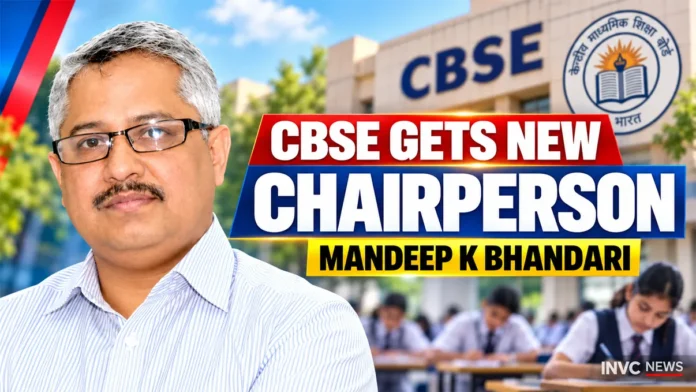
Senior IAS officer Mandeep K Bhandari has been appointed the new Chairperson of the Central Board of Secondary Education, putting fresh leadership in place at India’s national school board after months of administrative changes and controversy surrounding digital evaluation.
Bhandari is a 2001-batch IAS officer of the AGMUT cadre and was serving as Principal Secretary to the Lieutenant Governor of Jammu and Kashmir before his new appointment.
The Appointments Committee of the Cabinet approved his appointment as CBSE Chairperson under the Ministry of Education.
His arrival comes at a crucial time for the board as CBSE prepares for future examinations, evaluation reforms and greater use of technology in assessment.
THE 60-SECOND BRIEF
New CBSE Chairperson: Mandeep K Bhandari
Service: IAS
Batch: 2001
Cadre: AGMUT
Previous Role: Principal Secretary to the Lieutenant Governor of Jammu and Kashmir
Appointment Approved By: Appointments Committee of the Cabinet
Ministry: Ministry of Education
Key Challenge: Examination reforms and rebuilding confidence after the On-Screen Marking controversy
Who Is Mandeep K Bhandari?
Mandeep K Bhandari is a senior Indian Administrative Service officer from the AGMUT cadre.
He belongs to the 2001 IAS batch and has held several administrative assignments during his career.
Before his appointment to CBSE, he was serving as Principal Secretary to the Lieutenant Governor of Jammu and Kashmir.
Bhandari also has a medical background.
His educational qualifications include an MBBS, giving him an academic profile that differs from many career administrators who move into education-sector leadership roles.
CBSE Gets New Leadership
The government approved Bhandari’s appointment on September 25.
He will head the Central Board of Secondary Education under the Ministry of Education.
The government has temporarily upgraded the post to the rank and pay of Additional Secretary to the Government of India for the appointment.
Bhandari replaces Lokhande Prashant Sitaram, who had been holding additional charge of the CBSE chairperson’s post.
Third CBSE Chairperson in Around Four Months
The leadership change is especially significant because CBSE has seen rapid changes at the top in recent months.
Bhandari becomes the third officer to head the board within roughly four months.
The changes began after the government removed then-CBSE Chairperson Rahul Singh and Secretary Himanshu Gupta in June.
Lokhande Prashant Sitaram subsequently held additional charge.
Bhandari will now take full responsibility for the board.
Why the Appointment Matters
CBSE is one of India’s most influential school education institutions.
Millions of students appear for its Class 10 and Class 12 examinations each year.
Its decisions affect:
Board examinations
Evaluation systems
School affiliations
Curriculum implementation
Teacher guidelines
Result processing
Re-evaluation procedures
Digital examination systems
Any leadership change at CBSE therefore directly affects a very large student and parent population.
On-Screen Marking Controversy in the Background
Bhandari takes charge after CBSE faced criticism over its On-Screen Marking system, commonly referred to as OSM.
The system was introduced to digitise the evaluation of Class 12 answer sheets.
Instead of checking only physical answer books, evaluators could assess digitised copies through an electronic platform.
The idea was to make evaluation faster and more transparent.
However, the rollout attracted complaints.
Students and parents raised concerns over alleged answer-sheet mix-ups, technical glitches, problems accessing digital answer books, payment failures and delays in re-evaluation-related processes.
Government Had Ordered Inquiry
The controversy led to significant administrative action.
In June, the government removed CBSE Chairperson Rahul Singh and Secretary Himanshu Gupta from their positions.
An inquiry was also ordered into procurement and implementation issues linked to the digital evaluation system.
Those developments placed CBSE’s examination and technology systems under greater scrutiny.
Bhandari now enters the organisation while those concerns remain part of the institutional backdrop.
What Students and Parents Will Watch
For students and parents, the immediate focus will be on examination reliability.
CBSE faces the challenge of ensuring that digital reforms do not create new uncertainty around marking and results.
Several areas will remain under close watch:
Accuracy of evaluation
Access to answer sheets
Re-evaluation procedures
Result processing
Data security
Portal stability
Exam-related grievance systems
Clear communication with schools and students
The board will also need to ensure that future technology upgrades undergo adequate testing before large-scale implementation.
Digital Evaluation Likely to Remain Important
The OSM controversy does not necessarily mean CBSE will abandon digital evaluation.
Technology remains central to examination reform across education systems.
Digital marking can reduce physical movement of answer sheets, improve monitoring and potentially accelerate evaluation.
However, technology works only when the supporting systems remain reliable.
Therefore, Bhandari’s tenure could focus heavily on balancing digitisation with accuracy, transparency and accountability.
CBSE Exam Reforms Will Be Closely Watched
The board is already moving through a period of wider examination reform.
Changes connected to assessment patterns, competency-based learning and the implementation of the National Education Policy have steadily altered the school examination landscape.
That means the new Chairperson will not manage only routine board examinations.
He will also oversee a broader transition in how CBSE assesses students.
What Schools Will Expect
CBSE-affiliated schools will look for clarity and consistency from the new leadership.
Schools regularly depend on CBSE for:
Academic circulars
Exam schedules
Teacher training
Affiliation requirements
Assessment guidelines
Practical examination rules
Result procedures
Any major transition at the board therefore requires clear communication.
Stable leadership could become particularly important ahead of upcoming examination cycles.
Bhandari’s Administrative Experience
Bhandari brings extensive administrative experience to the new position.
Apart from his recent Jammu and Kashmir assignment, he has held several responsibilities in public administration.
He also spent a significant period associated with the Shri Mata Vaishno Devi Shrine Board, where he served in senior administrative roles.
His background combines field administration, institutional management and policy implementation.
That experience will now be tested in a large national education system.
Bigger Challenge: Rebuilding Trust
The new Chairperson’s challenge goes beyond examinations.
CBSE must also maintain confidence among students, parents, teachers and schools.
When evaluation systems malfunction or grievance procedures become difficult, the impact is highly personal for students because examination scores can influence admissions and academic choices.
Therefore, transparency will matter as much as technology.
Clear communication around any future changes could help prevent confusion and reduce disputes.
What Happens Next
Mandeep K Bhandari will now take charge of CBSE and oversee the board’s administrative and academic priorities.
Attention will turn to whether the new leadership announces any review of digital evaluation systems or changes to examination procedures.
The upcoming board examination cycle will provide an early test.
Students, schools and parents will closely watch whether CBSE improves the reliability of its digital systems while continuing examination reforms.
INVC NEWS Bottom Line
Mandeep K Bhandari has been appointed CBSE Chairperson at a sensitive moment for the national school board. The 2001-batch IAS officer takes charge after rapid leadership changes and controversy around On-Screen Marking. His immediate challenge will be to strengthen examination systems, improve digital reliability and maintain confidence among millions of students, parents and schools.
What happened. Why it matters. What comes next.