TEHRAN, IRAN | AUGUST 23, 2026 —
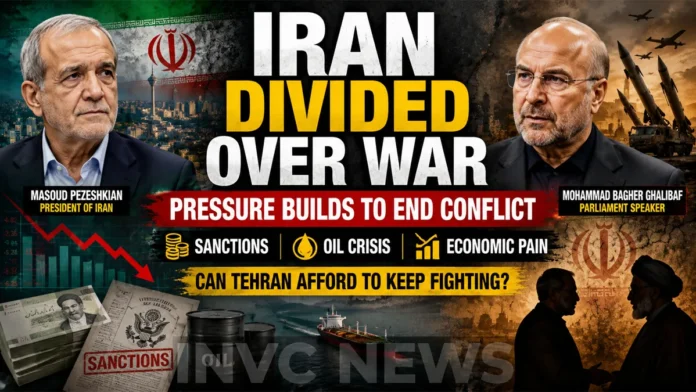
An increasingly visible Iran political split over war is emerging inside Tehran as President Masoud Pezeshkian and Parliament Speaker Mohammad Bagher Ghalibaf warn that prolonged conflict, sanctions and economic disruption are placing growing pressure on the country, while powerful hardline figures continue to resist concessions to the United States.
The divide does not amount to an open rupture within the Iranian state. Nor does it mean that Pezeshkian and Ghalibaf are prepared to accept Washington’s demands.
But their increasingly direct comments about the cost of war reveal a significant debate over one central question:
How much longer can Iran afford to keep fighting while its economy deteriorates?
Pezeshkian has argued that the conflict must eventually end and suggested that reaching that point sooner could be better for the country.
Ghalibaf has approached the same issue through economics, warning that military strength alone cannot protect national security if ordinary people face hunger, financial circulation weakens and domestic production deteriorates.
Their remarks come as the United States prepares a tougher economic-pressure campaign against Tehran, Iranian oil exports face severe disruption and the Strait of Hormuz crisis continues to complicate one of the country’s most important sources of revenue.
Pezeshkian Says the War Must End
President Masoud Pezeshkian has delivered one of his clearest public arguments yet for ending the conflict.
His position is not based on surrender.
Instead, he has argued that Iran should seek peace from what he describes as a position of strength and dignity.
Pezeshkian has acknowledged that Iran is under severe pressure but has suggested that prolonging the conflict indefinitely would impose unnecessary costs.
The president’s message is significant because it challenges the idea that continued confrontation automatically strengthens Iran’s bargaining position.
His argument is effectively that military resilience has value only if it can eventually be converted into a political outcome that protects the country and reduces economic suffering.
Ghalibaf Issues Stark Economic Warning
Parliament Speaker Mohammad Bagher Ghalibaf has also placed the economy at the center of Iran’s security debate.
Speaking amid escalating U.S. economic pressure, Ghalibaf warned that a country cannot depend on military power alone if its economy is unable to function effectively.
His comments linked national security directly with:
- Financial circulation
- Domestic production
- Economic growth
- Household living standards
- Resistance to sanctions
Ghalibaf has also called for stronger economic cooperation with neighboring countries and greater use of national currencies in regional trade to reduce dependence on the U.S. dollar.
His approach suggests that Tehran’s struggle with Washington is increasingly being fought not only through missiles, naval deployments and diplomacy, but through currency, trade, oil exports and economic resilience.
Iran’s Economy Is Becoming the Real Battlefield
The economic consequences of the conflict are becoming increasingly difficult for Iranian officials to ignore.
Iran has faced years of sanctions, but the latest confrontation has created new pressure because traditional methods of adapting to restrictions are being combined with severe disruption to maritime exports.
Oil is particularly important.
Iran depends heavily on energy exports for foreign currency.
When tanker traffic becomes difficult and crude exports slow, Tehran loses access to dollars and other foreign currencies needed to finance imports and stabilize the economy.
The result can spread quickly through domestic markets.
A shortage of foreign exchange can weaken the currency.
A weaker currency raises import costs.
Higher import costs contribute to inflation.
And inflation reduces the purchasing power of ordinary households.
That is the chain reaction Pezeshkian and other economically focused officials appear increasingly concerned about.
Iran’s Central Bank Sounds the Alarm
Economic warnings are not coming only from political leaders.
Iranian Central Bank Governor Abdol Nasser Hemmati has acknowledged severe economic pressures, including disruption to oil exports, foreign-exchange shortages, reconstruction expenses and increased unemployment among younger Iranians.
That is important because it moves the discussion beyond political rhetoric.
The officials responsible for managing Iran’s economy are increasingly confronting the practical consequences of prolonged conflict.
For Tehran, the problem is not simply surviving another round of sanctions.
It is maintaining enough economic activity to preserve public stability while continuing to finance national defense.
Hardliners Reject Pressure for Concessions
The push toward de-escalation faces major resistance.
Powerful hardline officials associated with Iran’s security establishment remain skeptical of compromise with Washington.
Their argument is fundamentally different.
They believe the United States is using economic pressure to force Iran into concessions that would weaken its strategic position.
From that perspective, accepting a deal under pressure could encourage Washington to demand even more.
Hardliners therefore argue that Tehran should continue resisting until the United States accepts Iran’s conditions.
Some conservative politicians have gone further, portraying calls for peace under current circumstances as a sign of weakness.
That leaves Iran with two competing strategic instincts.
One says worsening economic conditions make compromise increasingly necessary.
The other says worsening pressure is exactly why Iran must refuse to compromise.
Failed US-Iran Deal Strengthened the Skeptics
The collapse of the previous diplomatic framework has made Pezeshkian’s position harder.
Iran and the United States had created a 60-day negotiating framework aimed at moving from an initial memorandum of understanding toward a broader settlement.
But that deadline expired without a comprehensive agreement.
The two countries remained divided over sanctions, maritime access, military deployments, Iran’s nuclear program and the Strait of Hormuz.
The failure has given Iranian hardliners a powerful argument:
Why trust Washington again if the previous agreement failed?
That distrust makes another compromise politically more difficult even as the economic case for negotiations becomes stronger.
Also Read: US-Iran Talks: UN Calls for Fresh Negotiations After 60-Day Deal Deadline Expires
The United Nations has urged both sides to return to negotiations before confrontation produces another major escalation.
Strait of Hormuz Is Central to Iran’s Economic Crisis
The Strait of Hormuz sits at the intersection of Iran’s military strategy and economic problems.
The waterway is one of the world’s most important energy corridors.
Iran views control and influence around Hormuz as a strategic asset.
But prolonged disruption also damages Iran itself.
If tankers cannot move normally, Tehran struggles to export its own crude.
That creates an unusual strategic contradiction.
Iran can use disruption in Hormuz to impose costs on the United States and Gulf economies.
But the longer the disruption continues, the greater the damage to Iran’s own ability to earn energy revenue.
That is why Hormuz has become one of the most difficult issues inside any potential peace agreement.
Tehran Has Sought Alternative Hormuz Arrangements
Iran has already explored arrangements with Oman designed to restore some commercial shipping while preserving Tehran’s leverage over the waterway.
Those negotiations demonstrated that Iran does not necessarily want a permanently frozen Strait of Hormuz.
Instead, Tehran appears interested in a system that restores economic movement without surrendering its strategic position.
Also Read: Iran-Oman Near Deal on New Hormuz Shipping Route; Tehran Says Strait Will Not Fully Reopen
The difficulty is finding an arrangement that Iran, the United States, Gulf states and global shipping companies can all accept.
Trump Administration Turns Up Economic Pressure
Washington is moving in the opposite direction.
The Trump administration is preparing a new round of sanctions intended to intensify pressure on Iran’s economy.
U.S. Treasury Secretary Scott Bessent has signaled that Washington intends to dramatically strengthen its economic campaign.
The strategy is based partly on the belief that sanctions can achieve results without requiring another major military escalation.
That creates additional pressure on Pezeshkian.
If Iran’s economy deteriorates further while hardliners continue rejecting concessions, the president could find himself politically trapped between American pressure from outside and resistance from Iran’s security establishment inside.
Ghalibaf Wants Iran to Beat Sanctions Through Regional Trade
Ghalibaf’s answer is not simply to negotiate.
He has also argued that Iran needs a stronger regional economic strategy.
During discussions with Iranian and Iraqi business leaders, he emphasized increasing bilateral trade and reducing dependence on dollar-based financial systems.
Iran has tried similar approaches before.
Trading through national currencies, informal financial networks and regional partners can reduce exposure to American sanctions.
But these alternatives have limitations.
International energy trade remains heavily dollar-oriented.
Major financial institutions fear U.S. secondary sanctions.
And physical disruption to oil exports cannot be solved simply by changing the currency used for payment.
China Is Crucial to Iran’s Survival Strategy
China is another essential factor.
Before the current conflict, Chinese buyers purchased the overwhelming majority of Iran’s exported crude.
Beijing has opposed unilateral U.S. sanctions and continues to reject Washington’s pressure strategy.
That provides Tehran with an important diplomatic and economic partner.
However, there is a physical limitation.
Chinese refiners cannot buy oil that Iran is unable to ship.
If maritime disruption prevents Tehran from moving crude through the Gulf, political support from Beijing cannot fully compensate for lost export volumes.
Some Chinese refiners have already sought alternative supplies from other producers as available Iranian cargoes decline.
This strengthens the argument inside Tehran that the Hormuz crisis itself must eventually be resolved.
Ordinary Iranians Face the Consequences
The most politically sensitive issue is the effect on ordinary citizens.
Sanctions and conflict can translate into higher prices, weaker purchasing power, unemployment and shortages.
For households, debates over maritime security or nuclear diplomacy may feel distant.
But food prices, rent, jobs and currency depreciation are immediate.
That makes economic hardship a potential political risk for the Iranian leadership.
Officials pushing for de-escalation appear increasingly concerned that prolonged economic deterioration could eventually threaten domestic stability.
Hardliners, by contrast, may believe the state can withstand greater public dissatisfaction without changing strategic direction.
That difference in risk tolerance is one of the most important elements of Iran’s internal debate.
Youth Unemployment Adds Another Pressure Point
Young Iranians could become especially important.
A weakened economy reduces job creation.
Restricted foreign investment limits business expansion.
Currency instability makes entrepreneurship more difficult.
And prolonged confrontation can encourage skilled workers to seek opportunities abroad.
That creates a long-term challenge extending far beyond the current war.
A country can rebuild damaged infrastructure.
Recovering lost human capital can be much harder.
Is Pezeshkian Really Challenging Iran’s Hardliners?
It is important not to overstate the split.
Pezeshkian remains part of the Islamic Republic’s political system.
He is not calling for Iran to abandon its strategic objectives.
Ghalibaf is also a conservative political figure and should not simply be described as an opposition moderate.
The real disagreement is more specific.
It concerns how Iran should achieve its goals.
Pezeshkian and economically focused officials appear more willing to accept negotiations and limited compromise if that can end the war and reduce economic pressure.
Hardline security figures appear more willing to tolerate economic pain in pursuit of broader strategic concessions from Washington.
That distinction matters.
It is a policy struggle inside the Iranian establishment, not a simple government-versus-opposition confrontation.
The Previous Peace Framework Nearly Created an Exit
Earlier negotiations showed that some room for diplomacy exists.
A proposed framework discussed sanctions relief, maritime security, Iran’s nuclear program and an end to military confrontation.
Also Read: Trump Says US Wants Iran Deal but Rules Out Any Iranian Nuclear Weapons Program
The central problem was implementation.
Washington and Tehran accused each other of failing to honor commitments.
Once trust collapsed, both sides returned to pressure.
Iran tightened its posture around Hormuz.
Washington restored and expanded sanctions.
The window for compromise narrowed.
Higher Oil Prices Do Not Automatically Save Iran
Some Iranian hardliners argue that disruption in the Gulf can benefit Tehran by driving global oil prices higher.
In theory, higher prices increase the value of every barrel Iran manages to sell.
But that logic works only if enough oil can actually reach buyers.
If export volumes collapse, a higher global price may not compensate for the lost shipments.
Meanwhile, high energy prices also encourage competing producers to increase supply.
That makes prolonged disruption a risky economic strategy for Tehran.
India Is Also Feeling the Economic Fallout
Iran’s internal political struggle has consequences far outside the country.
India imports most of the crude oil it consumes and is sensitive to prolonged increases in global energy prices.
Higher Brent crude can increase India’s import bill, contribute to inflationary pressure and affect the rupee.
The Strait of Hormuz is particularly important because large volumes of crude oil and LNG consumed across Asia normally pass through the waterway.
Also Read: Iran-America War Sends Crude Higher: Will Petrol and Diesel Get Costlier in India?
That means any internal Iranian decision about continuing or ending the conflict can ultimately affect consumers thousands of miles away.
Can Pezeshkian Change Iran’s Policy?
That remains the biggest question.
Iran’s political system distributes authority across several institutions.
The president does not independently determine national-security policy.
The parliament speaker also cannot impose a settlement by himself.
The security establishment and senior leadership retain enormous influence over military and negotiating strategy.
So public calls from Pezeshkian and Ghalibaf do not guarantee that Tehran will change course.
But they are significant because they reveal that economic pressure is increasingly affecting the internal policy debate.
Hardliners Still Have a Powerful Argument
The anti-concession camp can point to the failure of earlier negotiations as evidence that the United States cannot be trusted.
They can argue that economic pressure will continue even if Iran compromises.
They can also present continued resistance as the only way to preserve national sovereignty.
That narrative becomes particularly powerful whenever Washington announces tougher sanctions or threatens military action.
In other words, the same American pressure intended to force Iran toward compromise can sometimes politically strengthen those inside Tehran who oppose compromise.
Iran Faces a Dangerous Strategic Choice
The dilemma is becoming increasingly stark.
If Iran continues the confrontation, it risks deeper economic damage.
If it makes major concessions, hardliners may argue that years of resistance were wasted.
If Tehran accepts limited negotiations, Washington may demand additional guarantees.
And if diplomacy fails again, public confidence in negotiations could fall even further.
There is no easy path.
What Happens Next?
Several developments will show which faction is gaining influence.
New US sanctions: The severity of Washington’s next measures could accelerate economic pressure.
Oil exports: Any recovery or further decline in Iranian crude shipments will directly affect foreign-currency availability.
Hormuz traffic: A negotiated increase in tanker movement could give economically focused officials room to argue for wider de-escalation.
Pezeshkian’s rhetoric: Further direct calls to end the conflict would signal growing urgency.
Hardline reaction: Statements from military and conservative figures will reveal how strongly they oppose compromise.
Diplomatic mediation: Egypt, Oman and other regional governments may become increasingly important if formal US-Iran talks restart.
Iran’s War Debate Is Becoming an Economic Debate
The most revealing development inside Iran may be that the argument is no longer only about military victory.
It is about economic endurance.
President Masoud Pezeshkian is asking whether prolonging the war serves Iran’s interests.
Mohammad Bagher Ghalibaf is warning that national security cannot be separated from economic stability.
Central-bank officials are confronting falling oil revenue and foreign-exchange pressure.
Hardliners continue to insist that pressure must not force Iran into surrender.
All sides claim to be protecting the Islamic Republic.
They increasingly disagree over how much economic pain the country should endure to achieve that objective.
That is what makes the emerging Iran political split over war so important.
The next phase of the conflict may not be decided only by missiles, warships or negotiations.
It may be decided by whether Iran’s economy can withstand the pressure long enough for its hardliners to maintain their current strategy — or whether worsening conditions eventually give the advocates of de-escalation a stronger voice.