By Team INVC | INVC NEWS
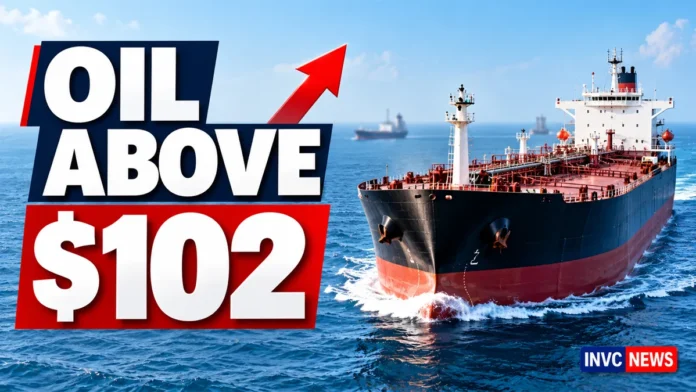
MUSCAT, Oman | October 3, 2026 — Oil does not need another daily surge to keep pressure on household and business budgets. Brent crude prices ended Friday at $102.25 per barrel, leaving the international benchmark above $100 as a fresh tanker incident near Oman renewed concerns about shipping security. For India, the concern extends beyond the next petrol bill: sustained expensive crude can raise import costs and squeeze fuel-dependent businesses. However, the latest settlement shows a slight decline—not an uninterrupted climb toward $103.
INVC NEWS | BEYOND THE HEADLINE
THE 60-SECOND BRIEF
- Friday’s Brent settlement: $102.25 per barrel, down 6 cents.
- Thursday’s move: Brent jumped 4.37%, closing at $102.31.
- New shipping incident: UKMTO reported that an unknown projectile struck a crude tanker four nautical miles east of Oman.
- Crew status: All crew were reported safe; no environmental impact was reported at that stage.
- Consumer takeaway: Expensive crude creates cost pressure, but it does not establish an immediate increase in Indian petrol or diesel prices.
What Happened Near Oman
The United Kingdom Maritime Trade Operations said early Saturday that a tanker’s master had reported a strike by an unknown projectile.
The initial information did not establish who was responsible. Therefore, the incident should not become a confirmed accusation against a particular country or group without further evidence.
It also matters to separate the shipping report from the market data. Friday’s settlement and Saturday’s incident update are distinct developments. The available information does not establish a fresh post-incident surge in Brent.
Brent Remains Expensive Despite Friday’s Small Decline
Thursday’s rally lifted the front-month December Brent contract by $4.28 per barrel. Friday’s marginal retreat left most of that increase intact.
Reuters attributed Friday’s easing partly to Europe’s agreement to release diesel reserves. Consequently, the market faces competing pressures: shipping insecurity can support prices, while additional supply can offer relief.
That balance explains why a dramatic headline about a tanker incident cannot, by itself, describe the direction of oil prices.
Why Shipping Risk Matters Even Without a Confirmed Spill
An oil shipment has to reach its destination before a refinery can use it. Security incidents can therefore matter through delivery timing as well as the volume of crude available.
If operators delay voyages, change routes or require additional precautions, costs could rise. Insurance and freight expenses may also become relevant. These are potential consequences, rather than confirmed effects of this particular incident.
For market watchers, the stronger evidence would be reports of delayed cargoes, changed shipping schedules or higher transport charges. Those developments would show whether the security concern has translated into a measurable supply problem.
What Expensive Crude Could Mean for India
For an oil-importing economy such as India, sustained higher crude prices can increase the cost of overseas purchases. The exchange rate also matters: a weaker rupee would make a dollar-priced cargo more expensive in domestic currency.
However, Brent alone does not determine the final cost of every shipment. Actual purchasing costs depend on the crude grade, contract terms, freight and other charges.
The practical risk is persistence. A brief price spike and several weeks of elevated prices can have different consequences for business budgets and pricing decisions.
Will Petrol and Diesel Become More Expensive Immediately?
This report does not establish a new Indian retail fuel-price increase.
Petrol and diesel prices depend on more than one crude benchmark. Refining economics, taxes, exchange rates and pricing decisions also influence what motorists pay.
Readers should therefore check actual local retail rates before changing their travel budget. Likewise, businesses should distinguish a higher international input cost from an announced increase in their own fuel bill.
Which Businesses Should Watch Closely?
Airlines, transport operators and manufacturers with significant energy costs have reason to monitor sustained oil-price movements.
Still, the effect will vary. Fuel contracts, hedging arrangements and the ability to adjust customer prices can change how much pressure a business absorbs.
Investors should examine those differences before assuming that every company in a sector faces the same outcome. A crude-price headline provides context; company disclosures provide the evidence for a specific business.
What Happens Next
Three developments deserve attention: further verified information about the tanker incident, evidence of disruption to cargo movements, and the next trading session’s response.
Any reserve release will also matter through its timing, composition and delivery. An announcement alone cannot show how quickly additional fuel reaches buyers.
INVC NEWS Bottom Line
Brent’s latest settlement confirms oil above $102, while the Oman incident adds a fresh security concern. For India, the key question is whether that concern keeps energy costs elevated—not whether a petrol-price increase automatically follows today.