
NEW DELHI, August 13, 2026
India Weather Alert August 13: Relentless monsoon rain has triggered deadly landslides, flooding and widespread travel disruption from Mumbai and Himachal Pradesh to Odisha, Jammu and Kashmir and Rajasthan. Seven people have died in a landslide in Mumbai, while hundreds of roads have faced closures in Himachal Pradesh as the India Meteorological Department forecasts continued rain through August 18.
The latest IMD outlook indicates heavy rain at isolated locations across several parts of northwestern, central, eastern, northeastern and western India. The forecast does not mean that every district will experience continuous or equally intense rainfall. However, saturated ground, swollen waterways and unstable slopes could increase the risk of landslides, flash flooding and road closures.
How Did the Mumbai Landslide Kill Seven People?
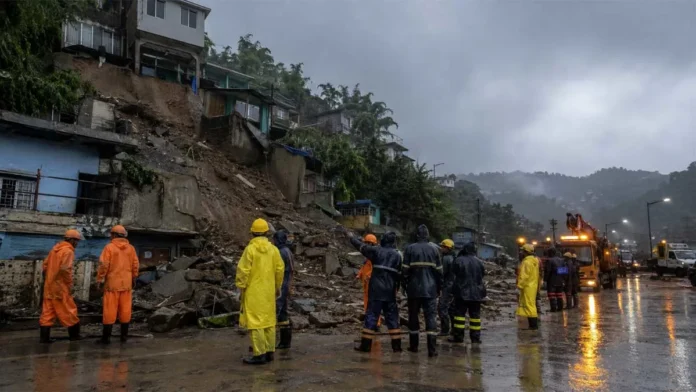
The deadly landslide occurred at Gaushiya Chawl in Mumbai’s Ghatkopar area at approximately 3:45 a.m. Wednesday. A section of a hillside collapsed after heavy rain, sending soil, rocks and debris onto closely packed homes below.
Rescue teams pulled victims from the debris and transported the injured to hospitals. Seven people, including children, died in the incident. Reports on the number of injured varied as rescue and hospital updates continued.
Emergency personnel from the fire department, police, civic authorities and disaster-response agencies participated in the operation. Narrow lanes and congested construction around the site made it difficult for rescue teams to move heavy equipment into the affected area.
Mumbai Mayor Ritu Tawde visited the location to assess the rescue operation and announced financial assistance of ₹400,000 for the family of each person killed. Authorities also reviewed the safety of homes located near vulnerable slopes.
The tragedy underlined the risk faced by densely populated settlements near unstable hillsides during periods of intense monsoon rain. Details of the Mumbai landslide
How Severe Is the Monsoon Crisis in Himachal Pradesh?
Persistent rain and repeated landslides have disrupted roads, electricity distribution and drinking-water services across Himachal Pradesh. At one stage, officials reported 313 roads blocked across the state, although the number has continued to change as restoration teams reopen routes and fresh landslides cause new closures.
Mandi recorded the largest share of disruptions in that assessment, with 117 roads closed. Chamba had 74 affected roads, followed by Kullu with 60, Shimla with 36 and Sirmaur with 13.
At least 65 water-supply schemes and 112 electricity transformers were also reported affected. Repair teams have been deployed, but continued rainfall could slow restoration work in mountainous districts.
State assessments have placed the monsoon-season death toll at up to 75 since June 30, depending on the reporting period and the classification of weather-related incidents. Estimated losses to public and private property have crossed ₹911 crore.
Residents and tourists have been advised to avoid unnecessary travel through landslide-prone areas, particularly during heavy rainfall and at night. Travelers should confirm road conditions with district authorities before entering remote areas.
What Has the IMD Forecast Through August 18?
The IMD has forecast isolated heavy rainfall over Himachal Pradesh on August 13 and again from August 15 through August 18. Isolated very heavy rainfall is possible on August 14.
Heavy rain is also likely across Jammu and Kashmir through August 18. Uttarakhand could receive heavy rain on August 13, August 15 and August 18, with very heavy rainfall possible on August 14 and from August 16 to 17.
Punjab, Haryana, Chandigarh and Delhi may experience heavy rain between August 14 and 18. Heavy rainfall is also forecast over eastern Uttar Pradesh through August 18 and western Uttar Pradesh from August 14 to 17.
In central India, rain is expected across Madhya Pradesh, Chhattisgarh and Vidarbha on several days. Odisha, Gangetic West Bengal, Jharkhand, Bihar, the northeastern states, Konkan and Goa also remain within the broader active monsoon zone.
The IMD clarifies that color-coded warnings indicate the level of preparedness or action required. People should check the latest district-specific bulletin because warning levels may change as weather systems move. IMD all-India weather bulletin
Which Odisha Districts Face the Greatest Rain Risk?
A low-pressure area over the Bay of Bengal has strengthened monsoon activity across Odisha. Balasore and Bhadrak have been among the districts facing the highest risk of intense rainfall, while warnings have also covered Jajpur, Kendrapara, Jagatsinghpur, Cuttack, Angul, Keonjhar, Mayurbhanj and Dhenkanal.
Some locations could receive heavy to very heavy rainfall, with isolated pockets potentially recording extremely heavy rain. However, exact rainfall totals and district warning colors should be checked against the latest IMD Bhubaneswar bulletin because forecasts can be revised several times a day.
Thunderstorms, lightning and gusty winds could accompany the rain. Winds along and off the Odisha coast may reach 40–50 kilometers per hour, with gusts of up to 60 kilometers per hour. Sea conditions could remain rough to very rough, increasing the danger for fishing vessels and small boats.
Residents in low-lying areas should watch for waterlogging and rapid rises in local streams. People should avoid taking shelter under trees during thunderstorms and stay away from damaged power lines.
How Has Rain Affected Jammu and Kashmir and Uttarakhand?
Heavy rain has caused localized flooding, landslides and waterlogging in parts of Kishtwar, Kathua and Pulwama districts in Jammu and Kashmir.
A damaged section of the Gulabgarh–Machail route affected movement in Kishtwar. In Kathua, a landslide reportedly blocked the Bani–Basohli road near Tikri Mor. Waterlogging along the Srinagar–Anantnag corridor near Awantipora in Pulwama also led to traffic restrictions.
The IMD forecast keeps Jammu and Kashmir under the risk of isolated heavy rainfall through August 18. Mountain roads could become dangerous quickly because of falling rocks, landslides or sudden runoff.
In Uttarakhand, authorities temporarily suspended the Madhyamaheshwar pilgrimage amid rain, fragile sections of the route, landslide danger and repair work. Pilgrims should wait for official clearance before attempting the journey.
What Damage Has Heavy Rain Caused in Rajasthan?
An active monsoon has produced intense rain across several districts of Rajasthan. Bassi in Chittorgarh recorded 227 millimeters of rainfall, leading to flooding and disruption in surrounding areas.
In Udaipur, the Udai Sagar reservoir crossed the 21-foot level, prompting officials to open two gates by one foot each to release water. Authorities continued to monitor inflows and downstream conditions.
In Kota, about one foot of water accumulated inside the Mukundra tunnel on the Delhi–Mumbai Expressway, forcing officials to close it temporarily. Waterlogging also affected traffic in Jaipur and other urban areas.
The IMD forecast indicates heavy rainfall over eastern Rajasthan on August 13 and 14. Residents should avoid flooded underpasses, tunnels and low-lying roads. Drivers should never attempt to cross moving water when its depth or road condition is unclear.
Which Other Regions Could Receive Heavy Rain?
The IMD’s forecast through August 18 includes rainfall across a broad section of India:
- Madhya Pradesh: Heavy rain at isolated locations on multiple days, with very heavy rainfall possible in some eastern districts.
- Chhattisgarh: Heavy rain and thunderstorms, with locally very heavy rainfall possible.
- Vidarbha: Isolated heavy rain through much of the forecast period.
- West Bengal and Jharkhand: Heavy rain, thunderstorms and gusty winds in some areas.
- Bihar: Heavy rain risk from August 14 to 17.
- Northeastern states: Widespread rain, with very heavy rainfall possible in Arunachal Pradesh, Assam and Meghalaya from August 15 to 18.
- Konkan and Goa: Widespread rain through August 18, with isolated heavy rainfall during the first part of the period.
- Madhya Maharashtra: Heavy rain at isolated locations on August 13 and from August 15 to 16.
Safety Advice During Heavy Rain
People living in affected states should follow district-level advisories because local warnings can change rapidly.
- Avoid unnecessary travel through hilly and landslide-prone areas.
- Do not cross flooded roads, bridges, tunnels or underpasses.
- Stay away from riverbanks, drains and unstable slopes.
- Keep phones charged and emergency supplies accessible.
- Unplug electrical appliances if water enters a building.
- Follow evacuation instructions without delay.
- Travelers should verify road and pilgrimage-route conditions before departure.
- Fishermen should follow coastal warnings and avoid rough seas when advised.
Rainfall forecasts are updated regularly. Residents should rely on the latest bulletins from the IMD, state disaster-management authorities, district administrations and local police.











Comments are closed.