
By Team INVC | INVC NEWS
Published: September 1, 2026 |09 : 43 AM IST
NEW DELHI, India | September 1, 2026 —
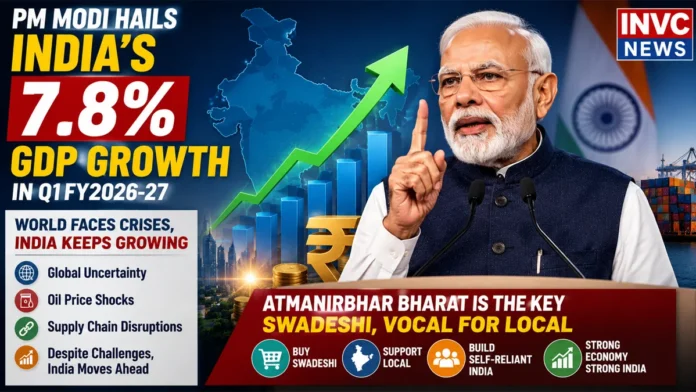
India GDP growth 7.8% has given Prime Minister Narendra Modi a fresh opportunity to push his economic message of self-reliance, with the Prime Minister saying India continues to expand rapidly despite wars, supply-chain disruptions, oil-price shocks and persistent uncertainty across the global economy.
In a new social-media video shared on Tuesday, PM Modi congratulated citizens after India recorded 7.8% real GDP growth in the April-June quarter of FY2026-27, describing the performance as the outcome of collective resolve and hard work.
Official data released by the Ministry of Statistics and Programme Implementation confirmed real GDP growth of 7.8% in Q1 FY27, while nominal GDP expanded 10.3%.
PM Modi: World Is in Crisis, India Still Moving Fast
PM Modi said the global environment has remained deeply unstable since the COVID period, with wars, disrupted supply chains and economic shocks affecting countries across the world.
Despite those pressures, he argued, India has continued to move ahead at a strong pace.
The Prime Minister had also described the 7.8% growth figure a day earlier as a major achievement, saying India had delivered the performance despite oil-price shocks, supply-chain problems and global uncertainty.
The growth number exceeded both the Reserve Bank of India’s 7% projection and the roughly 7.1% median expectation of economists surveyed before the release.
Manufacturing and Financial Services Power Growth
The headline GDP figure was supported by strong expansion across several major parts of the economy.
Manufacturing grew around 9.2%, while financial, real-estate and professional services expanded by roughly 12.1%.
Gross Value Added increased by about 8.2%, indicating strong underlying activity across the economy.
Consumer spending, government expenditure and investment also supported the April-June performance, while private investment showed renewed momentum.
The numbers reinforce India’s position among the fastest-growing major economies, even though the 7.8% expansion was lower than the 8.6% growth recorded in the previous quarter.
PM Modi Turns GDP Growth Into Swadeshi Pitch
PM Modi did not stop at celebrating the numbers.
He used the GDP milestone to make a broader appeal for Atmanirbhar Bharat, Swadeshi and Vocal for Local, saying India must preserve its growth momentum by reducing unnecessary dependence on foreign goods and services.
The Prime Minister urged Indians to think about where their money is being spent.
He specifically encouraged people to avoid unnecessary foreign travel, reconsider destination weddings abroad and prioritise spending within India.
He also argued that greater emphasis on locally produced goods and services would strengthen domestic industry and help India move towards becoming a developed economy.
‘Wedding in India’ and Spending at Home
One of the more striking elements of PM Modi’s message was his renewed push for “Wedding in India.”
He urged families planning lavish destination weddings to consider holding those celebrations within the country so that spending supports Indian hotels, workers, tourism businesses and local supply chains.
The Prime Minister also cautioned against unnecessary gold purchases and called for a broader shift in consumer behaviour towards domestic economic activity.
The message expands the traditional Swadeshi idea beyond manufactured goods into travel, weddings, tourism and household spending.
Strong GDP, But Risks Have Not Disappeared
The 7.8% figure is undoubtedly a strong start to FY27, but risks remain.
Elevated crude oil prices remain particularly important for India because the country imports most of its oil requirement.
A weaker rupee, geopolitical tensions in West Asia and possible inflation pressures could also affect growth in the coming quarters.
Economists have nevertheless begun considering stronger full-year growth expectations after the better-than-forecast Q1 performance.
Opposition Questions Whether Growth Is Reaching Households
The GDP numbers have also triggered a political debate.
Congress leaders have questioned whether the headline growth figure adequately reflects employment creation, wages, consumer confidence and household economic conditions.
The Opposition has argued that strong aggregate GDP growth should ultimately translate into more jobs and stronger incomes for ordinary households.
The government, meanwhile, sees the Q1 figures as evidence that the economy remains resilient despite severe external pressures.
Why the 7.8% GDP Number Matters
India entered FY2026-27 facing an unusually complicated global environment.
Energy-market volatility, geopolitical conflict, disrupted trade routes and uncertainty in international markets all had the potential to slow domestic activity.
Yet growth came in comfortably above expectations.
The key question now is whether India can sustain growth near or above 7% through the remainder of the financial year while controlling inflation and creating enough jobs.
For PM Modi, the answer increasingly centres on one theme: stronger domestic capabilities, greater Swadeshi consumption and a more self-reliant Indian economy.
Also Read – : India GDP Growth Hits 7.7%, Rajnath Singh Hails Economic Strength Amid Global Uncertainty
Also Read – : Digital India Completes 11 Years, PM Modi Calls It Foundation of a Self-Reliant India
Also Read – : India’s New FDI Rules Attract $511 Million as AI, Manufacturing and Data Centers Draw Investors








Comments are closed.