By Team INVC | INVC NEWS
Published: August 29, 2026 | 19 : 00 PM IST
NEW DELHI, India | August 29, 2026 —
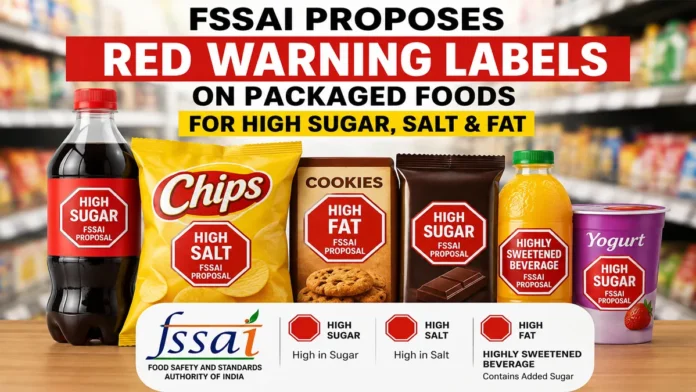
FSSAI warning labels on packaged food could soon become much harder for consumers to miss. India’s food regulator has proposed prominent red front-of-pack warnings for certain packaged foods and beverages containing high levels of sugar, salt and saturated fat, potentially reshaping how millions of consumers compare products on supermarket shelves.
Under the proposal, qualifying products could carry a red hexagonal warning symbol with declarations such as “HIGH FAT,” “HIGH SUGAR,” “HIGH SALT” or “HIGHLY SWEETENED BEVERAGE.”
The proposal is significant because nutritional information on packaged foods in India is currently concentrated largely on the back of packs, where many consumers may never examine the details closely.
However, consumers should note one important point: these warnings are proposed and are not yet a final nationwide labelling rule. The framework could still change during the regulatory and legal process.
Which Packaged Foods Could Get Red Warning Labels?
The proposed system would target packaged products considered high in key nutrients linked with excessive consumption concerns.
These include:
- Sugar
- Salt
- Saturated fat
According to the proposal described in a filing before the Supreme Court, the red warning mechanism would apply when a product is high in at least two of the specified nutrients.
The exact warning displayed would depend on the nutritional profile of the product.
For consumers, this could mean that instead of turning a packet around and searching through a nutritional table, a prominent warning could appear directly on the front.
That could affect the buying experience across categories such as packaged snacks, confectionery, sweetened beverages and other processed foods, depending on the final thresholds and exemptions.
What Would the Warning Look Like?
The proposal envisages a red-coloured hexagonal symbol designed to be immediately visible.
Possible declarations include:
HIGH FAT
HIGH SUGAR
HIGH SALT
HIGHLY SWEETENED BEVERAGE
The idea is straightforward: make critical nutritional information easier to identify before a consumer decides to buy.
The Food Safety and Standards Authority of India has previously explored front-of-pack nutritional labelling as part of broader efforts to help consumers make more informed food choices.
This Does Not Mean Every Packaged Food Gets a Red Label
This distinction is important.
The proposal does not mean every biscuit, beverage, snack or packaged food sold in India would automatically receive a red warning.
Whether a product receives a warning would depend on its nutritional composition and the thresholds contained in the final framework.
Single-ingredient food products are proposed to be exempt, while implementation is expected to happen in phases, giving manufacturers time to adapt packaging and formulations.
Why This Could Matter to Indian Consumers
Front-of-pack warnings could significantly change how people compare products.
Imagine two similar snack packets sitting next to each other.
Today, a shopper may have to inspect several lines of nutritional information to understand differences in sugar, salt or fat.
With prominent front-pack warnings, those differences could become visible almost instantly.
That could prove particularly relevant for parents buying food for children and consumers actively monitoring sugar, sodium or saturated-fat intake.
Also Read – : New Study Links Food Preservatives in Packaged Foods to Higher Blood Pressure and Heart Disease Risk
Why Food Companies Will Watch This Closely
The potential impact extends far beyond packaging design.
India has a packaged food and beverage market worth more than $100 billion, making any nationwide front-of-pack warning system commercially significant.
Large manufacturers may have to review:
- Product formulations
- Sugar and salt content
- Package design
- Consumer communication
- Marketing strategy
- Health positioning
Companies could also have an incentive to reformulate some products if reducing sugar, salt or saturated fat helps avoid a warning under the eventual rules.
Major multinational food and beverage companies have previously raised concerns over mandatory warning-label approaches, arguing that nutritional policy must be scientifically grounded and effective for consumers.
Supreme Court Pressure Has Put Food Labels Back in Focus
The front-of-pack debate has gained momentum amid scrutiny from the Supreme Court and public-health campaigners seeking clearer warnings on products containing high levels of unhealthy nutrients.
The court has pushed authorities to act on the long-running issue.
The latest FSSAI position represents a significant development after years of debate over what form front-of-pack nutritional information should take.
India had explored red colour-coded warning approaches in earlier years as well, but the policy did not become a comprehensive national warning regime.
The current proposal therefore revives a debate that has been running for years rather than creating an entirely new concept.
Will Chips and Soft Drinks Definitely Carry Red Labels?
Not necessarily.
Consumers should be careful with headlines suggesting that all chips, colas, biscuits or chocolates will automatically receive a red warning.
The final outcome will depend on:
- Final nutrient thresholds
- Product composition
- Regulatory exemptions
- Implementation rules
- Any modifications before notification
A particular brand or product should therefore not be labelled “high sugar” or “high salt” under the proposed regime unless it actually meets the final regulatory criteria.
Could Food Recipes Change?
Potentially, yes.
Front-of-pack warnings can create a commercial reason for manufacturers to rethink recipes.
If consumers begin choosing products without red warnings, manufacturers may respond by reducing sugar, salt or saturated fat where technically and commercially feasible.
That could lead to competition not only on price and taste but also on nutritional positioning.
However, reformulation would remain a business decision and should not be assumed for any individual company until announced.
What Should Consumers Do Right Now?
Nothing changes immediately at the supermarket because the proposed system has not yet become the final nationwide rule.
Consumers should continue checking existing nutrition panels and ingredient lists.
Useful information to compare includes:
- Added or total sugar
- Sodium
- Saturated fat
- Serving size
- Calories
- Ingredient order
A “healthy-looking” package or marketing phrase should never replace reading the nutritional information.
Also Read – : India Allows 1 Million Tonnes of Duty-Free Sugar Imports as Prices Surge
What Happens Next?
The next major development will be the progression of the proposal toward a formal regulatory framework.
Consumers and food manufacturers will need to watch whether the final rules retain the red hexagonal warning design, exactly which nutrient thresholds are adopted, how exemptions are defined and how much transition time companies receive.
Until the regulations are finalized, the biggest takeaway is simple:
India is moving toward making high sugar, salt and fat information far more visible on the front of packaged foods—but the final rules are still to come.