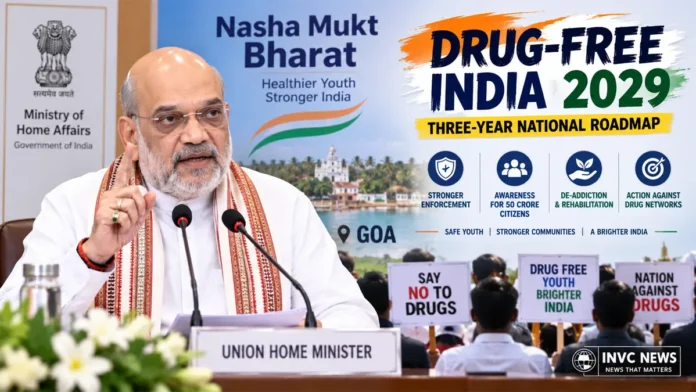
PANAJI, Goa, India | September 6, 2026 —
Drug-Free India 2029 has emerged as one of the Union government’s major internal-security and public-health targets, with Union Home Minister Amit Shah on Sunday outlining a three-year national drive aimed at dismantling narcotics networks, targeting traffickers, strengthening rehabilitation and mobilizing millions of citizens against drug abuse.
Addressing a press conference in Goa, Shah said the government would pursue a coordinated nationwide campaign through 2029 and strengthen enforcement, intelligence sharing, financial investigations, rehabilitation and public participation.
The government has already framed its 2026–2029 narcotics-control roadmap, but Shah’s latest remarks placed renewed emphasis on measurable targets and the scale of action planned over the next three years.
The initiative combines law enforcement with prevention, rehabilitation, community participation and tighter controls on synthetic and precursor drugs.
Drug-Free India 2029 Becomes National Mission
Shah linked the campaign directly with Prime Minister Narendra Modi’s Viksit Bharat 2047 vision and argued that India’s development ambitions require a generation protected from drug addiction.
The Home Minister said the government intends to attack the narcotics ecosystem at multiple levels rather than focusing only on individual seizures.
That strategy includes identifying trafficking networks, disrupting their finances, targeting production facilities, strengthening intelligence operations and expanding treatment for people affected by addiction.
The government also wants states, central agencies and local institutions to operate under a more coordinated framework.
For policymakers, the approach reflects a shift from isolated anti-drug operations toward a long-term national strategy.
Four Pillars to Drive Three-Year Anti-Drug Roadmap
The 2026–2029 roadmap rests on four broad pillars.
The first focuses on enforcement, intelligence and operations, with agencies expected to pursue organized trafficking networks through coordinated intelligence-led action.
The second targets precursor chemicals and synthetic drugs, an increasingly important challenge because illicit manufacturers can use legal or semi-regulated chemical supply chains to produce narcotics.
The third pillar addresses demand reduction and harm reduction, including awareness, treatment and rehabilitation.
The fourth focuses on capacity building, coordination and monitoring, ensuring that agencies share information and track measurable outcomes.
The government wants these four areas to work together rather than operate as disconnected programmes.
Target: 100 Major Drug Networks
One of the most significant goals outlined under the campaign involves dismantling 100 international and inter-state drug trafficking networks over the next three years.
Large narcotics networks often operate across multiple jurisdictions and use complex transportation, financial and communication systems.
Breaking such networks requires cooperation among the Narcotics Control Bureau, state police forces, intelligence agencies, customs authorities and other enforcement bodies.
The government is therefore emphasizing intelligence-based operations rather than relying solely on seizures made at the retail level.
The objective is to move higher up the trafficking chain and target organizers, financiers and kingpins.
India to Pursue 100 Narcotics Fugitives
Authorities have also set a target of bringing 100 narcotics-related fugitives back to India.
International drug trafficking cases frequently involve suspects who operate from abroad or leave the country after becoming targets of investigations.
Bringing such fugitives back requires cooperation with foreign governments, international agencies and diplomatic channels.
The target signals that extradition and international law-enforcement cooperation will play a larger role in India’s anti-narcotics strategy.
It also reflects the government’s view that drug trafficking increasingly operates as a transnational security challenge rather than a purely domestic crime problem.
100 Illegal Drug Laboratories in Crosshairs
The roadmap also aims to identify and destroy 100 clandestine drug laboratories.
Illegal laboratories represent a particularly serious threat because synthetic narcotics can be manufactured away from traditional cultivation areas.
Such operations may involve precursor chemicals, hidden production facilities and distribution networks that can change locations rapidly.
Authorities therefore plan to increase surveillance of chemical supply chains and strengthen intelligence on synthetic-drug production.
The government views early disruption of production as critical to preventing illegal substances from reaching distribution networks.
Campaign Aims to Reach 50 Crore Citizens
Enforcement represents only one part of the initiative.
The government plans to take the anti-drug campaign to approximately 50 crore citizens, significantly expanding the public-awareness component of the programme.
Schools, colleges, communities and youth organizations are expected to become important parts of this outreach.
Authorities want prevention messages to reach young people before addiction begins.
The campaign also seeks to involve families, educators, civil society organizations and local communities in identifying and addressing drug-related risks.
This broader approach recognizes that enforcement alone cannot eliminate demand for narcotics.
One Lakh ‘Nasha Mukt Mitras’ Planned
The government also plans to build a network of one lakh Nasha Mukt Mitras, or community-level participants who can support awareness and prevention activities.
Such volunteers could become a bridge between government programmes and local communities.
Their role could include encouraging awareness, guiding affected individuals toward treatment and helping communities identify emerging drug-abuse patterns.
Community participation becomes particularly important in areas where social stigma may prevent individuals or families from seeking help.
The government’s strategy therefore combines tougher action against traffickers with a more supportive approach toward people affected by addiction.
De-Addiction Network to Expand
Another major component of the roadmap involves expanding India’s treatment and rehabilitation capacity.
The number of de-addiction centres is targeted to rise to 1,751.
Rehabilitation forms a crucial part of the government’s distinction between drug traffickers and people suffering from addiction.
While authorities intend to pursue traffickers aggressively, the policy seeks treatment, counseling and rehabilitation for affected individuals.
That distinction is important because drug addiction involves both criminal networks and public-health challenges.
Expanding accessible treatment facilities could help ensure that enforcement operations are supported by long-term recovery programmes.
Amit Shah Links Drugs With National Security
Shah has repeatedly argued that narcotics trafficking should not be viewed only as a conventional law-and-order problem.
The government increasingly links the drug trade with organized crime, illegal financial flows, cross-border networks and narco-terrorism.
That assessment has pushed narcotics control higher on India’s internal-security agenda.
Financial investigations are expected to play an increasingly prominent role as agencies attempt to identify how trafficking networks move and conceal money.
Targeting finances can make it harder for criminal organizations to rebuild after individual consignments or operatives are intercepted.
Goa Gets Special Attention in Anti-Narcotics Push
Shah made the latest announcement during his visit to Goa, a state where narcotics enforcement remains an important governance issue because of its large tourism sector and international connectivity.
The Home Minister noted the presence of an Anti-Narcotics Task Force in Goa and called for cooperation from the public and media.
State-level enforcement will remain crucial because drug markets and trafficking patterns differ significantly across regions.
Border states, coastal regions, large metropolitan areas and international transport hubs can each face different forms of narcotics activity.
A national strategy therefore depends heavily on effective state-level implementation.
Enforcement Numbers Show Scale of Crackdown
The Centre says it has sharply intensified seizures, destruction of narcotics and enforcement operations over the past decade.
Large seizures demonstrate the scale of trafficking activity that agencies face, but they also highlight why the government now wants to focus more strongly on dismantling entire networks.
The 2026–2029 roadmap is intended to make enforcement more targeted and measurable.
Rather than judging success only by the volume of narcotics seized, authorities increasingly want to measure whether trafficking organizations, production facilities, financial networks and distribution chains have been permanently disrupted.
Three Years Could Define India’s Anti-Drug Strategy
The next three years will test whether the government can turn ambitious targets into measurable results.
Success will depend on coordination between the Centre and states, intelligence sharing, international cooperation, financial investigations, border enforcement and treatment infrastructure.
It will also depend on public participation.
The government’s Drug-Free India 2029 push therefore combines two very different approaches.
Against traffickers and organized networks, it promises stronger enforcement.
For people struggling with addiction, it emphasizes treatment, rehabilitation and social support.
As the three-year roadmap moves forward, attention will focus on whether agencies can dismantle the targeted networks, bring fugitives back to India, shut illegal laboratories and expand rehabilitation facilities on schedule.
The goal is ambitious, but the government has now put measurable targets at the center of its campaign against narcotics.