NEW DELHI, India | September 6, 2026 —
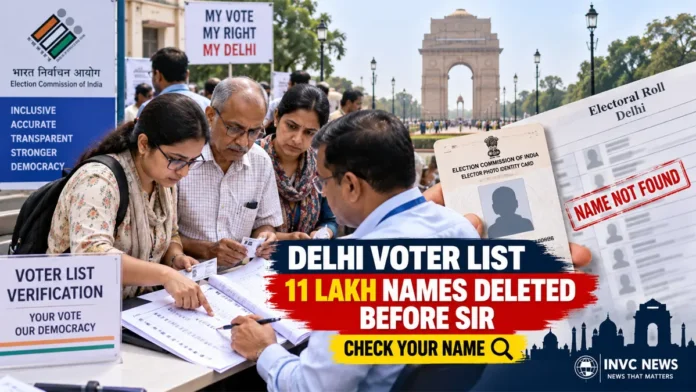
Delhi SIR Voter List has come under renewed scrutiny after electoral data showed that nearly 11 lakh names disappeared from the Capital’s rolls between January 2025 and June 2026, before the Special Intensive Revision began, while residents across several areas have reported missing names and incorrect voter records.
The figures add a fresh layer to Delhi’s already closely watched electoral-roll revision.
Delhi had about 1.56 crore electors in January 2025. By June 2026, before the SIR exercise formally began, the number had fallen to around 1.45 crore.
That amounts to a reduction of roughly 11 lakh electors over the 16-month period.
However, the figure must be understood separately from the millions of names that did not appear in Delhi’s subsequent draft SIR roll.
11 Lakh Names Were Removed Before SIR Began
The nearly 11 lakh deletions occurred between January 2025 and June 2026.
Delhi’s electoral roll contained approximately 1.561 crore electors in January 2025.
By June 2026, the figure had dropped to about 1.451 crore.
The Special Intensive Revision began later, on June 30.
This distinction matters because the 11 lakh figure does not represent names deleted by the SIR exercise itself.
Electoral rolls undergo continuous revision, and names can be added or removed through prescribed Election Commission procedures.
Officials have attributed the earlier fall to routine revisions as well as possible errors during voter-list verification.
Around 3 Lakh Deletions Came in May-June Period
A significant part of the decline occurred shortly before SIR began.
Around three lakh names were removed between May and June 2026, during the period when booth-level officials were carrying out pre-SIR mapping work.
That timing has attracted particular attention because the pre-SIR exercise was intended to help officials map existing electors against earlier electoral records.
Some booth-level officials have maintained that they were not supposed to remove voters merely because a person could not immediately be mapped during that exercise.
The Election Commission’s procedures nevertheless allow electoral rolls to undergo routine additions and deletions throughout the year under prescribed conditions.
The central question is therefore whether every deletion followed the required process and whether affected voters received sufficient information.
Residents Say They Did Not Know Their Names Were Missing
The issue has gained additional significance because several Delhi residents have said they were unaware that their names had already been removed.
Some voters reported that other members of their families received SIR enumeration forms while they did not.
When they approached booth-level officials, they were told that their names were no longer present in the electoral roll and that they would need to apply again for inclusion.
Such cases turn what could otherwise remain a statistical issue into a direct voter-access concern.
A voter whose name is absent from the electoral roll cannot vote unless the name is restored through the prescribed process before the relevant election.
Mangolpuri Case Adds to Accuracy Concerns
Fresh complaints have also emerged over incorrect categorisation in Delhi’s draft rolls.
At a public hearing in Mangolpuri, one resident reportedly found himself classified as deceased despite being alive and continuing to live at the same address.
Other participants at the hearing also complained about missing entries and discrepancies in voter records.
Such cases do not establish that errors affect the entire revision exercise, but they underline why verification and the claims-and-objections process remain important.
Electoral-roll accuracy requires authorities to remove ineligible or duplicate entries while also ensuring that eligible voters do not disappear because of administrative mistakes.
Delhi Draft Roll Has Already Seen Major Reduction
The earlier 11 lakh deletions are separate from the much larger reduction seen after the SIR exercise.
Before SIR, Delhi had approximately 1.45 crore registered electors.
The draft electoral roll released after the revision contained roughly 97.5 lakh electors.
That means around 47.6 lakh names were not included in the draft list.
The Election Commission has stressed that absence from a draft electoral roll does not automatically mean a genuine voter has permanently lost the right to be enrolled.
The draft stage exists precisely so eligible voters can seek inclusion and challenge errors before the final roll is published.
What Should Delhi Voters Do if Their Name Is Missing?
Delhi voters should first verify whether their names appear in the current draft electoral roll.
A voter can search using electoral details, EPIC information or the relevant Assembly constituency and polling-station records.
If an eligible voter’s name is missing, the individual can approach the local Booth Level Officer and use the prescribed Election Commission process to seek inclusion.
Form 6 is generally used to apply for inclusion in the electoral roll.
Form 8 applies to certain corrections and changes involving an existing voter record.
Form 7 can be used for objections to inclusion or requests for deletion under applicable rules.
Voters should rely on official Election Commission instructions when filing any application or objection.
Claims and Objections Window Becomes Critical
The claims-and-objections period will now play a major role in determining the accuracy of Delhi’s final electoral roll.
Eligible voters whose names are missing have until the notified deadline to raise their claims and provide the necessary documentation.
The final electoral roll is scheduled for publication in November.
Until that process concludes, the draft roll remains subject to correction.
This makes voter awareness especially important during September.
Residents who assume that holding an old voter ID card automatically guarantees that their name remains on the current electoral roll could face problems if they do not verify their status.
Election Commission Faces Accuracy Test
Electoral-roll revision involves two competing responsibilities.
Election authorities must remove duplicate entries, deceased voters, people who have permanently shifted and entries that no longer satisfy eligibility requirements.
At the same time, officials must protect eligible citizens from wrongful exclusion.
A clean electoral roll therefore cannot be judged only by how many names authorities remove.
Accuracy, transparency, notice and accessible correction mechanisms remain equally important.
The growing number of complaints in Delhi places fresh attention on how effectively that balance is being maintained.
Political Parties Likely to Intensify Scrutiny
The Delhi SIR process has already attracted political attention.
Questions surrounding deleted names can quickly become politically sensitive because electoral rolls directly determine who can participate in elections.
Opposition parties may seek explanations for unusually large reductions, while election authorities can point to the need to remove duplicate, shifted, deceased or otherwise ineligible entries.
INVC NEWS will treat political allegations separately from verified electoral data.
Any claim that names were deliberately removed for partisan reasons would require independent evidence and should not be presented as established fact.
Why the 11 Lakh Figure Matters
The most important new revelation is the timing.
Nearly 11 lakh names had already disappeared from Delhi’s electoral roll before the Special Intensive Revision formally began.
That means the debate over Delhi’s voter list extends beyond the current SIR draft alone.
It also raises questions about the continuous revision process that operated during the preceding 16 months.
The issue now requires answers on three fronts: why such a large number of names were removed, whether affected voters received adequate notice and how quickly genuine electors can restore incorrectly deleted entries.
For Delhi’s voters, the immediate message is simpler.
Do not assume your voter registration remains active simply because you possess a voter ID card. Check your name in the electoral roll and use the official claims process if it is missing.