NEW DELHI, India | September 22, 2026 —
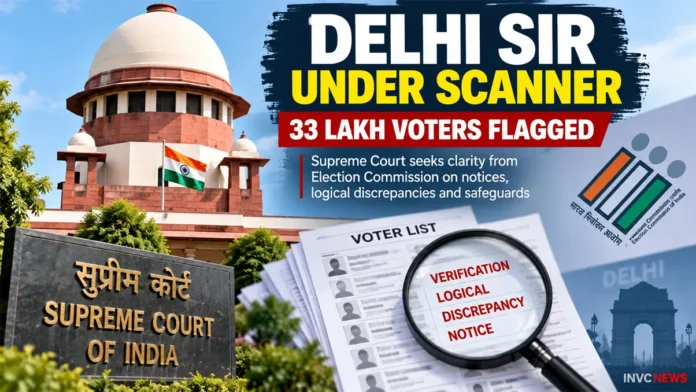
The Supreme Court on Tuesday raised questions over the way notices are being issued to voters during the Delhi Special Intensive Revision (SIR), observing that some appeared to have been generated “almost mechanically” and asking the Election Commission of India to consider whether additional safeguards or filters were needed before notices were sent.
A three-judge Bench comprising Chief Justice of India Surya Kant and Justices Joymalya Bagchi and V Mohana was hearing a petition challenging aspects of the ongoing revision of Delhi’s electoral rolls.
The Court also sought greater clarity on what the Election Commission means by a “logical discrepancy” and what exactly an affected voter must clarify when such an issue is flagged.
The case has major implications because about 33.13 lakh electors have been identified under “no mapping” and “logical discrepancy” categories, although the number of notices actually generated so far is lower at around 31.64 lakh.
Supreme Court Questions ‘Mechanical’ Notice Process
During the hearing, Justice Joymalya Bagchi observed that notices appeared to be going out almost mechanically and asked the Election Commission to examine whether additional filters should be introduced before they are generated.
Chief Justice Surya Kant separately said that the meaning of “logical discrepancy” needed greater explanation so that a voter could clearly understand what information the authorities wanted.
The Court’s concern centred not merely on whether a notice contained a reason, but whether the reason was understandable enough for an ordinary voter to respond effectively.
The Bench suggested that election officials could explain common discrepancies in simpler language and provide standard guidance to affected electors.
Court Suggests FAQ for Delhi Voters
One practical suggestion from the Bench was the publication of a frequently asked questions, or FAQ, document covering the most common types of objections and discrepancies.
Chief Justice Surya Kant suggested that standard responses to around 10 to 15 common queries could be published online, circulated through newspapers and shared through election officials and mobile contacts.
The Bench also said Booth Level Officers should actively assist voters in understanding what documents or information would be sufficient to resolve a notice.
That could become particularly important because millions of Delhi electors are now moving through the verification process.
How Many BLOs Are Handling the Notices?
The scale of the exercise also came under scrutiny.
Justice Bagchi asked how many Booth Level Officers had been deployed after roughly 30 lakh notices were generated.
Appearing for the Election Commission, Senior Advocate Dama Seshadri Naidu told the Court that around 14,000 BLOs and 1,200 Electoral Registration Officers had been deployed to manage the process.
The Election Commission also said manpower had been increased to deal with the workload.
The Chief Justice observed that these BLOs could help voters respond to notices rather than leaving people to navigate the verification process on their own.
Election Commission: No Voter Will Be Deleted Without Hearing
The Election Commission rejected the suggestion that voters could simply lose their names automatically because they received a notice.
Its counsel told the Supreme Court that no voter would be deleted without being given an opportunity to be heard.
The Delhi Chief Electoral Officer has separately clarified that receiving an SIR notice does not itself amount to deletion from the electoral roll.
A notice is part of the verification process, and affected electors can submit explanations and supporting material before the electoral authorities take a final decision.
What Is a ‘Logical Discrepancy’?
The phrase has become central to the controversy.
According to available Delhi SIR data, 19.33 lakh electors were placed in the “logical discrepancy” category, while around 13.80 lakh fell under “no mapping” because their records could not be linked with the previous 2002 revision.
Logical discrepancies can include mismatches involving a voter’s name, a parent’s name or unusual age differences between family members recorded in electoral data.
Name mismatches account for a significant share of the notices. Other flagged issues include age-gap anomalies between voters, parents and grandparents.
The petitioners have asked for disclosure of the criteria, definitions, algorithmic parameters and operational guidelines used to classify voters under these categories.
Petitioners Raise Document Requirement Concerns
Advocate Prashant Bhushan, appearing for petitioners Anjali Bhardwaj and Amrita Johri, argued that some voters may struggle to answer the notices because the documents they are asked to produce may not directly explain the discrepancy identified by the system.
He cited the example of a notice questioning the age difference between a voter and a parent.
The Election Commission responded that the listed documents were not exhaustive and said voters could provide other relevant information to clarify the issue.
Delhi’s Migrant Population Also Comes Into Focus
Chief Justice Surya Kant noted that Delhi presents a distinctive challenge because of its large migrant population.
People may previously have been registered in another city or state before moving to Delhi, making historical record matching more complicated.
The Chief Justice said verification could also help ensure that a person is not simultaneously registered to vote in two places.
Senior Advocate Kapil Sibal also raised practical questions about whether BLOs could physically reach every household in Delhi’s numerous multi-storey buildings.
The Election Commission said camps, sensitisation programmes and WhatsApp groups were being used to help electors.
Court Says BLOs Could Be Available at Ward Offices
Justice Bagchi suggested that BLOs could also remain available at ward offices so voters would know where to approach them directly.
The Election Commission said arrangements of that nature had already been made.
The discussion highlighted a larger concern: voters receiving notices need both clear information and an accessible person who can help resolve the issue.
47.7 Lakh Excluded From Draft Roll — But This Is a Separate Group
Another large number associated with the Delhi SIR requires careful distinction.
Delhi had about 1.451 crore registered electors before the draft revision.
The draft roll published on August 31, 2026 contained approximately 97.54 lakh names, meaning roughly 47.6–47.7 lakh electors were not included in the draft roll.
However, those 47.7 lakh excluded names are not the same group as the 33.13 lakh voters facing discrepancy notices.
The 33.13 lakh are electors appearing in the draft list whose records have been flagged for further verification.
This distinction is crucial when reporting the scale of the SIR process.
Only Around 23,000 Notice Cases Cleared So Far
The verification workload remains substantial.
As of the latest available figures, around 23,000 of approximately 31.6 lakh people issued notices had completed hearings and secured confirmation in the final-roll process.
Hearings are scheduled to continue until October 29, with the final Delhi electoral roll expected on November 4, 2026.
The Election Commission has indicated that the timeline could be reconsidered if the exercise cannot be completed within the available period.
Supreme Court Seeks Status Report
At the end of Tuesday’s hearing, the Supreme Court formally issued notice on the petition.
The Bench directed the authorities to explain the immediate steps being taken and sought a status report.
The matter is expected to return before the Court after approximately two weeks.
The Court also referred to safeguards previously ordered in SIR-related proceedings involving Bihar and West Bengal, including disclosure of excluded names and reasons.
For millions of Delhi voters, the key issue now is practical rather than political: whether every eligible voter receives a clear notice, adequate assistance and a meaningful opportunity to correct the electoral record before the final roll is published.