
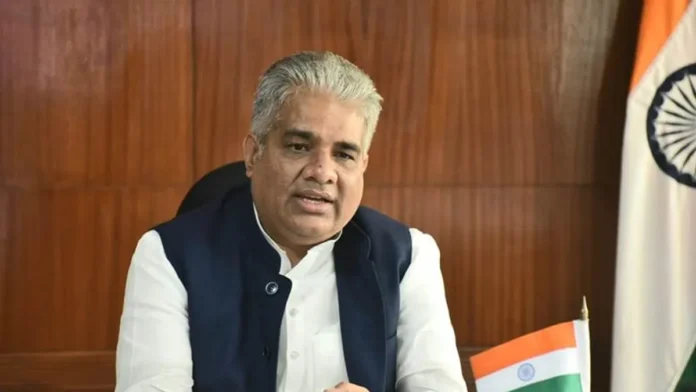
New Delhi, October 30, 2026: With winter approaching and air pollution becoming a growing concern across the National Capital Region (NCR), the Centre has announced another major measure to control pollution. Union Environment Minister Bhupender Yadav has announced a complete restriction on construction and demolition activities across the NCR from November 5 to November 20.
The proposed 15-day restriction is aimed at reducing dust emissions from construction sites, demolition work and related activities, which contribute to deteriorating air quality during the winter months.
The announcement comes at a time when Delhi and neighbouring cities are struggling to maintain better air quality despite recent rainfall and stronger winds. Although rain brought some temporary improvement, pollution levels remained a concern across several parts of the region.
For residents, construction companies, builders and infrastructure agencies, the announcement could have significant implications. The restrictions are expected to affect construction schedules and require stricter compliance with pollution-control measures.
Construction and Demolition Activities to Face Restrictions from November 5
According to the announcement by Union Environment Minister Bhupender Yadav, construction and demolition activities across the NCR will remain completely prohibited between November 5 and November 20.
The measure is intended to control dust pollution during a period when unfavourable weather conditions often prevent pollutants from dispersing effectively.
Construction sites can release substantial amounts of dust through excavation, movement of construction materials, demolition, transportation of debris and other activities. These emissions can worsen air quality, particularly when wind speeds are low.
The proposed restriction is therefore an important part of the wider effort to reduce local pollution sources.
Builders, contractors, infrastructure developers and government agencies will need to take note of the announced dates and await the detailed implementation instructions from the relevant authorities.
Delhi Already Has a Separate Construction Restriction Plan
An important distinction needs to be made between the newly announced NCR-wide restriction and the Delhi government’s previously announced winter pollution measures.
According to the Centre’s official account of a high-level meeting held in September, Delhi had planned restrictions on dust-generating demolition and outdoor civil construction activities from November 1, 2026, to January 31, 2027.
A complete ban on construction and demolition activities was separately planned in Delhi from December 10, 2026, to January 20, 2027.
These are separate measures with different timelines. The implementation orders and applicable exemptions will determine exactly which activities can continue and under what conditions.
Rain Brings Some Relief, but Pollution Remains a Concern
Delhi experienced cloudy skies, rainfall, thunderstorms and strong winds on Thursday, October 29. However, the weather changes did not immediately bring a substantial improvement in the city’s daily average air quality.
According to the Central Pollution Control Board (CPCB), Delhi recorded an average AQI of 222 on Thursday, placing it in the poor category. This was slightly better than Wednesday’s reading of 229.
The improvement followed a rise in pollution over the preceding days.
Delhi’s AQI had increased from 174 on October 26 to 197 on October 27 and 229 on October 28 before declining to 222 on October 29.
However, the latest morning reading on October 30 showed a more encouraging improvement. Delhi’s AQI was reported at 121 at 6 AM, in the moderate category.
The improvement in the morning reading does not necessarily mean that pollution has been brought under control. Air quality can fluctuate throughout the day depending on wind speed, temperature, emissions and atmospheric conditions.
IITM Forecast: Poor Air Quality Could Return
The Air Quality Early Warning System for Delhi, operated by the Indian Institute of Tropical Meteorology (IITM), indicated that air quality could remain moderate on October 30 and October 31 before deteriorating to the poor category on November 1.
Its subsequent six-day outlook also indicated a possibility of poor air quality.
This forecast highlights why authorities are preparing additional restrictions before pollution levels potentially worsen during the winter season.
Low wind speeds and an unfavourable ventilation index can prevent pollutants from dispersing, allowing particulate matter to accumulate close to the ground.
Greater Noida West Among the More Polluted Areas
Pollution has remained a concern beyond Delhi’s municipal boundaries.
On Thursday, Greater Noida recorded an AQI of 214, placing it in the poor category. Greater Noida West reportedly recorded higher pollution levels than Greater Noida.
Noida and surrounding areas also experienced cloudy weather and intermittent rainfall. Although temperatures declined, the weather changes did not immediately eliminate the pollution problem.
The situation underlines the importance of coordinated action across Delhi, Noida, Greater Noida, Ghaziabad, Gurugram and other NCR cities.
Air pollution does not respect administrative boundaries, and isolated action by individual cities may not be sufficient to achieve sustained improvement.
DDA Plans Green Corridor Along the Yamuna
Alongside emergency pollution-control restrictions, the Delhi Development Authority (DDA) is pursuing an infrastructure initiative aimed at improving green and public spaces in the capital.
The project involves developing a cycle track along the western bank of the Yamuna, connecting the Old Railway Bridge with the NH-24/NH-9 stretch.
The proposed development is intended to improve access to cycling infrastructure and encourage more sustainable forms of urban mobility.
A DDA tender for the cycle-track project has been published, covering the stretch from the Old Railway Bridge to NH-24 along the western bank of the Yamuna.
Such projects can contribute to better public spaces and encourage environmentally friendly mobility. However, their long-term impact on air pollution will depend on implementation, maintenance and the extent to which people adopt cleaner transport options.
What Will the Construction Ban Mean for Residents and Builders?
The announced November 5–20 restriction could affect several categories of construction-related activities across the NCR.
These may include:
- Building construction and outdoor civil works.
- Demolition of existing structures.
- Excavation and other dust-generating activities.
- Construction-related movement and handling of materials.
The precise scope, exemptions and enforcement procedures will depend on the detailed orders issued by the competent authorities.
Builders and contractors should monitor official instructions rather than assume that every category of work will be treated identically.
For residents, the restrictions are intended to reduce one important source of local dust pollution. However, construction restrictions alone cannot solve the NCR’s air-quality problem.
Vehicular emissions, industrial pollution, road dust, waste burning, regional emissions and agricultural residue burning also need sustained attention.
The Bigger Question: Will These Measures Deliver Cleaner Air?
Delhi-NCR’s annual pollution crisis requires more than temporary restrictions. Measures need to address both immediate pollution sources and the structural causes of poor air quality.
The proposed construction ban, vehicle restrictions, industrial inspections, dust-control measures and green infrastructure initiatives represent different parts of this wider strategy.
The real test will be implementation. Construction sites must comply with dust-control rules, enforcement agencies must act consistently, and neighbouring NCR authorities must coordinate their efforts.
For millions of residents, the priority is straightforward: cleaner air, fewer pollution-related health risks and effective action that continues beyond a few weeks.
Bottom Line: The Centre’s November 5–20 construction and demolition restriction is a significant pollution-control announcement for Delhi-NCR. But its success will depend on strict enforcement and coordinated action against all major sources of pollution, not construction dust alone.