LEH, INDIA — August 17, 2026
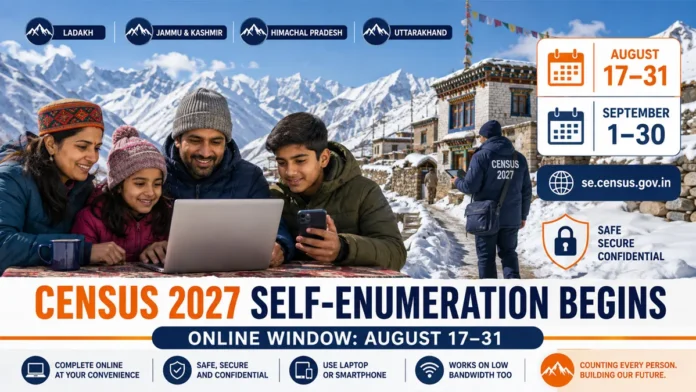
Census 2027 self-enumeration opened Monday for residents of snowbound areas in Ladakh, Jammu and Kashmir, Himachal Pradesh and Uttarakhand, allowing eligible households to submit their information online before officials begin door-to-door enumeration.
The optional online window will remain open from August 17 through August 31, 2026. Census personnel will then visit households in the identified areas from September 1 through September 30 to verify self-enumerated records and collect information from people who did not use the online facility.
Residents can complete the process through the official government portal at se.census.gov.in. After successfully submitting the form, a unique Self-Enumeration identification number, or SE ID, will be generated.
Households should preserve this number and provide it to the authorized enumerator during the field visit. The enumerator will use the SE ID to verify that the household’s information has already been submitted.
Why Census Work Is Starting Early in These Areas
The special schedule applies to locations that become difficult or impossible to access after heavy winter snowfall.
Remote settlements in Ladakh, Jammu and Kashmir, Himachal Pradesh and Uttarakhand include high-altitude villages with limited roads, weak mobile connectivity and long walking routes. Completing the count before winter reduces the risk that households will be missed.
For these snowbound areas, the census reference date—or the fixed point to which the collected information relates—will be midnight on October 1, 2026.
The reference date for most of the rest of India will be midnight on March 1, 2027. Population enumeration in other parts of the country is expected to take place during February 2027.
Census 2027 will be India’s 16th population census and the eighth conducted since independence. It will also be the country’s first fully digital census, according to the government’s official Census 2027 overview.
How to Complete Census 2027 Self-Enumeration
Eligible residents can follow these steps:
- Visit the official portal at se.census.gov.in.
- Register or sign in using the authentication method displayed on the official website.
- Enter the required household and individual information.
- Review all entries carefully before submitting the form.
- Complete the final submission within the August 17–31 window.
- Save or write down the unique SE ID generated after submission.
- Provide the SE ID to the authorized census employee during the September field visit.
Self-enumeration is optional. Residents who cannot access the portal or do not want to complete the form online can provide their information when an enumerator visits their home.
What Will the 40 Census Questions Cover?
The government has finalized 40 questions for population enumeration. The questionnaire contains 11 additions compared with the 2011 census schedule.
The precise wording and response options should be followed exactly as displayed on the official portal or notified schedule. Broadly, the questions cover the following areas:
| Category | Information likely to be collected |
|---|---|
| Personal details | Name, age, date of birth, sex and marital status |
| Family information | Relationship to the head of household and information about parents |
| Social identity | Religion, Scheduled Caste or Scheduled Tribe status and caste |
| Identification details | Information connected with Aadhaar, voter ID, passport and driving license |
| Contact information | Mobile number and related household contact details |
| Language | Mother tongue and other languages known |
| Education | Literacy, school or college attendance and educational level |
| Disability | Information about specified disabilities |
| Employment | Work status, occupation, industry and nature of economic activity |
| Migration | Place of birth, previous residence, permanent address and reason for migration |
| Fertility | Questions related to children born and surviving, where applicable |
| Health-related information | COVID-19 vaccination status |
| Residence | Present address, permanent address and duration of stay |
Respondents should answer only the questions displayed on the official form. They should not provide unrelated banking information, card numbers, passwords or financial account credentials.
Caste Question Included for the First Time in Independent India’s Regular Census
A significant feature of Census 2027 is the inclusion of caste enumeration beyond the established Scheduled Caste and Scheduled Tribe categories.
This will be the first regular population census conducted after independence to collect broader caste information. In earlier post-independence censuses, systematic caste-related enumeration was generally limited to Scheduled Castes and Scheduled Tribes.
The caste question is listed among the 40 notified items. Enumerators are expected to record the caste name provided by the respondent rather than independently determine or authenticate the response against a separate list.
The information could influence future analysis of India’s social and economic composition. However, publication and classification decisions will remain subject to the government’s data-processing rules.
Important OTP and Fraud Warning
Residents should use only the official portal ending in census.gov.in.
Online registration may use a secure authentication process, including an OTP sent directly to the resident’s device. However:
- Never disclose an OTP, password or login code to a visiting enumerator.
- Do not complete the census through links received from unknown numbers.
- Do not pay anyone to submit the census form.
- Census personnel should not ask for bank-account, credit-card or UPI PIN details.
- Verify the identity of a visiting census employee.
- Do not share the SE ID publicly; provide it only to an authorized enumerator.
No fee is charged for self-enumeration or the door-to-door census process.
How Digital Verification Will Work
Once a household completes the online questionnaire, the system generates an SE ID. During the field operation, the enumerator will visit the address and use that identification number to confirm that the submission exists.
This does not necessarily eliminate the household visit. Verification is needed to ensure that the property and residents have been covered and that no household has been counted twice or omitted.
The digital process is intended to reduce the time required for questioning at the doorstep while allowing residents to enter their details at their convenience.
Field personnel will use the Census 2027-PE mobile application to collect population information. The application can work in online and offline modes, allowing enumerators to record data in areas with poor or unavailable internet connectivity.
Ladakh Census to Cover Remote High-Altitude Settlements
Enumeration in Ladakh will cover an estimated population of approximately 274,000 across its seven districts.
The operation includes remote communities where census employees may have to walk for several hours to reach a small number of households. Some settlements have limited road access, while others are located at extremely high elevations.
Hanle in the Changthang region stands at an elevation of about 15,000 feet. Other settlements in Zanskar and the Leh region can remain cut off or difficult to reach during winter.
Officials have said that even if only one family lives in a remote settlement, an enumerator will be assigned to cover it. Special arrangements are also being made for military and Indo-Tibetan Border Police personnel stationed in high-altitude areas.
Jammu and Kashmir Enumeration
Sixteen snowbound districts in Jammu and Kashmir are included in the advance schedule, covering an estimated population of approximately 8.81 million.
The identified areas include difficult terrain in districts such as Doda, Poonch and Kupwara. Some villages may become inaccessible during winter because of snow-covered roads and mountain passes.
Employees will use digital devices wherever operationally possible. Offline data collection will be available in areas without dependable mobile networks.
More Than 6,900 Himachal Snowbound Areas Identified
Approximately 6,903 snowbound villages and localities in Himachal Pradesh have been selected for early enumeration.
The operation includes areas in:
- Kinnaur
- Lahaul and Spiti
- Pangi in Chamba
- Bharmour in Chamba
Komic village in the Spiti Valley is among the high-altitude settlements covered. Located at approximately 15,049 feet, it is often described as one of the world’s highest permanently inhabited villages accessible by a motorable road.
Himachal Pradesh plans to deploy approximately 20,390 employees and officials for the operation. Digital monitoring tools will help authorities track progress at the village, district and state levels.
Uttarakhand Census to Cover 131 Villages and Three Towns
Advance enumeration in Uttarakhand will cover approximately 52,000 people in 131 villages and three towns.
The identified villages include:
- 69 villages in Uttarkashi
- 23 villages in Chamoli
- Four villages in Rudraprayag
- 35 villages in Pithoragarh
The three towns are Gangotri, Badrinath and Kedarnath.
Approximately 162 enumerators and 34 supervisory officials are expected to participate. Members of the armed forces and paramilitary units stationed in snowbound areas will also be counted.
Because of security requirements, certain information relating to military and paramilitary personnel may initially be recorded through authorized offline procedures and later entered into the secure census system.
Are Census Responses Confidential?
Information collected during the census is protected under India’s census framework and is intended to be used for statistical purposes.
Individual household records are not published as public personal profiles. Census results are generally released in aggregated form, showing population, demographic and socioeconomic patterns across different geographic areas.
Residents should nevertheless ensure that they are dealing only with authorized personnel and the official self-enumeration portal.
Why Census 2027 Matters
Census data helps governments plan schools, hospitals, roads, housing, water supplies, transportation systems and welfare programs.
It also provides updated information about migration, employment, education, language, age distribution and household composition.
For remote Himalayan communities, accurate enumeration is particularly important because small populations can otherwise be overlooked in planning and resource allocation.
The early operation in snowbound regions is intended to ensure that geographical isolation and severe winter weather do not prevent any household from being counted.