NEW DELHI, August 14, 2026
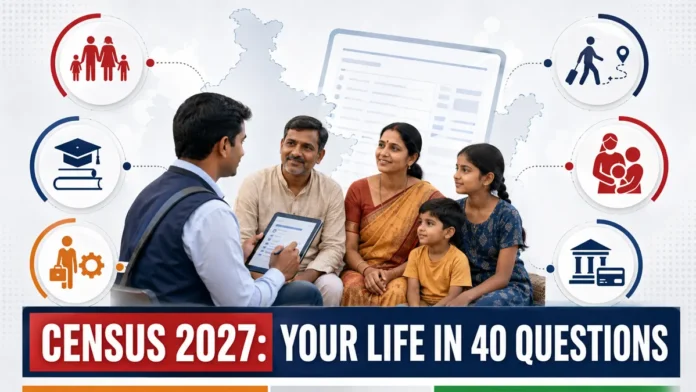
Census 2027 questions will seek to create a detailed picture of who you are, how your family is structured, what you studied, where you work, why you migrated and which financial or identity documents you possess.
The population count will no longer be limited to answering one basic question: How many people live in India?
Through its newly notified 40-point Household Schedule, the government will collect demographic, social, educational, economic and migration-related information from individuals across the country.
The questionnaire includes familiar subjects such as name, age, sex, marital status and religion. However, it also covers digital literacy, commuting patterns, bank accounts, Aadhaar, voter ID, passport details and the place where a person received a Covid-19 vaccination.
Most notably, Census 2027 will include comprehensive caste enumeration of all individuals for the first time since Independence. Previous national censuses systematically recorded Scheduled Caste and Scheduled Tribe status but did not enumerate every caste.
What will the 40 Census questions reveal?
The notified questions can be divided into seven broad areas:
| Category | Question numbers | Information covered |
|---|---|---|
| Personal and family identity | 1–14 | Name, relationship, age, marriage, nationality, religion, caste, parents, disability and languages |
| Education and literacy | 15–17 | Literacy, digital literacy, educational attendance and qualifications |
| Employment and work | 18–25 | Work status, profession, industry, worker category, job search and commuting |
| Migration and residence | 26–30 | Birthplace, previous residence, reason for migration and permanent address |
| Women and children | 31–33 | Children surviving, children born alive and births during the previous year |
| Covid vaccination | 34 | Place where the respondent received a Covid-19 vaccine |
| Financial and digital identity | 35–40 | Bank accounts, mobile, Aadhaar, voter ID, passport and driving license |
Who are you? Questions about personal identity
The first part of the Census schedule will establish a person’s basic identity and position within the household.
Respondents will be asked their name, relationship with the household head, sex, date of birth and age in completed years.
The questionnaire will also record:
- Current marital status
- Age at marriage
- Spouse’s name
- Declared nationality
- Religion
- Scheduled Caste or Scheduled Tribe status and caste
- Father’s particulars
- Mother’s particulars
- Disability status
- Mother tongue and other languages known
These details will help produce a demographic picture of households and communities across India.
How will caste information be collected?
Question 10 combines Scheduled Caste, Scheduled Tribe and caste information.
Census 2027 will be the first post-Independence national Census to undertake comprehensive caste enumeration of all individuals. The government approved its inclusion through a decision taken by the Cabinet Committee on Political Affairs on April 30, 2025.
A predefined list of every caste is not expected to be presented to respondents. People are likely to state their caste, and the answer will be recorded as provided before being processed under the Census classification system.
The government’s Census 2027 backgrounder confirms that caste information will be collected electronically during the population-enumeration phase.
What did you study? Education and digital-literacy questions
Three questionnaire items focus on education.
Respondents will be asked about their literacy as well as their ability to use digital tools. This means the Census will attempt to distinguish conventional reading and writing skills from digital literacy.
The schedule will also establish:
- Whether the person attends an educational institution
- The highest educational level completed
- The respondent’s academic stream or discipline
These answers could provide a nationwide picture of educational participation, qualifications and access to digital skills.
What do you do? Eight questions about employment
Employment and economic activity form the largest clearly defined block in the Household Schedule.
Questions 18 to 25 examine whether a person worked at any time during the previous year and the nature of that employment.
The Census will ask about:
- Whether the person worked during the last year
- Category of economic activity
- Occupation or profession
- Nature of the industry, trade or service
- Class or category of worker
- Non-economic activity among marginal, semi-marginal and non-workers
- Whether such a person is seeking or available for work
- Travel to the workplace
The questions will cover not only people currently employed but also those outside regular employment who may be looking for work.
Information about travel to work can help measure commuting patterns and the relationship between residential locations and employment centers.
Where did you come from—and why did you move?
Five questions, numbered 26 to 30, will examine migration and residence.
Respondents will provide:
- Their birthplace
- Their last place of residence
- The reason they migrated
- How long they have lived in the present village or town
- Their permanent residential address
This section could help explain not only where people are living but how and why India’s population is moving.
Employment, marriage, education, displacement and family circumstances are among the reasons that may influence migration. The collected information will enable the Census to measure movement between villages, towns, cities, districts and states.
Which questions apply specifically to women?
Questions 31, 32 and 33 collect fertility and child-survival information from specified categories of women.
Women who are currently married, widowed, divorced or separated will be asked:
- How many of their children are currently alive
- How many children they have given birth to alive
Currently married women will additionally be asked how many children were born alive during the preceding year.
These questions will contribute to demographic measurements involving fertility, birth patterns and child survival.
Why does the Census ask about Covid vaccination?
Question 34 concerns the place where a person received a Covid-19 vaccination.
The notified item asks for the vaccination location, not a medical diagnosis or a detailed vaccination history.
The government notification does not publicly explain the precise analytical purpose of this question. Therefore, it would be speculative to claim that the information is intended for a particular policy, permanent health record or future program.
From bank accounts to Aadhaar: Six document-related questions
Questions 35 to 40 move from personal identity toward financial access and identification documents.
Respondents may be asked for:
- Total number of bank accounts
- Mobile number, if available
- Aadhaar number, if available
- Voter ID number, if available
- Passport number, if the person holds an Indian passport
- Availability of a driving license
Mobile, Aadhaar and voter ID numbers are expressly qualified with “if available.” Passport details apply only to Indian passport holders, while the final item asks whether a driving license is available.
The bank-account question seeks the total number of accounts rather than the respondent’s balance or transaction history.
Does every question apply to every person?
No. Several questions are conditional.
Questions concerning births and surviving children apply only to specified categories of women. Passport details apply only to Indian passport holders, while mobile, Aadhaar and voter ID details are listed as applicable when available.
Employment questions may also differ according to whether someone is a regular worker, marginal worker, semi-marginal worker or non-worker.
Enumerators will use the Household Schedule to determine which questions apply to each respondent.
Is Census 2027 entirely digital?
Census 2027 is planned as India’s first fully digital Census.
Enumerators will use mobile-based technology to collect information, and an online self-enumeration option will be offered before door-to-door counting begins.
The exercise will take place in two principal phases:
- House Listing and Housing Census: Records buildings, households, housing conditions, amenities and assets.
- Population Enumeration: Records individual demographic, social, educational, cultural and economic details.
The government has approved approximately ₹11,718.24 crore for the nationwide exercise.
When will population enumeration begin?
Population enumeration in Ladakh and designated snowbound areas of Jammu and Kashmir, Himachal Pradesh and Uttarakhand will run from September 1 to 30, 2026.
Online self-enumeration in these regions will be available from August 17 to 31.
For most of India, the Census reference date will be March 1, 2027. The reference date for the designated snowbound regions will be October 1, 2026.
The official Census schedule confirms the separate reference dates.
More than a headcount
Taken together, the 40 Census 2027 questions attempt to show far more than India’s total population.
They will record who people are, how families are connected, which languages they speak, what they studied, whether they work, why they moved and which financial or identity systems they can access.
In effect, the Census will seek to transform millions of individual answers into a broad social and economic portrait of India.