New Delhi, India, August 19, 2026
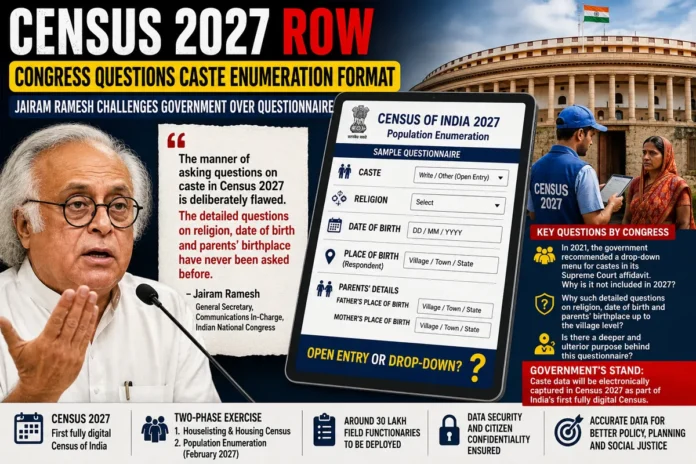
Census 2027 caste questions have become the center of a fresh political confrontation after Congress questioned the way caste information is being collected and raised concerns over detailed questions relating to religion, date of birth and the birthplace of respondents’ parents.
Congress general secretary in charge of communications Jairam Ramesh alleged Wednesday that the structure adopted for caste enumeration was “deliberately flawed” and questioned why respondents were not being offered a standardized drop-down list of castes.
Ramesh also alleged that the collection of granular information on religion and parental birth details raised wider questions about the purpose of the exercise.
The government has not accepted those allegations. Officially, Census 2027 is being conducted under the Census Act, 1948 and Census Rules, 1990, with the Centre saying the exercise is intended to collect demographic, socioeconomic and cultural information required for policymaking.
Why Has Congress Raised Questions Over Census 2027?
The immediate controversy centers on the format being used to record caste.
Congress argues that allowing respondents to state their caste through an open-entry field could create spelling variations, duplicate entries, regional naming differences and difficulties in standardizing the final data.
Ramesh has questioned why the government did not instead create a standardized registry from which respondents or enumerators could select a caste.
His criticism draws on the Centre’s own arguments made before the Supreme Court in 2021 during litigation involving the Socio-Economic and Caste Census.
According to Congress, that affidavit acknowledged that a predetermined caste register and a drop-down selection system could have helped generate more consistent data.
Congress Asks: Why No Drop-Down Menu for Caste?
Ramesh’s central question is straightforward: if the government itself previously identified the absence of a standardized caste register as a major problem, why is Census 2027 again relying on an open-ended approach?
Congress argues that a drop-down menu could help prevent multiple spellings and classifications of the same caste.
For example, the same community may be known by slightly different names in different states or may be recorded differently depending on local pronunciation.
Without standardization, Congress argues, aggregating national caste numbers could become difficult.
Whether the open-ended methodology will materially undermine the quality of the final data cannot be determined until the enumeration and classification process is completed.
What Did the Government Say in 2021?
The controversy has revived attention on the Centre’s position during the 2021 Supreme Court proceedings concerning caste data.
At that time, the Union government opposed directions requiring a full caste census and highlighted problems associated with the 2011 Socio-Economic and Caste Census.
Among the difficulties identified were inconsistencies in caste names, spelling variations and the absence of a comprehensive national caste register.
Congress says that argument is relevant today because Census 2027 is intended to deliver precisely the type of caste information whose collection the government previously described as technically complicated.
Ramesh has therefore accused the government of contradicting its earlier position.
Government Has Officially Confirmed Caste Enumeration
There is no ambiguity over whether caste will be counted in Census 2027.
The Union Cabinet has formally confirmed that caste information will be captured electronically during the second phase, known as Population Enumeration.
The Cabinet Committee on Political Affairs decided on April 30, 2025 to include caste enumeration in the upcoming Census.
The government has described India’s social and demographic diversity as one of the reasons for collecting the information.
In February 2026, the Home Ministry also told Parliament that caste-related questions would form part of the second phase and would be finalized according to established procedures.
Census 2027 Is India’s First Fully Digital Census
Another major change is technological.
Census 2027 will be the first Indian Census conducted primarily through digital means.
Enumerators will use mobile applications for data collection, while a central digital system will be used for monitoring the exercise.
Citizens will also have the option of self-enumeration.
The government says the digital system is intended to improve the quality and speed of data collection and make Census results available sooner.
Security features have also been built into the digital architecture, according to the Cabinet-approved scheme.
Congress Raises Questions Over Religion Details
Congress has also questioned the level of information being sought regarding religion.
Ramesh said the questionnaire goes into unusually granular detail and argued that the government should explain why such information is required.
Religion itself, however, is not a new Census category.
Official government documents identify religion among the longstanding demographic parameters collected in the Indian Census, alongside Scheduled Caste and Scheduled Tribe status, language, education, economic activity, migration and fertility.
The political dispute is therefore less about whether religion is recorded at all and more about the level and structure of related information being sought.
Parents’ Birthplace Questions Become Another Flashpoint
Ramesh has also objected to questions concerning respondents’ parents, particularly details related to their place of birth.
The Congress leader has questioned why such information is being sought at a detailed geographical level.
These questions have become politically sensitive because information about parental birthplace can potentially provide important migration and demographic data.
Congress, however, argues that the government should explain clearly why such detailed information is necessary and how it will be used.
There is currently no evidence establishing Congress’s allegation that these questions have an improper purpose.
Census Data Is Legally Confidential
Ramesh himself acknowledged that Census information is subject to confidentiality protections while simultaneously questioning the expanded questionnaire.
Under India’s Census framework, information collected from individuals is protected and is intended to be used for statistical purposes rather than disclosed as individual public records.
The government has also said Census 2027 will include security safeguards because the exercise will be conducted digitally.
That distinction is significant in the political debate.
The Census can collect highly detailed personal demographic information while still publishing results only in aggregated statistical form.
Why Caste Enumeration Is Historically Significant
Census 2027 marks a major change in India’s post-Independence population-counting system.
While Scheduled Caste and Scheduled Tribe information has regularly been collected, comprehensive caste enumeration across the wider population has not been part of the regular post-Independence Census in the same way.
The decision to include caste is therefore politically and administratively significant.
The resulting data could influence debates involving social justice, welfare policy, representation and reservation.
That is one reason political parties are paying unusually close attention not merely to whether caste is counted, but how it is counted.
Congress Accuses Modi Government of Another ‘U-Turn’
Congress has linked the current dispute to the government’s changing position on caste enumeration.
The opposition party points to the Centre’s 2021 Supreme Court affidavit as evidence that the government was previously resistant to conducting a broad caste census.
The political position changed in April 2025 when the Cabinet Committee on Political Affairs decided that caste would be included in Census 2027.
Congress described that decision at the time as a reversal forced by political pressure.
Ramesh is now arguing that the methodology being adopted risks weakening the usefulness of the very caste enumeration the government subsequently accepted.
That remains a political claim rather than an established finding about the Census methodology.
Why Standardizing Caste Data Is Complicated
Collecting caste information at national scale is technically challenging.
India has thousands of communities and sub-communities whose names can vary across regions.
A caste may have:
- different spellings;
- different local names;
- sub-caste identities;
- state-specific classifications;
- overlapping titles; or
- different administrative status across states.
A completely open-response system provides flexibility but can create challenges during classification.
A fixed drop-down menu provides standardization but creates a different problem: deciding in advance which names and variants must be included.
That methodological tension lies at the heart of the current controversy.
Could an Open-Ended Caste Question Produce Reliable Data?
An open-ended question is not automatically unreliable.
Its usefulness depends heavily on what happens after responses are collected.
If census authorities build robust coding systems capable of identifying alternate spellings, aliases, sub-castes and regional names, the raw responses could potentially be standardized during processing.
However, if the classification system is inadequate, inconsistencies could make aggregation more difficult.
The government has said Census 2027 will collect data electronically and is designed to improve data quality.
Detailed information on how every caste response will ultimately be standardized will therefore be crucial to evaluating the process.
Census 2027 Will Be Conducted in Two Phases
The nationwide Census is being conducted in two major stages.
The first is the Houselisting and Housing Census, covering housing conditions, amenities and household assets.
The second is Population Enumeration, which collects information about individual residents.
For most of India, Population Enumeration is scheduled for February 2027.
For Ladakh and designated snow-bound areas of Jammu and Kashmir, Himachal Pradesh and Uttarakhand, the population count is being conducted earlier because of climatic conditions.
Around 3 Million Personnel to Conduct Census
The enormous scale of Census 2027 adds another dimension to the methodological debate.
Around 3 million field functionaries are expected to participate in the exercise.
Enumerators, supervisors, trainers and administrative officers will collect and verify information across every household in the country.
In a caste enumeration exercise, consistency between millions of individual entries becomes especially important.
Digital collection could reduce some transcription problems, but the classification of diverse caste names will still require careful data processing.
Why the 2011 Experience Matters
Much of the present controversy traces back to lessons from the Socio-Economic and Caste Census 2011.
That exercise collected caste information separately from the regular Census but produced an enormous number of caste-name variations.
The Centre later argued that inconsistencies made the raw caste data difficult to use reliably.
Congress is now using that history to question whether Census 2027 has adequately solved the same methodological challenge.
The government’s answer is likely to depend on the new digital classification and processing system rather than simply on the wording of the question itself.
Census Data Could Have Major Policy Consequences
The stakes extend far beyond statistics.
Reliable caste data could inform discussions concerning:
- reservation policies;
- welfare targeting;
- education;
- employment;
- social representation;
- development programs; and
- distribution of public resources.
Because those decisions can affect millions of people, political parties want confidence that communities will be counted accurately.
That makes methodological transparency especially important.
Congress Wants Government to Explain the Questionnaire
Congress is effectively asking the Centre to publicly explain three issues.
First, why has a standardized caste drop-down system not been adopted?
Second, why are detailed parental birthplace and related demographic questions being collected?
Third, how will the government guarantee that the resulting caste figures are standardized and reliable?
Ramesh has gone further by suggesting that there may be an improper motive behind the questionnaire.
No evidence establishing such a motive has been presented publicly, and the allegation remains part of the political dispute.
Government Says Census Will Produce Better Data
The government’s stated position is that the digital Census will improve both the quality and speed of population data.
Mobile-based data collection, centralized monitoring and Census-as-a-Service are among the technological changes introduced for 2027.
The Centre says these systems will enable information to be disseminated down to the village and ward level and provide ministries with clean, machine-readable data for policymaking.
Caste information will form part of that expanded digital database.
Census 2027 Row Likely to Intensify
The controversy surrounding Census 2027 caste questions is unlikely to disappear quickly.
For Congress, the issue provides an opportunity to challenge the Modi government on a politically sensitive subject it has pushed strongly in recent years.
For the Centre, the task will be demonstrating that a caste enumeration involving more than a billion people can produce accurate, standardized and useful results.
The key question is therefore no longer simply whether caste should be counted.
That decision has already been made.
The new political battle is over how caste will be recorded, standardized and ultimately used.
Until the government provides more detailed technical explanations of its methodology, Congress is likely to keep questioning the questionnaire — while its allegations about ulterior motives remain political claims rather than established facts.