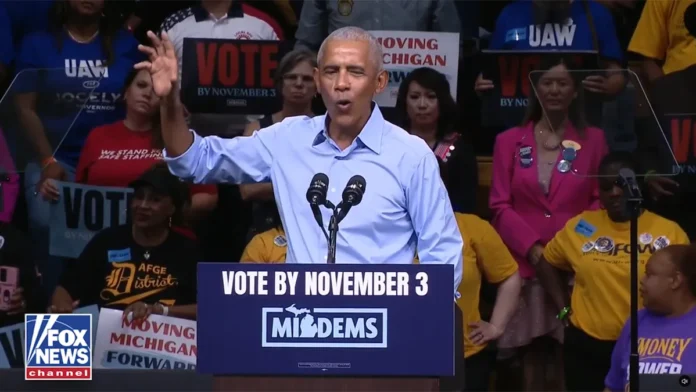
Cleveland, Ohio, October 25, 2026: Former US President Barack Obama has mocked President Donald Trump’s renovation projects at the White House, comparing the redesigned residence to a place where former Iraqi leader Saddam Hussein had opened a Cheesecake Factory. Obama made the remarks during a campaign rally in Ohio as he urged voters to support Democratic candidates ahead of the November 3 midterm elections.
Obama targeted Trump’s plans for a new White House ballroom, changes to the Rose Garden, a helicopter landing area on the South Lawn and the extensive use of gold decoration. His remarks drew laughter and applause from the crowd in Cleveland, where he was campaigning for Democratic gubernatorial candidate Amy Acton and Senate candidate Sherrod Brown.
The former president used the rally to broaden his criticism beyond the White House’s appearance, questioning Trump’s priorities at a time when many Americans are concerned about living costs and economic pressures.
‘He Should Be on HGTV’: Obama Takes Aim at White House Renovations
Obama began his criticism by suggesting that Trump appeared unusually focused on renovating and decorating the presidential residence.
“He seems very focused on home renovations. He should be on HGTV,” Obama told the audience, referring to the television network known for home-improvement programmes.
He then listed the changes that have become part of the debate over Trump’s second-term White House projects. These include construction of a large ballroom, paving work in the Rose Garden and the creation of a helicopter landing area on the South Lawn.
Obama also singled out the gold-coloured decorative elements associated with Trump’s design preferences.
“There’s gold everywhere. What’s up with the gold?” he asked before delivering the comparison with Saddam Hussein and the American restaurant chain Cheesecake Factory.
The remark was one of the sharpest lines in Obama’s speech and reflected the increasingly personal tone of the midterm campaign. His broader argument was that the president appeared more interested in the appearance of the White House than in addressing household costs and other concerns affecting voters.
The White House renovation projects have attracted attention because they alter parts of one of the most recognisable buildings in the United States. Supporters of the work have pointed to practical uses for some improvements, including permanent facilities for official events and upgraded helicopter access. Obama, however, used the projects to question the administration’s priorities.
Ohio Campaign Focuses on Vivek Ramaswamy and Amy Acton
The rally was also an opportunity for Obama to support Democrats in two closely watched Ohio races.
Republican Vivek Ramaswamy is running for governor against Democrat Amy Acton. Obama criticised Ramaswamy over an advertising campaign that featured Acton’s estranged mother.
Acton has publicly discussed difficult experiences during her childhood, including abuse, neglect and homelessness. She accused her opponent of using painful personal history for political advantage. Ramaswamy defended the advertisement as part of the political contest.
President Trump and Vice President JD Vance also defended the advertisement, while several prominent Ohio Republicans, including Governor Mike DeWine, called for it to be withdrawn.
Obama argued that political campaigns should maintain standards of decency, particularly when candidates discuss an opponent’s family or personal experiences.
“There’s no line he will not cross, no low he will not sink to,” Obama said of Ramaswamy, criticising the decision to use the material in the campaign.
The dispute has become part of a wider argument about the tone of the Ohio governor’s race. Acton and her supporters say the advertisement crosses a line by exploiting private family trauma, while Ramaswamy has defended his campaign’s approach.
Obama’s appearance gave Acton a high-profile platform as she competes for the governorship. He also backed Sherrod Brown, the former three-term US senator seeking to return to the Senate in a contest against Republican Jon Husted.
Obama Defends Abdul El-Sayed in Michigan
After campaigning in Ohio, Obama travelled to Detroit, Michigan, to support Democratic Senate candidate Abdul El-Sayed.
El-Sayed, a former public health official, has faced criticism over his progressive political views, name and Muslim faith. Obama said such attacks echoed tactics he had encountered during his own political career, including false claims about his birthplace.
Addressing a packed high-school auditorium in Detroit, Obama referred to the controversy surrounding his own background and joked about the long-running demands that he produce proof of his citizenship.
He also defended El-Sayed’s connection to Michigan, saying the candidate was firmly rooted in the state.
The remarks highlighted the role of identity and religion in the campaign, while Obama urged voters to focus on the candidates’ records and public positions rather than attempts to question their belonging.
El-Sayed is running against Republican Mike Rogers in a contest that could contribute to the wider battle for control of the US Senate.
Obama Urges Ohio Voters to Back Democrats
Following his Ohio rally, Obama used the social media platform X to urge voters to support Acton for governor and Brown for the US Senate.
He argued that Democratic candidates had devoted their careers to serving Ohio residents and encouraged supporters to organise locally, make voting plans and turn out in large numbers.
Obama’s involvement reflects the Democratic Party’s effort to mobilise voters in competitive states during the final stretch of the midterm campaign. The November 3 elections will determine control of Congress and shape the political environment for the remainder of Trump’s presidency.
While Obama’s remarks focused heavily on Trump’s conduct and priorities, he also called on Democrats to present concrete policy proposals. He argued that the party needed to explain how it would address living costs, healthcare affordability, housing and household utility bills rather than relying solely on opposition to the administration.
Obama Criticises Defence Secretary Pete Hegseth
Obama also took aim at Defence Secretary Pete Hegseth, using his remarks to question the administration’s handling of the conflict involving Iran.
He claimed that American service members had been wounded, that US missile stockpiles had declined and that Iran had gained leverage over the Strait of Hormuz. These were assertions made during a political speech and should be assessed against independently verified military and strategic reporting.
Obama contrasted those concerns with what he portrayed as Hegseth’s emphasis on the physical appearance and testosterone levels of US service members.
His comments added a national-security dimension to a campaign speech that otherwise centred on the economy, political conduct and the White House renovation projects.
The Strait of Hormuz is a critical maritime passage for global energy shipments. Any disruption or change in the balance of control around the waterway can affect oil markets, shipping costs and international security. Obama’s remarks therefore connected the midterm campaign to the broader debate over the consequences of the Iran conflict.
Why Obama’s Campaign Appearance Matters
Obama remains a prominent figure in Democratic politics and has been campaigning to help the party compete in states where congressional and gubernatorial races are closely contested.
His appearances in Ohio and Michigan combine personal criticism of Trump with support for individual Democratic candidates. The approach is intended to energise Democratic voters, encourage turnout and make the midterms a referendum on the current administration’s policies and conduct.
Trump and his Republican allies have also campaigned actively in the Midwest. The dispute over Acton’s family, the competing claims about economic performance and the debate over the White House renovation projects illustrate how personal attacks and policy arguments have become intertwined in the final days before voting.
The outcome of the elections will depend on voters’ assessments of candidates, local issues, the economy and the national political climate. Obama’s remarks are one part of that wider contest, not a measure of how voters will ultimately decide.
The Bottom Line
Barack Obama used his Ohio campaign appearance to mock Donald Trump’s White House renovations, delivering a pointed comparison involving Saddam Hussein and Cheesecake Factory. He also criticised Vivek Ramaswamy over a controversial campaign advertisement, defended Abdul El-Sayed in Michigan and challenged Defence Secretary Pete Hegseth over the administration’s handling of the Iran conflict.
The speeches show how the November 3 midterm campaign has become a broader argument over political conduct, economic priorities and national security. Obama is seeking to turn dissatisfaction with Trump and his allies into support for Democratic candidates, while the election will ultimately be decided by voters across the country.