NEW DELHI, India | September 26, 2026 —
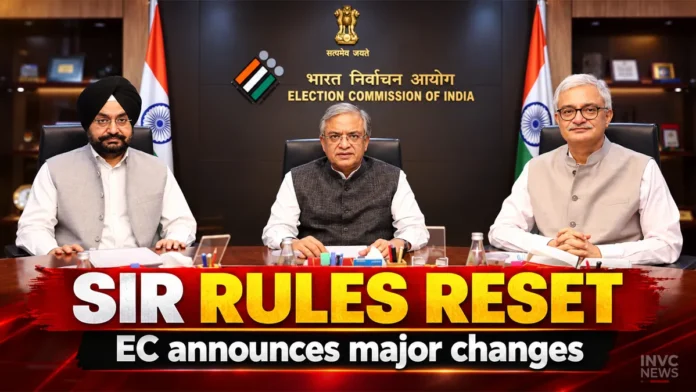
The Election Commission of India has announced a major operational reset of the Special Intensive Revision process, making home-based document collection the norm for certain notice cases, reducing the need for physical hearings and ordering a fresh review of the ECINet platform.
Under the new framework, Booth Level Officers will visit voters who received notices for being unmapped or for logical discrepancies, collect their documents at home and upload them to ECINet for a decision by the Electoral Registration Officer.
The Commission has also directed that such voters should not ordinarily be called to ERO or AERO offices. If a hearing becomes necessary in an exceptional case, it should preferably be conducted online.
At the same time, the poll body has extended key SIR deadlines in Delhi and Maharashtra, ordered special assistance for vulnerable voters and reiterated that major SIR orders were approved unanimously by the full three-member Commission.
THE 60-SECOND BRIEF
Home verification: BLOs will visit voters facing unmapped or logical-discrepancy notices and collect documents at their homes.
No routine office hearings: Such voters will generally not need to appear before ERO or AERO offices.
Online hearings: Exceptional hearings should preferably be conducted online.
Family representation: An adult family member can be authorized to attend a hearing on behalf of the elector if required.
Special support: Help desks and camps will be organized for people living in night shelters, workers, poor households and homeless persons.
ECINet review: A committee led by a Senior Deputy Election Commissioner and including an independent IIT or IIIT expert will review the system.
Delhi deadline: Claims and objections extended to October 30, 2026.
Maharashtra deadline: Claims and objections extended to October 12, 2026.
Institutional position: The Commission says major SIR orders were unanimously approved.
Home Visits Replace Office Runs for Many Voters
The biggest change directly affects voters who have received SIR notices because their records are unmapped or contain logical discrepancies.
Instead of asking these voters to repeatedly visit election offices, BLOs will now go to their homes.
They will collect the required documents and upload them to ECINet.
The ERO will then take a decision on the basis of the material submitted.
For voters, this is one of the most practical changes announced in the latest review.
It could significantly reduce travel, waiting time and confusion, especially for people who may find it difficult to visit government offices.
Physical Hearings Will No Longer Be Routine
The Election Commission has also changed the hearing process.
Voters covered by these notice categories should not ordinarily be called to ERO or AERO offices.
If the ERO decides that a hearing is necessary in an exceptional case, the hearing should preferably take place online.
The Commission has also allowed an elector to authorize an adult family member to attend the hearing on their behalf when required.
Facilities for online hearings are to be strengthened.
This marks a clear shift toward a less burdensome verification process.
Special Camps for Homeless People, Workers and Vulnerable Groups
The Commission has instructed District Election Officers to create adequate help desks and hold special camps for people who may struggle with the normal registration process.
The groups specifically mentioned include:
People living in night shelters
Workers and laborers
Poor households
Homeless persons
The objective is to make voter registration and verification more accessible to people who may lack stable housing, easy internet access or the ability to visit election offices during working hours.
Form 6 Declaration Gets Fresh Emphasis
The Election Commission has also reiterated that the declaration attached to Form 6 for the SIR process has been upheld by the Supreme Court.
Form 6 is used by eligible citizens seeking inclusion in the electoral roll.
The Commission has clarified that during non-SIR periods, the forms prescribed under the Registration of Electors Rules, 1960, will continue to apply.
The clarification matters because Form 6 has become one of the most closely discussed procedural elements of the voter-roll revision process.
ECINet Comes Under Fresh Review
The Election Commission has ordered a formal review of ECINet.
A committee headed by a Senior Deputy Election Commissioner will examine whether the system fully complies with the relevant laws and rules.
The committee will also include an independent expert from an IIT or IIIT.
The Commission said field officers already have role-based access to ECINet according to their statutory powers.
However, if the review finds that additional flexibility is required, further changes can be made operational.
New Election-Tech Projects Will Face Another Layer of Scrutiny
The Commission has also tightened the approval process for future technology initiatives.
All new IT modules and portal-related projects will first be discussed by a Committee of Officers before being placed before the Commission for approval.
This introduces another institutional checkpoint before major digital changes are rolled out.
Given the growing role of technology in voter registration and electoral-roll management, this part of the decision could have long-term significance.
Delhi Gets a Longer Window
The Commission has extended the claims and objections period in Delhi following a request from the Chief Electoral Officer.
The new deadline for filing claims and objections is:
October 30, 2026
The deadline for disposal of notices, claims and objections is now:
November 30, 2026
The extension gives voters more time to correct records, contest entries or seek inclusion where necessary.
Maharashtra Deadlines Also Extended
Maharashtra has received an extension as well.
The new deadline for filing claims and objections is:
October 12, 2026
The deadline for disposal of notices, claims and objections is:
November 10, 2026
The Election Commission said the changes were approved following a request from the Chief Electoral Officer of Maharashtra.
Special Enrollment Drive for People Left Out
The Commission said SIR has already been completed in 20 states and Union Territories, including Bihar and West Bengal.
It also clarified that anyone whose name was left out during SIR can still apply for inclusion through the continuous updation process.
The same applies to young and first-time voters.
Chief Electoral Officers, District Election Officers and Electoral Registration Officers have been directed to immediately launch a special enrollment drive for such electors.
That means exclusion during an SIR exercise does not automatically end a voter’s opportunity to seek inclusion.
Commission Meetings Will Get Formal Agendas and Minutes
One of the less visible but potentially important decisions concerns the Election Commission’s own internal procedures.
The Commission said agendas for all its meetings will now be circulated in advance.
Minutes will also be issued.
The move creates a more formal record of what was discussed and what decisions were taken.
It could also make internal decision-making easier to track over time.
Commissioners’ Directions Must Be Followed
The Commission also said all directions issued by Election Commissioners to officers must be meticulously complied with.
Annual Performance Appraisal Reports for officers must be completed within the prescribed timeline, with December 31 set as the annual deadline.
Foreign trips by officers will also require approval from the Commission.
These measures are aimed at internal administrative discipline rather than the voter-facing side of SIR.
ECI Says Major SIR Orders Were Unanimous
The Election Commission also addressed questions surrounding internal differences.
It reiterated that the SIR order issued on June 24, 2025 for states and Union Territories, beginning with Bihar, received unanimous approval from the Commission.
It said later SIR schedules for 12 states and Union Territories, and subsequently for 19 states and Union Territories, were also approved unanimously.
The Commission further said the final number of electors will only be known after final publication in the remaining Phase III states.
Full Commission Approved the September 26 Decisions
Saturday’s meeting was attended by Chief Election Commissioner Gyanesh Kumar and Election Commissioners S.S. Sandhu and Vivek Joshi.
The Election Commission said the September 26 Press Note reflected decisions taken at the meeting and had the approval of the full Commission.
That point is central to the poll body’s response to recent questions over internal disagreement.
Why These Changes Matter to Ordinary Voters
For most voters, the significance of the announcement is not institutional language.
It is what happens when a notice arrives.
Under the revised process:
A BLO can come to the voter’s home.
Documents can be collected there.
A voter will not normally have to appear at an election office.
If a hearing is unavoidable, it should preferably happen online.
An adult family member may represent the elector when permitted.
Vulnerable voters should have access to dedicated help desks and camps.
Those are concrete procedural changes that directly affect how voters experience SIR.
THE BIGGER PICTURE
The Election Commission’s latest intervention does two things at the same time.
First, it changes the operational side of SIR.
Second, it responds to questions about how the Commission itself has taken decisions.
The voter-facing changes focus on convenience, accessibility and digital review.
The institutional changes focus on meeting procedures, IT scrutiny and compliance with directions issued by commissioners.
Together, they amount to a broader recalibration of how SIR is administered.
WHAT HAPPENS NEXT
The real test now moves from Nirvachan Sadan to the ground.
BLOs will have to carry out home visits consistently.
District officials will need to create help desks and special camps.
Online-hearing facilities will have to work reliably.
The ECINet review committee will have to examine whether the platform fully complies with the law and identify any changes that may still be required.
Delhi and Maharashtra will operate under their extended timelines.
Special enrollment drives will also begin for eligible voters who remain outside the rolls.
The effectiveness of the September 26 decisions will ultimately depend on implementation.
INVC NEWS Bottom Line
The Election Commission has not merely issued another clarification on SIR.
It has changed how significant parts of the process will work.
Documents can now be collected at home.
Routine physical hearings are being reduced.
Online hearings will be preferred in exceptional cases.
Vulnerable voters are getting dedicated assistance.
ECINet is going under a fresh compliance review.
Delhi and Maharashtra have received additional time.
And amid questions over internal differences, the Commission has reiterated that its major SIR orders carried unanimous approval.
The policy reset is now on paper.
The next test is whether voters experience the same change on the ground.
What happened. Why it matters. What comes next.