UNITED NATIONS, United States | September 26, 2026 —
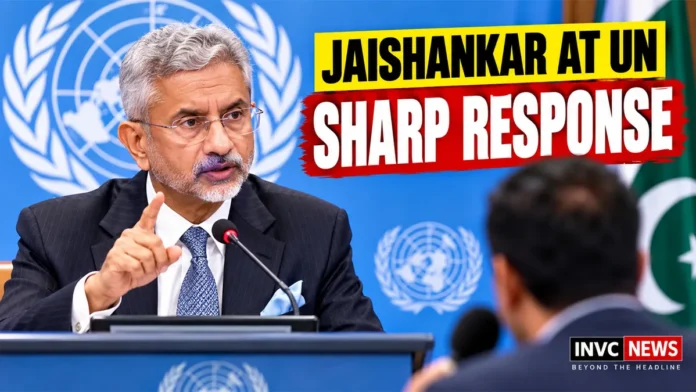
India’s External Affairs Minister S. Jaishankar delivered a sharp response to a Pakistani journalist at the United Nations after being asked when India would stop allegedly sponsoring terrorism in Pakistan.
The exchange took place at UN headquarters in New York after Jaishankar and Liberian Foreign Minister Sara Beysolow Nyanti addressed reporters on the launch of a new international group focused on the safety and security of shipping and seafarers.
When the journalist raised the allegation, Jaishankar rejected the premise and responded: “A terrorist country is asking me that question. Come on.”
India’s Permanent Representative to the United Nations, Harish Parvathaneni, then said the response had been heard “loud and clear.”
THE 60-SECOND BRIEF
What happened: A Pakistani journalist questioned S. Jaishankar at the UN over alleged Indian involvement in terrorism in Pakistan.
Jaishankar’s response: He rejected the allegation and described Pakistan as a “terrorist country.”
Where: United Nations headquarters in New York.
Why Jaishankar was speaking: India and Liberia were announcing a new international group focused on maritime and seafarer security.
Wider context: India and Pakistan continue to accuse each other over terrorism and cross-border security issues.
The Exchange at the United Nations
The confrontation unfolded after the formal media remarks had concluded.
Jaishankar and Liberian Foreign Minister Sara Beysolow Nyanti had been speaking about the newly launched Group of Friends on Safety and Security of Shipping and Seafarers.
A Pakistani journalist then asked Jaishankar when the Indian government would stop sponsoring terrorism in Pakistan.
Jaishankar immediately pushed back against the allegation.
His brief response quickly became one of the most widely discussed moments from the UN exchange.
Why India and Liberia Were Addressing the Media
The original focus of the event was maritime security.
India and Liberia launched a new international grouping aimed at drawing attention to growing threats faced by commercial ships and seafarers.
Jaishankar said attacks on commercial shipping had become a serious concern across important maritime routes.
These include the Gulf, the Red Sea and nearby waterways.
India has a direct interest in the issue because large numbers of Indian nationals work as seafarers on commercial vessels around the world.
Maritime Security Has Become a Major Concern
Recent attacks on commercial vessels have increased pressure on governments to strengthen protection for shipping crews.
The risks are particularly serious in strategically important waterways such as the Strait of Hormuz, the Gulf of Oman, the Gulf of Aden and the Red Sea.
India has repeatedly highlighted the safety of its seafarers operating in conflict-affected regions.
The issue has gained even greater importance amid continuing tensions across West Asia.
Exchange Comes Amid India-Pakistan Tensions
The Jaishankar exchange also reflects the wider political and diplomatic tensions between India and Pakistan.
India has repeatedly accused Pakistan-based groups of carrying out terrorist attacks against Indian targets.
Pakistan denies sponsoring terrorism and has, in turn, accused India of interference and hostile activity inside Pakistan.
Those competing claims remain a major source of tension between the two countries.
Shehbaz Sharif Faced Questions a Day Earlier
The episode came shortly after Pakistani Prime Minister Shehbaz Sharif was also questioned by an Indian journalist at the United Nations.
The journalist asked Sharif when Pakistan would stop harboring terrorists.
Sharif did not respond.
The back-to-back exchanges show how terrorism continues to dominate India-Pakistan interactions even during broader multilateral events.
Why Jaishankar’s Response Drew Attention
Jaishankar is known for direct diplomatic messaging, particularly on national security and foreign policy.
His latest remark attracted attention because it condensed India’s long-standing position on Pakistan and terrorism into a brief public response.
The exchange also took place in a highly visible international setting.
That gave the moment greater diplomatic and political significance.
India’s Position on Terrorism
The Indian government has consistently argued that terrorism must be addressed without political justification or selective standards.
New Delhi has repeatedly called for stronger international action against terrorist organizations, financing networks and safe havens.
India has also maintained that cross-border terrorism remains one of the biggest obstacles to normalized relations with Pakistan.
Pakistan disputes India’s characterization and rejects accusations that it sponsors terrorism.
Pakistan’s Position
Pakistan has accused India of supporting destabilizing activities inside its territory.
Indian authorities reject those allegations.
These competing narratives frequently surface at international forums, including the United Nations.
As a result, discussions involving terrorism often become highly contentious.
THE BIGGER PICTURE
The confrontation was brief, but it reflected a much deeper diplomatic dispute.
India and Pakistan continue to disagree sharply over terrorism, Kashmir, regional security and bilateral relations.
At the same time, both countries use international platforms to present their positions to a global audience.
The latest exchange shows how quickly an event focused on maritime security can become part of the wider India-Pakistan political contest.
WHAT HAPPENS NEXT
Jaishankar’s broader engagements at the United Nations are expected to continue focusing on India’s foreign-policy priorities, including maritime security, regional stability and international cooperation.
India and Pakistan are also expected to continue presenting sharply different positions on terrorism and regional security.
For now, one short exchange has become one of the most discussed moments from the latest round of UN diplomacy.
INVC NEWS Bottom Line
S. Jaishankar was asked by a Pakistani journalist when India would stop allegedly sponsoring terrorism in Pakistan.
He rejected the premise of the question and responded by calling Pakistan a “terrorist country.”
The exchange took place during a UN event centered on maritime safety, but it quickly shifted attention back to one of the most persistent disputes in India-Pakistan relations:
terrorism and national security.
What happened. Why it matters. What comes next.