WASHINGTON, United States | September 26, 2026 —
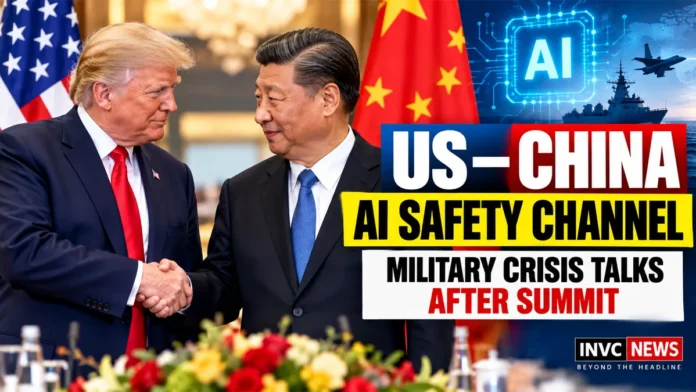
The United States and China have agreed to establish a new bilateral communication channel for artificial intelligence-related incidents and accelerate work on military crisis communications following a three-day summit between US President Donald Trump and Chinese President Xi Jinping.
The agreements mark one of the clearest attempts by Washington and Beijing to build guardrails around two areas where rivalry carries potentially serious global consequences: advanced artificial intelligence and military confrontation.
Both governments said the new mechanisms are intended to improve communication, reduce the risk of miscalculation and create direct channels for handling emergencies.
The summit also produced commitments to continue discussions on trade, strategic stability and other areas of bilateral concern.
THE 60-SECOND BRIEF
What happened: The US and China agreed to establish a communication channel for AI-related incidents.
Military talks: Both sides will strengthen crisis communications between their armed forces.
Who agreed: US President Donald Trump and Chinese President Xi Jinping.
Where: Washington, during Xi’s state visit and summit with Trump.
Why it matters: The mechanisms are designed to reduce the risk of accidental escalation involving AI or military forces.
What comes next: Officials are expected to continue discussions on implementation, trade and strategic stability.
New AI Communication Channel
One of the summit’s most significant technology outcomes was an agreement to establish a direct communication mechanism for serious AI-related incidents.
The channel is designed to allow US and Chinese officials to exchange information if advanced AI systems create significant national-security or cross-border risks.
The idea had been discussed before the summit but had not previously resulted in a formal mechanism.
US officials had pushed for a system that would improve transparency and provide a way for the two governments to communicate quickly during potentially dangerous AI incidents.
Why AI Safety Is Becoming a Diplomatic Issue
The United States and China are the two biggest competitors in the global race for advanced artificial intelligence.
Both countries are investing heavily in AI models, data centers, semiconductors and autonomous systems.
However, that competition also creates shared risks.
Advanced AI could potentially be used in cyberattacks, military systems, biological research, critical infrastructure and automated decision-making.
Governments therefore face the challenge of competing technologically while also trying to prevent an accident or misunderstanding from escalating into a broader crisis.
US and China Remain AI Rivals
The creation of a safety channel does not end the intense competition between Washington and Beijing.
The United States continues to restrict China’s access to some advanced semiconductor technologies.
China, meanwhile, is investing heavily in domestic chip manufacturing and developing its own advanced AI models.
Both countries view AI as strategically important for economic growth, national security and future military capabilities.
The new communication mechanism therefore represents cooperation in a narrow area rather than a broader technology partnership.
Military Crisis Communications Also Move Forward
The summit also produced agreement to improve military crisis communications.
That issue has become increasingly important because US and Chinese military forces regularly operate in the western Pacific.
Tensions involving Taiwan, the South China Sea and military aircraft or ships create repeated opportunities for dangerous encounters.
Direct military communication channels can allow commanders and officials to clarify intentions before an incident escalates.
Both governments have previously suspended or reduced military contacts during periods of political tension.
The latest agreement is intended to make those channels more reliable.
Why Military Hotlines Matter
A military hotline does not eliminate political disagreements.
Its purpose is more limited.
If aircraft, ships or military units become involved in a serious incident, direct communication can help both sides understand what happened.
That can reduce the risk that one government interprets an accident as a deliberate attack.
Similar mechanisms existed during the Cold War between the United States and the Soviet Union.
The US-China version reflects growing concern that modern military competition needs stronger crisis-management systems.
Trump and Xi Discuss Strategic Stability
The White House said the two countries agreed to pursue a relationship based on strategic stability, reciprocity and continued communication.
Trump and Xi also discussed several major international issues during the summit.
These included Iran, Russia, North Korea, international waterways and arms control.
The two leaders did not resolve many of the deeper disputes between their governments.
However, the agreements on communication suggest both sides want to reduce the risk that competition turns into uncontrolled confrontation.
Trade Talks Will Continue
Trade also remained a major part of the summit.
The United States and China agreed to continue discussions on reducing some tariffs and addressing selected bilateral trade issues.
Officials have been working through a new trade mechanism intended to manage disputes and identify areas where restrictions could be reduced.
However, major disagreements remain over technology controls, industrial policy, market access and strategic supply chains.
The summit therefore produced continued dialogue rather than a comprehensive trade settlement.
AI Cooperation Comes With Deep Distrust
The new AI channel will operate in an environment of significant mutual suspicion.
Washington worries that advanced Chinese AI could strengthen Beijing’s military and intelligence capabilities.
Beijing argues that US technology restrictions are designed to limit China’s development.
Both countries also fear that advanced AI systems controlled by the other side could create security risks.
That makes communication difficult but potentially more important.
Could AI Trigger an International Crisis?
As AI systems become more capable, governments increasingly worry about situations where software could contribute to geopolitical escalation.
A cyberattack generated or assisted by AI could be misidentified as direct government action.
Automated systems could also make mistakes when interacting with critical infrastructure or military networks.
Another concern involves misinformation or synthetic media generated during a political or military crisis.
A direct US-China communication channel could provide a way to clarify whether a serious AI-related incident was intentional, accidental or caused by a third party.
Military Competition Remains Intense
The agreement on crisis communications should not be interpreted as an end to military competition.
The United States continues to maintain a large military presence across the Indo-Pacific.
China continues to modernize its armed forces rapidly.
Taiwan remains one of the most sensitive issues in the bilateral relationship.
The South China Sea also remains a major source of disagreement.
The new communication framework is therefore primarily designed to manage risk rather than remove the underlying disputes.
THE BIGGER PICTURE
The Trump-Xi summit produced a notable shift in how the two countries are trying to manage technological and military competition.
For years, most US-China discussions focused on trade, tariffs and traditional security disputes.
Artificial intelligence has now become important enough to require its own diplomatic communication mechanism.
That reflects how quickly the technology has moved from a commercial issue to a national-security concern.
At the same time, the renewed focus on military crisis communications suggests Washington and Beijing recognize the danger of miscalculation.
Both countries remain strategic competitors.
The new agreements are designed to make that competition more manageable.
WHAT HAPPENS NEXT
Officials from both countries will now have to turn the summit commitments into functioning systems.
The AI communication channel will require rules on what types of incidents should be reported and which agencies will communicate with each other.
Military officials will also need to determine how crisis contacts operate during emergencies.
Further US-China discussions are expected in the coming months.
The effectiveness of the agreements will depend on whether both governments continue using the channels during periods of political tension.
INVC NEWS Bottom Line
The US and China remain locked in intense competition over technology, trade and military power.
But after the Trump-Xi summit, both sides have agreed on something increasingly important:
They need reliable ways to communicate when things go wrong.
A new AI incident channel and stronger military crisis communications will not resolve the underlying rivalry.
They are designed to prevent that rivalry from becoming a crisis neither side intended.
What happened. Why it matters. What comes next.