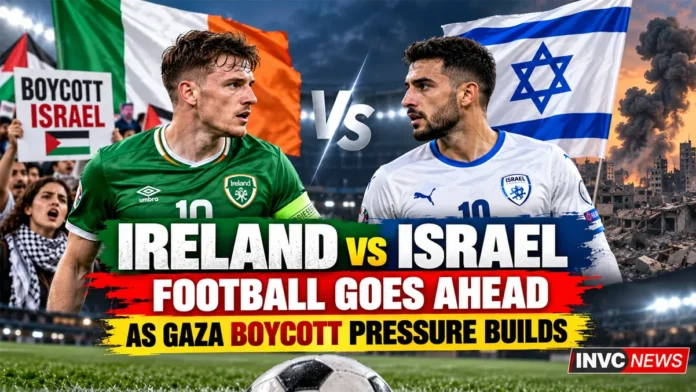
DUBLIN, Ireland | September 25, 2026 —
Ireland will go ahead with two UEFA Nations League matches against Israel despite a growing boycott campaign involving athletes, supporters, trade unions and political figures who argue that the games should not proceed because of Israel’s conduct in Gaza.
The Republic of Ireland are scheduled to face Israel on September 27 in Debrecen, Hungary, before playing the return fixture on October 4 in Bačka Topola, Serbia.
Neither match will take place in Ireland or Israel.
Irish supporters will not be given tickets for either fixture, while the October 4 game — officially Ireland’s home match — will be played behind closed doors.
The unusual arrangements underline just how far an ordinary Nations League double-header has moved beyond football.
The question surrounding the fixtures is no longer simply who wins.
It is whether a national football team should continue playing an opponent when a significant section of its own sporting and political community believes doing so normalises conduct they consider unacceptable.
THE 60-SECOND BRIEF
Ireland will fulfil both Nations League fixtures against Israel.
More than 160 Irish sportspeople have signed an open letter urging the national team to boycott the matches.
The Football Association of Ireland says refusing to play could cause significant and lasting damage to Irish football.
Ireland’s players have agreed to fulfil the fixtures.
The FAI has moved Ireland’s designated home game to Serbia, where it will be played behind closed doors.
No tickets will be sold to Irish supporters for either match.
Irish broadcaster RTÉ will show the games because of contractual obligations but has stripped back its coverage, removing studio presentation, punditry and advertising around the fixtures.
The controversy has intensified after Ireland manager Heimir Hallgrimsson said his side was “playing against genocide,” prompting a furious response from the Israel Football Association.
Two Football Matches, Almost No Sense of Normality
On paper, these are standard UEFA Nations League fixtures.
In reality, almost nothing about them is normal.
Israel’s designated home game against Ireland will take place at the Nagyerdei Stadion in Debrecen, Hungary, on September 27.
Ireland’s home fixture on October 4 will not be staged at Dublin’s Aviva Stadium.
Instead, it has been moved to the TSC Arena in Bačka Topola, Serbia.
That match will be played without spectators.
Irish fans will also be absent from the September fixture in Hungary, although a limited number of Israeli supporters are expected to be admitted.
The result is an international football tie largely separated from the supporters who would normally define it.
More Than 160 Irish Sportspeople Demand a Boycott
Pressure on the Irish team has intensified in the days before the first match.
More than 160 Irish sportspeople signed an open letter calling on the players to refuse to take part.
The campaign was organised by Irish Sport for Palestine.
Its supporters argue that playing Israel allows international sport to continue as normal despite the enormous civilian toll and destruction in Gaza.
The campaign has attracted support from current and former athletes across several sports.
Trade unions and parts of Ireland’s football community have also backed calls for a boycott.
The issue has therefore moved well beyond a small group of protesters.
It has become a national argument over where sport should draw the line between competition and political responsibility.
Why Is Ireland Playing?
The Football Association of Ireland has taken a different position.
The FAI has repeatedly warned that refusing to fulfil UEFA fixtures could expose Irish football to serious consequences.
Those could include sporting penalties, financial sanctions and wider consequences for Ireland’s position within European football.
The association has argued that a unilateral boycott could cause “significant and lasting harm” to the game in Ireland.
That concern helped shape a crucial vote earlier this year.
At an extraordinary FAI meeting in July, delegates voted 68% to 32% to endorse the board’s decision to proceed with the Israel fixtures.
The decision did not end the controversy.
It merely established what the association intended to do.
Ireland’s Players Will Take the Field
The players have now indicated that they will fulfil the fixtures.
Ireland captain Dara O’Shea said the squad would play and represent the country.
That does not mean the players are indifferent to the controversy.
The team has faced questions over whether it could make a separate gesture or protest surrounding the matches.
Any such action would carry symbolism of its own.
But as things stand, the team will take the field.
That distinction matters.
The players are not deciding whether Israel should remain a member of UEFA.
They are being asked to compete in fixtures placed in front of them by the governing structure of European football.
Ireland Manager’s Words Ignite a New Row
The dispute became even sharper after Ireland manager Heimir Hallgrimsson addressed the moral controversy surrounding the games.
Hallgrimsson said Ireland was “playing against genocide.”
The Israel Football Association responded angrily, accusing him of ignorance, hypocrisy and stupidity.
The exchange pushed an already contentious football fixture deeper into diplomatic territory.
Irish Taoiseach Micheál Martin subsequently described the Israeli football authority’s response as unacceptable.
Martin has strongly criticised Israeli policy in Gaza while also arguing that Ireland should avoid actions in football that could become self-defeating.
That illustrates the tension at the centre of the debate.
Ireland’s government has been among Europe’s strongest critics of Israel’s conduct in Gaza.
But criticism of Israeli policy has not automatically translated into support for withdrawing Ireland from UEFA fixtures.
The Word ‘Genocide’ Requires Important Context
The term at the centre of the controversy carries significant legal and political weight.
An independent United Nations Commission of Inquiry concluded in 2025 that Israel had committed genocide against Palestinians in Gaza.
Israeli authorities rejected that finding and have consistently denied genocide allegations, arguing that Israel’s military campaign targets Hamas and other armed groups rather than Palestinian civilians.
The wider legal and political dispute remains highly contested.
That is why describing the Gaza war simply through one side’s terminology can obscure the larger argument.
For boycott supporters in Ireland, however, the UN commission’s findings strengthened their case that normal sporting relations with Israel should end.
For Israel and its supporters, attempts to exclude the national team amount to politicising sport and unfairly targeting Israeli athletes.
Gaza Has Changed the Meaning of the Fixture
The political pressure cannot be separated from the scale of destruction in Gaza.
Tens of thousands of Palestinians have been killed during the conflict, according to Gaza health authorities.
Israel says its military campaign followed the Hamas-led attacks of October 7, 2023, in which about 1,200 people were killed in Israel and 251 were taken hostage.
Israel maintains that it has a right to defend itself and dismantle Hamas.
Critics argue that the scale of Palestinian civilian deaths, destruction and displacement has gone far beyond legitimate self-defence.
Those arguments now follow Israel into cultural and sporting events around the world.
Ireland’s two football fixtures have become one of the clearest examples.
RTÉ Will Broadcast the Matches — But Barely
Ireland’s national broadcaster will show the games, but its coverage will look very different from a normal international fixture.
RTÉ says it has contractual obligations to broadcast the matches.
However, there will be no studio presentation and no studio punditry.
Commentary will come from the international feed rather than an RTÉ commentary team.
The broadcaster will deploy only a minimal technical operation.
It has also chosen not to take advertising or sponsorship around the fixtures.
That is an extraordinary arrangement for matches involving Ireland’s national team.
It reflects the broadcaster’s attempt to meet contractual obligations without treating the fixtures as ordinary sporting events.
Even the Fans Have Been Removed From the Equation
The FAI has decided not to facilitate stadium access for Irish supporters for either game.
That changes the atmosphere dramatically.
International football normally depends on travelling supporters, national colours, songs and a visible sense of national identity.
Instead, one of the most politically charged international fixtures of the year will unfold with Ireland supporters absent.
The October match will have no crowd at all.
Football will still be played.
But much of what ordinarily makes international football feel like international football will be missing.
WHAT EACH SIDE SAYS
Boycott campaigners argue that refusing to play would send a powerful message of solidarity with Palestinians and would challenge what they regard as the normalisation of Israeli institutions during the Gaza conflict.
The FAI says it understands those concerns but believes a unilateral refusal to fulfil the fixtures could seriously damage Irish football.
Ireland’s government has strongly criticised Israeli policy while warning against sporting actions that could hurt Ireland itself.
The Israel Football Association rejects the political accusations surrounding its national team and has sharply criticised statements linking Israeli football with genocide.
UEFA continues to permit Israel to participate in its competitions and has not separated Ireland and Israel from playing each other.
That leaves the Irish team caught between competing obligations.
Why Russia Is Frequently Mentioned
Critics of UEFA regularly point to Russia.
European and world football authorities suspended Russian national teams and clubs following Russia’s full-scale invasion of Ukraine in 2022.
Campaigners ask why comparable action has not been taken against Israel.
UEFA’s position has been that decisions involving competition participation and draw restrictions are governed by different sporting, security and disciplinary considerations.
The comparison remains politically powerful but legally and institutionally contested.
For boycott supporters, it demonstrates inconsistency.
For UEFA, the circumstances are not treated as automatically equivalent.
THE BIGGER PICTURE
The Ireland-Israel dispute reflects a much wider question confronting international sport.
Can major sporting bodies realistically keep politics outside the stadium when national teams represent states?
The traditional answer has been that sport should remain separate from political disputes.
In practice, that separation has never been absolute.
Countries have been suspended.
Athletes have boycotted events.
Governments have pressured sporting organisations.
Fans have used stadiums to express political positions.
International sport has always operated alongside diplomacy, conflict and national identity.
Gaza has pushed that uncomfortable relationship back into the foreground.
Why Ireland Has Become Such a Flashpoint
Ireland occupies a distinctive position in the European debate over Palestine.
Public sympathy for Palestinians is strong, and Irish governments have frequently taken positions sharply critical of Israeli policy.
Diplomatic relations between Ireland and Israel have also deteriorated substantially.
Israel closed its embassy in Dublin in December 2024, citing what it described as extreme anti-Israel policies.
Against that background, asking Ireland’s national football team to play Israel was always likely to produce more than a sporting debate.
The fixture has become a proxy for a much larger disagreement.
WHAT HAPPENS NEXT
The first match takes place on Sunday, September 27 in Debrecen.
Attention will focus not only on the score but also on what Ireland’s players do before kickoff.
Any symbolic protest could become the defining image of the fixture.
The second match follows on October 4 in Serbia, behind closed doors.
Meanwhile, pressure on UEFA is unlikely to disappear.
Campaign groups will continue demanding Israel’s suspension, while Israeli football authorities will continue resisting attempts to link their national team to the actions of the Israeli government.
The argument could therefore last far longer than the two matches themselves.
INVC NEWS BOTTOM LINE
Ireland and Israel will play.
But describing these as ordinary football matches would miss the story.
The stadiums have changed.
Irish supporters have been kept away.
One match will be played behind closed doors.
More than 160 Irish sportspeople have demanded a boycott.
The national broadcaster has stripped its coverage to the minimum required by contract.
And the Irish manager’s comments have triggered a public clash with Israel’s football authorities.
The ball may still roll for 90 minutes.
But almost everything surrounding it has become political.
The central question is no longer whether Ireland can beat Israel on the pitch.
It is whether international sport can continue insisting that a match is simply a match when the conflict outside the stadium has already entered every part of it.