MUMBAI, India | September 25, 2026 —
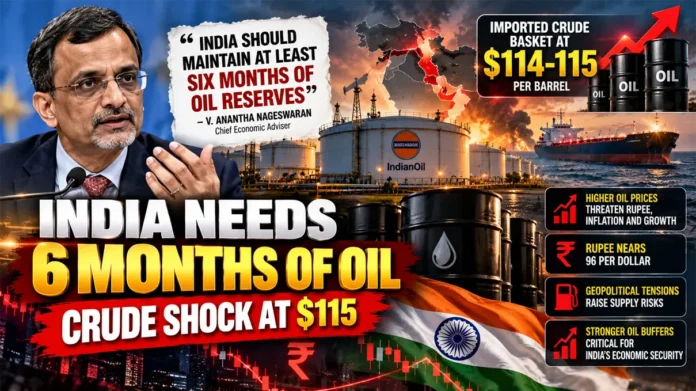
India should build enough oil reserves to withstand at least six months of supply disruption, the government’s Chief Economic Adviser has warned, as surging crude prices and worsening geopolitical tensions expose one of the country’s biggest economic vulnerabilities.
Chief Economic Adviser V. Anantha Nageswaran said India must strengthen physical buffers for critical commodities, including crude oil, because modern supply shocks are increasingly being driven by deliberate geopolitical actions rather than unexpected accidents.
His warning comes at a particularly uncomfortable moment.
India’s imported crude basket has climbed to around $114–115 a barrel, nearly 30% higher than levels seen in August.
The rupee has weakened close to 96 per US dollar.
Oil prices remain volatile.
And renewed Houthi attacks on Saudi Arabia have again raised fears of disruption across some of the world’s most important energy routes.
For India, which depends heavily on imported crude, this is not simply an oil-market story.
It is an inflation story.
A rupee story.
A stock-market story.
And increasingly, a national economic-security story.
THE 60-SECOND BRIEF
India’s Chief Economic Adviser says the country should maintain at least six months of oil storage.
The Indian crude basket has risen to roughly $114–115 per barrel.
Higher oil prices can weaken the rupee, increase India’s import bill, raise inflation and squeeze corporate margins.
India currently has 5.33 million metric tonnes of dedicated strategic petroleum reserve capacity at Visakhapatnam, Mangaluru and Padur.
Additional strategic storage of 6.5 million tonnes has also been approved at Chandikhol and Padur.
The broader message from the government’s top economic adviser is clear: India needs much stronger protection against geopolitical supply shocks.
‘Shocks Are Increasingly by Design’
Nageswaran’s warning goes beyond today’s crude price.
He argued that the global economic system itself has changed.
Supply disruptions are no longer necessarily temporary accidents caused by weather, natural disasters or technical failures.
Trade restrictions, sanctions, military conflicts and strategic control of commodities are increasingly being used as geopolitical tools.
That makes countries heavily dependent on imported energy more vulnerable.
India is one of them.
The country imports the majority of the crude oil required to run its economy.
That crude fuels cars, trucks and aircraft.
It feeds refineries.
It affects petrochemicals, plastics, paints, logistics and manufacturing.
And when crude becomes expensive, the impact does not stop at the petrol pump.
NUMBER THAT MATTERS: $114–115 A BARREL
The Indian basket of imported crude has risen to approximately $114–115 per barrel.
That represents an increase of roughly 30% from August levels.
For an economy of India’s size, such a move has enormous consequences.
Every sustained rise in oil prices increases the amount of foreign currency India needs to pay for energy imports.
That can widen the trade deficit.
It can increase demand for dollars.
And that, in turn, can put additional pressure on the rupee.
Rupee Already Feels the Pressure
The rupee ended Thursday around 95.9550 against the US dollar, after touching approximately 95.96 during the session.
Higher crude prices were one of the main pressures on the currency.
The relationship is straightforward.
Indian refiners need dollars to buy crude oil.
When oil becomes more expensive, dollar demand can increase.
If foreign investors are also withdrawing money from Indian financial markets at the same time, pressure on the currency can become even stronger.
A weaker rupee then makes imported oil more expensive in rupee terms.
That creates a difficult cycle.
Why Expensive Oil Hurts India More Than Many Economies
India is one of the world’s largest oil consumers but does not produce enough crude domestically to meet its requirements.
That dependence makes the country particularly sensitive to global oil shocks.
When crude prices remain elevated for a sustained period, several parts of the economy can feel the pressure.
Transportation becomes more expensive.
Airlines face higher aviation-fuel costs.
Paint, chemical and tyre companies can see raw-material expenses rise.
Logistics costs can increase.
The government may face greater pressure over fuel taxes or subsidies.
And businesses may eventually pass some of those costs on to consumers.
That is how an international conflict thousands of kilometres away can eventually reach an Indian household budget.
Why Six Months of Oil Storage Would Be a Big Change
Nageswaran’s suggestion of maintaining at least six months of oil storage is ambitious.
India currently operates strategic petroleum reserves at three underground locations.
Visakhapatnam: 1.33 million metric tonnes
Mangaluru: 1.5 million metric tonnes
Padur: 2.5 million metric tonnes
Together, they provide 5.33 million metric tonnes of dedicated strategic crude storage.
The government has also approved another 6.5 million tonnes of storage capacity at Chandikhol in Odisha and an additional facility at Padur in Karnataka.
But a six-month buffer would represent a much larger level of energy security than India’s existing dedicated strategic reserve system.
It would also require enormous investment.
Strategic Reserves Are Not Just About Cheap Oil
Strategic petroleum reserves serve a very different purpose from ordinary commercial oil stocks.
They are essentially an emergency insurance policy.
A country can release crude from these reserves when international supplies are suddenly disrupted.
India has used this mechanism before.
Strategic reserves can help refineries continue operating during a temporary crisis while the government searches for alternative suppliers.
But reserves cannot permanently shield an economy from a long war or prolonged global shortage.
That is why storage must work together with diversification of suppliers.
Russian Oil Adds Another Complication
India’s energy calculations have become more complex because of Russia.
Russian crude became an important part of India’s oil supply after Western sanctions reshaped global energy trade.
But India’s imports of Russian oil fell 16.5% in August to about 2.1 million barrels per day, and preliminary September data pointed to a further decline toward 1.9 million barrels per day.
At the same time, India is trying to diversify its supplies through the Middle East and other producers.
That makes geopolitical stability in both Russia and the Gulf extremely important for New Delhi.
If several major supply routes become politically constrained at the same time, India has fewer cheap alternatives.
Middle East Crisis Makes the Warning Urgent
The latest rise in crude prices has coincided with renewed instability in the Middle East.
Houthi missile attacks on Saudi Arabia have revived concerns over oil infrastructure and regional supply routes.
Saudi Arabia recently intercepted multiple ballistic missiles targeting areas including Taif and the Yanbu region.
Meanwhile, shipping through the Strait of Hormuz and Bab el-Mandeb has remained disrupted by the broader regional conflict.
These are not minor waterways.
They sit at the centre of the global energy system.
Any sustained disruption can quickly push freight, insurance and crude prices higher.
The Hidden Cost: Shipping
Even when oil continues moving, disruption can make it far more expensive.
Middle Eastern producers have increasingly used ship-to-ship transfers and alternative routes to keep crude flowing.
But those workarounds come at a cost.
Freight rates for very large crude carriers have surged dramatically during the crisis.
Higher transportation costs eventually become part of the delivered price of oil.
So even when physical supply does not disappear completely, the economic impact can still be severe.
WHY IT MATTERS FOR THE STOCK MARKET
Indian equity investors should pay close attention to oil.
A sustained oil shock can affect corporate profits across sectors.
Airlines generally suffer when aviation fuel becomes more expensive.
Paint and chemical manufacturers can face higher input costs.
Automobile and consumer companies may feel pressure if inflation reduces household purchasing power.
Banks can also be indirectly affected if higher inflation keeps interest rates elevated.
On Thursday, Indian equities fell sharply as crude prices, global bond yields and financial-sector weakness combined to hurt sentiment.
Oil is not the only reason the stock market is under pressure.
But for India, it remains one of the most important external risks.
WHY IT MATTERS FOR INFLATION
Higher crude prices do not immediately translate into an identical increase at the petrol pump.
Fuel pricing depends on several factors, including taxes, refinery economics and government policy.
But oil affects far more than petrol and diesel.
Transport costs influence vegetables, food products and manufactured goods.
Petrochemical costs affect packaging.
Freight affects almost every physical product moved across the country.
Therefore, prolonged expensive oil can gradually spread inflation throughout the economy.
That could complicate the Reserve Bank of India’s job.
WHY IT MATTERS FOR THE GOVERNMENT
An oil shock creates difficult policy choices.
The government can allow higher global costs to pass through to consumers.
Or it can absorb part of the pressure through lower taxes, subsidies or support to specific sectors.
But every intervention has a fiscal cost.
That is why the Chief Economic Adviser’s call for stronger strategic buffers matters.
A larger reserve cannot make expensive oil disappear.
But it can give policymakers more time and flexibility during a supply emergency.
CLAIM vs FACT
Claim: India can solve the oil problem simply by buying more from another country.
Fact: Supplier diversification helps, but major geopolitical disruptions can affect global prices regardless of where India buys its crude.
Claim: Strategic reserves can protect India indefinitely.
Fact: Reserves are primarily designed to absorb temporary disruptions and buy time during an emergency.
Claim: High oil only affects petrol and diesel prices.
Fact: Crude prices influence the rupee, inflation, freight, corporate margins, the current account and ultimately economic growth.
THE BIGGER PICTURE
Nageswaran’s warning is really about something larger than crude oil.
The world economy is becoming less predictable.
Trade is increasingly linked to national security.
Sanctions are being used as strategic weapons.
Countries are restricting access to critical technologies.
Shipping routes are being threatened by war.
And energy remains one of the easiest ways to pressure an importing economy.
For India, self-reliance cannot mean complete isolation from global trade.
The economy is too large and too deeply integrated into international supply chains.
Instead, the challenge is resilience.
India must remain globally connected while ensuring that one disrupted sea route, one hostile government or one commodity shock cannot bring critical sectors to a halt.
WHAT HAPPENS NEXT
Three developments deserve close attention.
First, oil prices.
If Brent and the Indian crude basket remain elevated for several weeks, pressure on inflation, the rupee and corporate profits will increase.
Second, Middle East diplomacy.
Any agreement that restores normal shipping through critical waterways could quickly reduce the geopolitical premium in crude prices.
Third, India’s strategic-storage policy.
The government will face increasing pressure to accelerate additional petroleum reserves and decide whether a six-month buffer is financially and physically achievable.
INVC NEWS BOTTOM LINE
India has spent years debating how to secure cheap oil.
The conversation may now need to change.
Cheap oil matters.
But guaranteed access to oil during a crisis may matter even more.
The Chief Economic Adviser’s six-month reserve proposal acknowledges a new geopolitical reality: the next energy shock may not arrive because the world suddenly runs out of crude.
It may arrive because somebody deliberately blocks access to it.
For an economy that wants to become a global manufacturing power, that vulnerability cannot be treated as a routine commodity-market problem.
India’s next major oil policy may therefore have to focus not only on the price of every barrel — but on how many barrels the country can still access when the world around it stops behaving normally.