MUMBAI, India | September 25, 2026 —
For millions of Indian investors, the stock market story of the past two years has become increasingly difficult to reconcile with the broader narrative of a fast-growing economy.
On September 24, 2024, the Nifty 50 touched a then-record 25,956.45 and the Sensex climbed to 84,983.77.
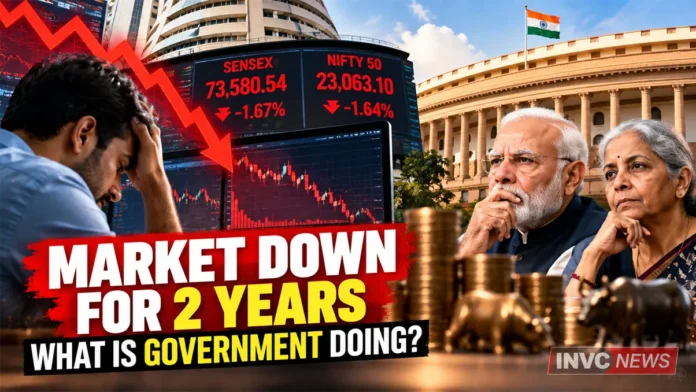
Exactly two years later, the Nifty closed at 23,063.10 and the Sensex at 73,580.54.
That puts the two benchmarks roughly 11% and 13% below those September 2024 record levels.
For investors who entered near the highs, the numbers tell a simple story: two years have passed, but benchmark wealth has moved backwards.
And that raises a question increasingly heard across India’s investing community:
While portfolios remain under pressure, what exactly are the government and market regulators doing?
THE 60-SECOND BRIEF
India’s benchmark indices remain below their September 2024 record levels.
Foreign investors have pulled billions of dollars from Indian equities as they chase cheaper and more technology-heavy markets elsewhere in Asia.
Retail investors continue pouring money into mutual funds and systematic investment plans, helping prevent a deeper fall.
Meanwhile, taxes on stock-market gains and derivative transactions have increased over the same period.
SEBI has tightened derivatives rules after its own research showed that the overwhelming majority of individual F&O traders lose money.
The government has also introduced measures aimed at attracting foreign capital and strengthening financial markets.
The uncomfortable reality is that neither the government nor SEBI can guarantee higher share prices — but tax policy, regulation, foreign capital rules and economic policy can influence the environment in which investors operate.
Two Years Later, the Index Is Still Below Its Peak
The comparison is striking.
In September 2024, Indian equities were celebrating record highs.
Investors were discussing when the Nifty would cross 30,000 rather than whether it could hold 23,000.
Two years later, the picture looks very different.
On September 24, 2026, the Nifty fell 1.64% to 23,063.10 and the Sensex dropped 1.67% to 73,580.54 — their worst single-day fall in about ten weeks.
The broader market also suffered.
Mid-cap stocks fell about 2.3%, while small-caps lost roughly 1.5% during the session.
For investors holding individual stocks rather than the benchmark indices, the experience can therefore be considerably worse than the Nifty or Sensex alone suggests.
Why Is India Underperforming?
It would be inaccurate to place the entire decline at the government’s door.
Several powerful global forces have worked against Indian equities.
Oil prices have repeatedly climbed toward or above $100 a barrel amid Middle East tensions.
That matters because India imports most of the crude oil it consumes.
Expensive oil can weaken the rupee, increase inflation pressure, worsen the trade balance and reduce corporate margins.
Global interest rates have also remained high.
When investors can earn attractive returns from US bonds or find faster-growing opportunities in other Asian markets, expensive Indian equities become harder to justify.
Foreign investors have responded accordingly.
By late August 2026, overseas investors had sold roughly ₹2.4 trillion — about $25 billion — of Indian shares during the year.
Reuters also reported that foreign investors were increasingly looking toward markets such as Japan, South Korea, Taiwan and parts of Southeast Asia.
India, once one of Asia’s favourite equity stories, has suddenly faced much more competition for global capital.
NUMBER THAT MATTERS: ₹2.4 TRILLION
That is approximately how much foreign investors had pulled from Indian equities during 2026 by late August.
Foreign selling is not the only reason markets decline.
But sustained outflows matter because foreign portfolio investors remain major participants in large Indian companies.
When they sell, domestic investors must absorb that supply.
And increasingly, they have.
India’s Small Investors Have Become the Shock Absorbers
One of the most important changes in Indian markets has been the rise of domestic investing.
Mutual fund SIP flows have become enormous.
In July 2026 alone, systematic investment plans contributed more than ₹31,900 crore.
That steady domestic money has helped cushion Indian equities against foreign selling.
In other words, Indian households are increasingly supporting a market from which foreign investors have been withdrawing capital.
That shift is a sign of deeper domestic financial participation.
But it also creates a legitimate policy question:
If households are being encouraged to invest more of their savings in financial markets, what protections and incentives should they expect in return?
Then Comes the Tax Question
This is where investor frustration becomes politically relevant.
In the July 2024 Budget, the government increased the tax on short-term gains from specified financial assets from 15% to 20%.
It also set the long-term capital gains tax rate at 12.5%, while increasing the annual exemption on certain listed financial assets from ₹1 lakh to ₹1.25 lakh.
For investors, that meant a higher tax rate on certain equity gains even as markets subsequently struggled.
Then came another change.
The Union Budget 2026-27 increased Securities Transaction Tax on futures from 0.02% to 0.05%.
STT on option premiums and certain option transactions was also raised to 0.15%.
The government’s stated objective was to discourage excessive speculation in derivatives.
That rationale has evidence behind it.
But investors naturally notice the other side of the equation:
When they make money, taxes apply.
When markets fall, the investment loss remains theirs.
CLAIM vs FACT
Claim: The government is doing nothing while investors lose money.
Fact: That is too broad.
The government has changed financial-market rules, proposed reforms designed to attract capital and opened additional investment routes for overseas investors.
The 2026 Budget proposed allowing individual persons resident outside India to invest in listed Indian companies through the Portfolio Investment Scheme.
It has also announced broader financial-sector reforms, including a high-level banking committee and measures intended to deepen corporate bond markets.
However, those policies do not directly guarantee higher equity-market returns.
Government, SEBI and RBI Are Not the Same Thing
This distinction is essential.
The Union government determines tax policy and many broader economic policies.
SEBI regulates securities markets.
The Reserve Bank of India controls monetary policy and manages issues involving liquidity, inflation and the rupee.
They are separate institutions with different responsibilities.
Therefore, blaming “the government” for every market fall oversimplifies how markets work.
At the same time, policymakers cannot completely detach themselves from market conditions.
Taxes, regulations, capital flows, inflation, fiscal borrowing, interest rates and economic growth all influence investor confidence.
The F&O Numbers Are Even More Disturbing
If long-term investors are frustrated, the experience of many derivatives traders has been considerably worse.
SEBI’s latest study found that 87.7% of individual traders lost money in equity derivatives during FY26.
Their combined net losses reached approximately ₹91,685 crore.
The number of active individual derivatives traders fell sharply as well.
SEBI has responded with measures including larger contract sizes, fewer weekly expiries and tighter premium and risk-management requirements.
Those measures are intended to curb excessive speculation rather than push stock prices higher.
That difference matters.
SEBI’s job is market integrity and investor protection — not maintaining the Nifty at a particular level.
NUMBER THAT MATTERS: ₹91,685 CRORE
That was the combined net loss suffered by individual equity-derivatives traders in FY26, according to SEBI data.
Nearly nine out of ten lost money.
That figure provides an important reality check whenever derivatives trading is presented as an easy route to wealth.
So What Is the Government Actually Doing?
The answer depends on what investors expect it to do.
If the expectation is that New Delhi should directly push the Sensex or Nifty higher, that would misunderstand the role of government in a market economy.
Governments cannot legitimately promise stock-market returns.
But they can influence the conditions that attract or repel investment.
They control taxation.
They shape fiscal policy.
They negotiate trade arrangements.
They determine many rules affecting foreign capital.
They influence infrastructure spending and economic reforms.
And through legislation and appointments, they help shape the broader regulatory architecture.
The relevant question, therefore, is not:
“Why has the government not made the stock market rise?”
A more useful question is:
“Are current policies making India sufficiently attractive for long-term domestic and global capital?”
THE BIGGER PICTURE
There is an unusual contradiction in India today.
Economic growth remains relatively strong.
Corporate earnings have shown periods of healthy growth.
Domestic SIP investment continues to expand.
Yet foreign investors have been selling Indian equities, the rupee has faced pressure, oil prices remain a major vulnerability and benchmark indices remain below their 2024 peaks.
Reuters reported in August that India was on course for one of its weakest annual equity performances in more than a decade, even as several other Asian markets delivered strong gains.
That divergence deserves attention.
It does not prove that India’s economic story has failed.
Nor does it prove that the market must immediately rebound.
It shows that strong GDP growth and strong stock-market returns are not necessarily the same thing.
WHY IT MATTERS
For years, Indian households were encouraged to move savings beyond traditional bank deposits and participate in financial markets.
That transition is happening.
SIP contributions have soared.
Demat accounts have multiplied.
Retail participation has expanded dramatically.
That makes stock-market policy increasingly important to ordinary households, not merely professional traders.
A market correction is part of investing.
But when weakness persists for years while household exposure rises, policymakers, regulators and financial institutions face greater scrutiny over taxation, investor protection, market structure and the quality of companies being brought to market.
WHAT HAPPENS NEXT
Investors should watch four developments closely.
Crude oil remains one of the biggest immediate risks because higher energy prices can feed inflation and weaken the rupee.
Foreign investor flows will indicate whether global institutions again see Indian valuations as attractive.
Corporate earnings must continue growing strongly enough to justify valuations.
And policy decisions on taxation, regulation and foreign investment will influence whether global capital returns.
None of these guarantees an immediate recovery.
But together they will determine whether India’s equity market can regain the momentum it lost after the 2024 peak.
INVC NEWS BOTTOM LINE
Indian equities are not collapsing because of one government decision, one tax or one regulator.
Global interest rates, expensive oil, foreign selling, currency weakness, valuations and geopolitical instability have all contributed to the pressure.
But investors are entitled to examine policy choices too.
Over the past two years, taxes on certain equity gains and derivative transactions have risen, even as benchmark indices have fallen below their September 2024 peaks.
At the same time, the government and SEBI have introduced measures aimed at controlling speculation, expanding investment access and strengthening financial markets.
The question now is not whether policymakers can manufacture a bull market.
They cannot.
The real test is whether India can create an investment environment in which domestic savings remain protected, foreign capital sees sufficient value to return, companies deliver sustainable earnings — and ordinary investors once again feel that patiently owning Indian businesses is worth the risk.