MUMBAI, India | September 24, 2026 —
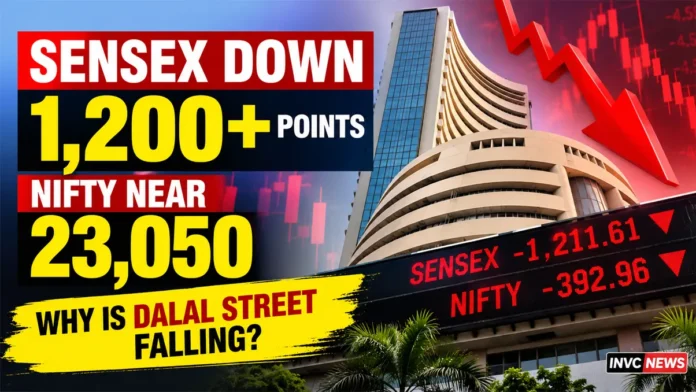
Indian stocks suffered a sharp afternoon selloff on Thursday as the Sensex plunged more than 1,200 points and the Nifty 50 slipped toward 23,050, with selling spreading across every major sector.
At around 1:58 PM IST, the BSE Sensex traded 1,211.61 points, or 1.61%, lower at 73,616.64. The NSE Nifty 50 dropped 392.96 points, or 1.68%, to 23,053.85.
The sudden increase in volatility was equally striking.
India VIX surged nearly 24%, signalling a sharp jump in investor nervousness as the afternoon decline gathered pace.
Financial services emerged as the biggest sectoral drag, while metal, infrastructure, auto, energy and FMCG shares also faced sustained selling pressure.
The fall marked a significant deterioration from the opening session, when the Sensex had initially dropped around 600 points.
By afternoon, however, selling intensified dramatically.
Why is the Indian stock market falling today?
Several domestic and global pressures converged at the same time.
Investors faced rising global bond yields, renewed expectations that interest rates could remain high, crude oil prices above $100 a barrel and weak cues from several overseas equity markets.
At the same time, sharp losses in insurance and financial stocks added another domestic layer of pressure.
Together, these factors pushed investors toward risk reduction and triggered selling across the broader market.
Financial services take the biggest hit
Financial services were the worst-performing major sector during the afternoon session, falling around 2.46%.
Insurance, banking and finance-related companies faced particularly heavy pressure.
The selloff followed fresh proposals from India’s insurance regulator that could reshape commission structures, distribution costs and expense limits across the industry.
Because financial companies carry significant weight in benchmark indices, weakness in the sector amplified the fall in both the Sensex and Nifty.
Every major sector trades in the red
The selloff was not restricted to one corner of the market.
Auto stocks were down about 1.34%, while energy and utility shares lost around 1.22%.
Infrastructure declined approximately 1.57%, while metal stocks dropped around 1.92%.
FMCG shares fell about 1.14%.
Meanwhile, IT, pharmaceuticals, real estate and media stocks also traded lower.
Media remained relatively less affected, but it too stayed in negative territory.
The broad-based weakness showed that investors were reducing exposure across sectors rather than reacting to a single company or industry.
Midcap and smallcap stocks also come under pressure
The damage extended beyond the headline indices.
Both the Nifty Midcap 100 and Nifty Smallcap 100 came under selling pressure during the session.
That matters because weakness in broader-market stocks often reflects a wider decline in investor risk appetite.
When large-cap, mid-cap and small-cap stocks fall together, market sentiment typically becomes more cautious.
Rising US bond yields shake global markets
One of the biggest global concerns remains the sharp rise in US Treasury yields.
Higher government bond yields can make fixed-income investments more attractive compared with equities.
They can also raise the discount rate investors use to value future corporate earnings.
As a result, expensive or high-growth equities can come under pressure when bond yields rise quickly.
For emerging markets such as India, elevated US yields can create another problem.
Foreign investors may become more inclined to keep capital in dollar-denominated assets, increasing pressure on emerging-market fund flows.
Crude oil above $100 adds another worry for India
Oil prices have become another major source of concern.
India imports most of the crude oil it consumes.
Therefore, sustained oil prices above $100 a barrel can increase the country’s import bill and potentially add pressure to inflation, the rupee and corporate input costs.
Higher energy prices can also complicate the outlook for interest rates.
For investors, that combination creates uncertainty across sectors ranging from aviation and paints to chemicals, logistics and consumer businesses.
Fed rate expectations return to centre stage
Global investors are also reassessing the outlook for US monetary policy.
The Federal Reserve recently raised interest rates, and strong economic data has kept expectations of further tightening alive.
If markets begin pricing in higher interest rates for longer, global equity valuations could face additional pressure.
Indian equities are not isolated from that shift.
Foreign institutional flows, currency movements, bond yields and risk appetite can all respond quickly to changes in US rate expectations.
Weak global markets add to selling pressure
Asian markets offered little comfort on Thursday.
Several regional benchmarks traded lower, adding to the cautious mood already created by higher yields and expensive crude oil.
US markets had also ended the previous session lower as rising Treasury yields and oil prices weighed on sentiment.
That weak global backdrop left Indian equities vulnerable when domestic financial shares started falling.
India VIX surge sends warning signal
The near 24% jump in India VIX is one of the session’s most important indicators.
India VIX reflects expected near-term volatility in the equity market.
A sharp rise normally signals growing uncertainty and increasing demand for protection against market swings.
Therefore, traders will closely watch whether volatility remains elevated through the closing session.
What should investors watch next?
The final hour of trade could become crucial.
The first major level to watch is whether the Nifty can hold the 23,000 mark.
A sustained break below that psychological level could further influence short-term sentiment.
For the Sensex, traders will closely monitor whether the index manages to recover from the day’s lows before the closing bell.
Investors will also track crude oil prices, US bond yields, foreign institutional flows and movements in financial stocks.
The market’s closing level will ultimately determine whether Thursday’s decline remains an aggressive intraday selloff or develops into a more significant technical breakdown.