NEW YORK, United States | September 24, 2026 —
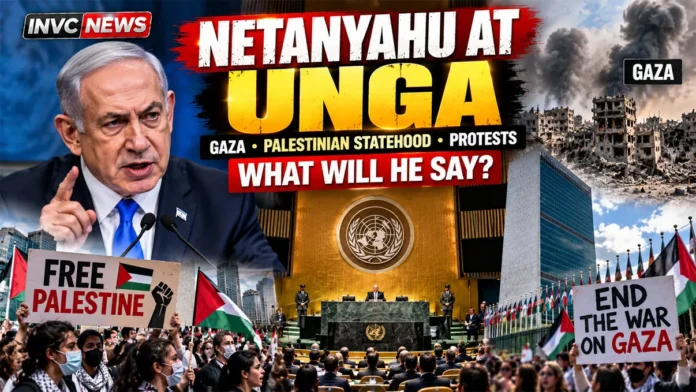
Israeli Prime Minister Benjamin Netanyahu is preparing to walk onto one of the world’s most closely watched diplomatic stages tonight — with protesters gathering in New York and some of the most divisive questions in Middle East politics waiting inside the United Nations.
Gaza.
Palestinian statehood.
West Bank settlements.
Israel’s military strategy.
Relations with Washington.
And growing international criticism of Netanyahu’s government.
Netanyahu is scheduled to address the 81st United Nations General Assembly at around 2 PM New York time, or approximately 11:30 PM IST.
He has already signalled that he intends to use the speech to defend Israel’s actions and confront critics.
That makes tonight’s address more than another UN speech.
It could become a direct battle over how Israel wants the world to understand the past three years — and what happens next.
Netanyahu Heads to the UN as Protests Build in New York
Demonstrations began gathering around New York ahead of Netanyahu’s arrival and are expected to continue around the United Nations during his address.
Pro-Palestinian activists have criticised Israel’s conduct in Gaza and Israeli settlement policies in the occupied West Bank.
Israeli supporters and Jewish groups have also voiced concerns about antisemitism and what they describe as unfair or one-sided attacks on Israel.
The result is a deeply polarised atmosphere around the UN gathering.
The debate is not confined to the streets.
Inside the General Assembly, Israel’s policies are also facing sustained diplomatic scrutiny.
Netanyahu Says He Will ‘Tell the Truth’ About Israel
Ahead of the trip, Netanyahu said he planned to use his UN appearance to defend Israel and its soldiers against accusations directed at his government.
He has argued that Israel has faced what he considers widespread misinformation about its military operations and security policies.
Netanyahu is expected to emphasise Israel’s position that its military campaigns have been directed against armed groups, including Hamas, and that the country continues to face serious security threats.
Critics of his government strongly dispute that framing.
They point to the scale of destruction and civilian suffering in Gaza, settlement expansion in the West Bank and allegations of violations of international law.
Those competing narratives are likely to collide directly in tonight’s speech.
Gaza Remains the Question Netanyahu Cannot Avoid
The Gaza conflict remains central to international criticism of Israel.
The war followed the Hamas-led October 7, 2023 attacks on Israel, in which about 1,200 people were killed and 251 people were taken hostage, according to Israeli figures cited in international reporting.
Israel subsequently launched a major military campaign in Gaza.
Gaza health authorities say more than 73,000 Palestinians have been killed during the conflict. Their figures include civilians and combatants without consistently separating the two categories.
Israel rejects accusations of genocide and says its forces target Hamas and other armed groups operating among civilian populations.
Those sharply conflicting positions have dominated international diplomacy for years.
Tonight, Netanyahu will have another opportunity to present Israel’s case directly to world leaders.
Palestinian Statehood Has Returned to the Centre of UN Diplomacy
Another major issue waiting for Netanyahu is the renewed international push around a two-state solution.
At a high-level UN meeting this week, Secretary-General António Guterres argued that a negotiated two-state framework remains the credible path toward lasting security for both Israelis and Palestinians.
The UN position supports two sovereign states broadly based on pre-1967 lines, consistent with relevant international law and previous agreements.
A number of governments have also increased diplomatic pressure around Palestinian recognition.
Netanyahu’s government has opposed moves toward Palestinian statehood under current conditions and has argued that Israel’s security concerns must come first.
That disagreement is likely to become one of the central political fault lines around his UN appearance.
West Bank Settlements Add Another Layer of Pressure
The occupied West Bank is also likely to feature heavily in the wider diplomatic conversation.
The UN and several governments have criticised Israeli settlement expansion, including plans affecting areas considered important to the territorial viability of a future Palestinian state.
Israel disputes many international criticisms of its settlement policies and cites historical, political and security arguments in support of its position.
The issue has become increasingly important because settlement expansion is directly connected to the broader debate over whether a viable two-state arrangement remains possible.
That makes any reference Netanyahu makes to the West Bank worth watching closely.
New York Mayor Zohran Mamdani Has Become Part of the Political Drama
Netanyahu’s visit also intersects with a highly charged political dispute inside New York.
Mayor Zohran Mamdani has accused Netanyahu of war crimes and has sharply criticised Israel’s conduct in Gaza.
Mamdani has also acknowledged that New York City does not have the legal authority to arrest Netanyahu.
Netanyahu has responded aggressively to the mayor’s criticism and has accused him of hostility toward Israel.
Reuters reported ahead of the speech that Netanyahu is expected to address the dispute during his UN appearance.
That means the speech could become unusual in one important respect:
Netanyahu may be speaking simultaneously to world leaders, American political audiences and voters back home in Israel.
Israeli Election Adds a Domestic Audience
Netanyahu is not arriving at the United Nations in a political vacuum.
Israel is approaching a general election scheduled for October 27, 2026.
That means every major international appearance also carries domestic political significance.
Supporters of Netanyahu are likely to focus on his defence of Israel’s security policy and his willingness to confront international criticism.
His opponents may instead focus on Israel’s diplomatic difficulties, the prolonged regional conflicts and questions surrounding his government’s strategy.
The same speech can therefore be heard very differently in New York and Jerusalem.
No Trump Meeting Currently Scheduled
Another detail attracting attention is Netanyahu’s unusually short US visit.
Current reporting indicates that no meeting with US President Donald Trump is scheduled during the trip.
Trump is in Washington hosting Chinese President Xi Jinping.
Netanyahu is expected to return to Israel shortly after his UN appearance.
The absence of a presidential meeting does not by itself establish a change in the broader US-Israel relationship.
However, it will be closely watched because Washington remains Israel’s most important strategic partner.
Palestinian President Mahmoud Abbas Also Addresses the UN
The Palestinian side of the conflict will also have a voice at this year’s General Assembly.
Palestinian President Mahmoud Abbas was authorised to participate by video after the United States denied him a visa.
The UN General Assembly approved virtual participation after a vote earlier this month.
That means the Israeli and Palestinian leadership are presenting sharply different political visions to the same global institution, even though Abbas is not physically present in New York.
What Should the World Listen for in Netanyahu’s Speech?
Three areas could determine whether tonight’s address produces genuine news beyond familiar political positions.
First: Gaza.
Will Netanyahu outline any new political or security plan for Gaza, or primarily defend Israel’s existing strategy?
Second: Palestinian statehood.
Will he offer any opening toward future negotiations, or reinforce his government’s current opposition?
Third: the wider region.
Iran, Lebanon, Hamas and Israel’s relationship with the United States remain part of a much broader security picture.
Any new language on those fronts could carry consequences far beyond the UN hall.
Why Tonight’s Speech Matters
Netanyahu has spoken at the United Nations many times.
But this appearance comes at an unusually sensitive moment.
Israel faces protests abroad.
The Gaza conflict remains unresolved.
The future of Palestinian statehood is again being debated at the highest diplomatic level.
Settlement policy is under renewed scrutiny.
An Israeli election is approaching.
And the political mood toward Israel is shifting in parts of Europe and the United States.
That gives Netanyahu a difficult task.
He will seek to defend Israel’s record and security policy.
Critics will be listening for accountability and signs of a different approach.
Palestinians and their supporters will be looking for what the speech says — or does not say — about their political future.
And governments around the world will be watching for any indication that diplomacy still has room to move.
Final Outlook
For now, the protesters are gathering.
Diplomats are preparing.
And the podium is waiting.
Later tonight, Benjamin Netanyahu will have the UN microphone.
The question is not simply whether his speech will be forceful.
It is whether he says anything that changes the political equation around Gaza, Palestinian statehood and Israel’s increasingly difficult diplomatic environment.
That is what could turn another UN address into one of the defining political moments of this year’s General Assembly.