MUMBAI, India | September 24, 2026 —
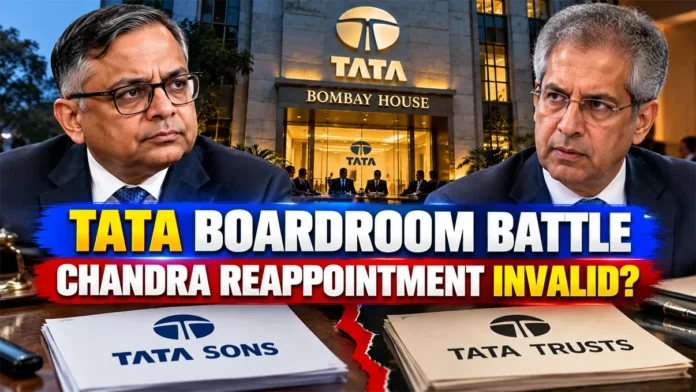
One of India’s most powerful corporate groups is facing a rare and increasingly public governance confrontation after Tata Trusts challenged N. Chandrasekaran’s reappointment as Chairman of Tata Sons and declared the September 17 board resolution legally invalid.
Tata Sons’ board had backed Chandrasekaran for another five-year term, extending his leadership beyond the end of his current tenure in February 2027.
But Tata Trusts — which collectively owns about 66% of Tata Sons — says the board did not satisfy a special voting requirement contained in Tata Sons’ Articles of Association.
The disagreement has now moved well beyond an ordinary succession debate.
At stake are questions over who ultimately controls key decisions at Tata Sons, how much authority the majority charitable shareholder can exercise through its nominee directors, and what happens next to the leadership of one of India’s largest corporate groups.
Chandrasekaran Had Earlier Decided Not to Seek Another Term
The roots of the dispute go back to August.
On August 12, 2026, Chandrasekaran informed the Tata Sons board that he did not intend to offer himself for reappointment after his current tenure ends on February 20, 2027.
Tata Trusts formally accepted that decision and asked Tata Sons to begin the process of constituting a selection committee to identify his successor.
According to Tata Trusts, Chandrasekaran’s decision had been clearly communicated and had already triggered succession planning.
That appeared to set the stage for a leadership transition.
Then came September 17.
Tata Sons Board Backs Chandrasekaran Again
At the September 17 board meeting, Tata Sons revisited the question of Chandrasekaran’s leadership.
The resolution to give him another term received support from four directors, while Tata Trusts Chairman Noel Tata opposed the proposal.
The Tata Sons board consequently treated Chandrasekaran as reappointed for a fresh five-year term.
Reuters also reported that the board backed steps toward a potential listing of Tata Sons, another subject that has contributed to tension between Tata Sons and its controlling shareholder.
But Tata Trusts immediately challenged the validity of the chairman vote.
Why Tata Trusts Says the 4-1 Vote Does Not Settle the Matter
This is where the dispute becomes more complicated than an ordinary boardroom vote.
Tata Trusts argues that Tata Sons’ Articles of Association require the affirmative support of a majority of the directors nominated by Tata Trusts for a decision such as the appointment or reappointment of the chairman.
There are currently two Tata Trusts nominee directors on the Tata Sons board.
One supported Chandrasekaran.
Noel Tata opposed him.
Tata Trusts argues that when there are only two nominee directors, a majority means both must support the resolution.
Since they split 1-1, the special condition was not satisfied, according to the Trusts.
For that reason, Tata Trusts says the overall 4-1 board count does not resolve the issue.
Tata Trusts Calls Resolution ‘Void Ab Initio’
Tata Trusts sharpened its position in a September 20 statement.
It said the Chandrasekaran resolution was “not validly passed”, had “no legal effect” and was “void ab initio” — a legal expression meaning invalid from the beginning.
The Trusts also rejected the argument that a chairman’s casting vote could cure the problem.
Its position is that a casting vote can address an equality of votes at the overall board level but cannot replace the separately required affirmative support of Trust-nominated directors.
That interpretation is central to the entire dispute.
Tata Sons and Tata Trusts Now Read the Same Rules Differently
The conflict therefore revolves around the Articles of Association — effectively the constitutional rules governing Tata Sons.
Tata Trusts says those rules give its nominee directors protective voting rights over key decisions.
Tata Sons’ board has taken a different legal view and proceeded with the reappointment.
That means the controversy is no longer simply about whether Chandrasekaran should continue.
It is about who has the legal authority to decide whether he can continue.
Until the dispute is resolved through agreement, shareholder action or legal proceedings, both sides remain attached to conflicting interpretations.
Cyrus Mistry Case Returns to the Centre of the Debate
Tata Trusts has also invoked the legal battle that followed the removal of former Tata Sons chairman Cyrus Mistry.
The Trusts argues that during that litigation, Tata Sons itself defended the special rights contained in its Articles of Association before the Supreme Court.
According to Tata Trusts, Tata Sons cannot now disregard the same protections when their use produces an outcome the board does not want.
That argument could become important if the current disagreement eventually reaches the National Company Law Tribunal or another court.
No final judicial ruling on Chandrasekaran’s 2026 reappointment dispute has yet been issued.
Noel Tata and Chandrasekaran Now Sit on Opposite Sides
The confrontation also puts two of the most influential figures inside the Tata structure on opposite sides.
Chandrasekaran has led Tata Sons since 2017 and oversees a group whose major businesses include TCS, Tata Motors, Tata Steel, Air India, Tata Power, Titan and several emerging technology ventures.
Noel Tata leads Tata Trusts, the charitable trusts that collectively control roughly two-thirds of Tata Sons.
That ownership makes the Trusts far more than an ordinary shareholder.
Their position can become decisive when major Tata Sons matters reach shareholders.
The Next Big Test Could Come at the AGM
The dispute may not end inside the boardroom.
Chandrasekaran also faces a separate shareholder-level issue involving his continuation as a director.
His position as chairman itself does not require the same shareholder vote, but his reappointment as a director does.
That makes Tata Trusts’ majority shareholding extremely important when the matter eventually comes before shareholders.
Tata Sons’ earlier annual general meeting was adjourned, meaning another shareholder meeting could become a crucial arena in the leadership battle.
Tata Sons Listing Adds Another Layer of Tension
Leadership is not the only disputed issue.
Tata Sons has also faced pressure surrounding a possible public listing after the Reserve Bank of India classified it as an upper-layer non-banking financial company.
Reuters reported that the September 17 board also backed moving toward a listing, while Noel Tata opposed that decision.
A listing could fundamentally alter the ownership and governance dynamics around Tata Sons.
For Tata Trusts, which currently exercises control through its dominant shareholding and special governance rights, the consequences could be significant.
That helps explain why the present boardroom dispute extends far beyond one individual’s tenure.
Air India and Big Investment Plans Raise the Stakes
The timing is especially sensitive because Tata Group is pursuing major investments in sectors ranging from aviation and semiconductors to batteries and advanced manufacturing.
Air India is undergoing an expensive transformation.
Tata Electronics is building semiconductor capacity.
Several group companies are committing billions of dollars to electric mobility, clean energy and digital infrastructure.
Reuters Breakingviews has argued that prolonged governance uncertainty could complicate major investment decisions across the group.
That does not mean operating companies will automatically face disruption.
However, continuing disagreement at the Tata Sons level could make long-term strategic decisions more difficult.
Is Chandrasekaran Still Tata Sons Chairman?
Yes.
Chandrasekaran remains Chairman of Tata Sons under his existing tenure, which runs until February 2027.
The dispute concerns whether the September 17 decision validly grants him another five-year term after that.
Tata Sons’ board says it has reappointed him.
Tata Trusts says that decision is legally ineffective.
Therefore, reports describing his reappointment as definitively cancelled would currently go too far.
The validity question remains disputed.
What Happens Next?
Three possibilities now stand out.
The two sides could reach an internal compromise.
The issue could be decided through shareholder processes.
Or the disagreement could ultimately move into formal litigation.
Reports have indicated that legal options, including possible proceedings before the National Company Law Tribunal, are being examined.
Whatever happens, the dispute has exposed an unusual divide at the top of a group long associated with institutional stability.
The key question is no longer merely whether N. Chandrasekaran should receive another five years.
It is whether the Tata Sons board or Tata Trusts has the decisive legal authority when the two disagree over who should lead the group.
Until that question is settled, one of corporate India’s most closely watched boardroom battles remains open.