NEW DELHI, India | September 24, 2026 —
Do not mistake “No UPI Day” for a nationwide shutdown of UPI.
UPI itself will continue to work.
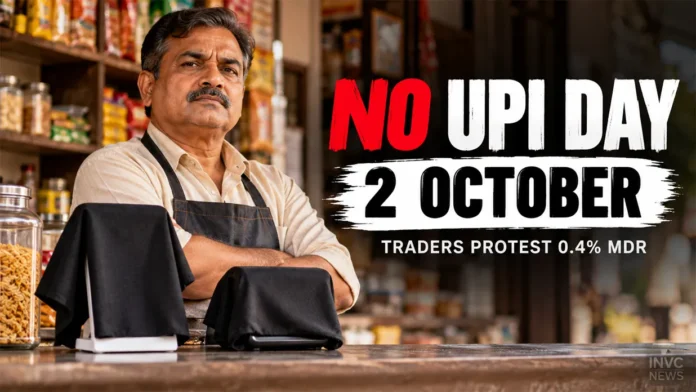
Instead, traders across several parts of India are preparing a symbolic protest on October 2, 2026, when participating shops may stop accepting UPI payments for the day, cover QR codes and sound boxes with black cloth, and ask customers to pay in cash.
The protest targets a new Merchant Discount Rate, or MDR, that will apply from October 15 to certain higher-value UPI payments made to merchants.
The controversy has already reached markets in Madhya Pradesh, where traders observed a No UPI Day on September 23.
Now business associations are trying to take the campaign nationwide on Gandhi Jayanti.
So what exactly is changing?
Will customers have to pay a UPI fee?
And why are traders opposing a charge that the government says will leave most UPI transactions untouched?
Here is the complete picture.
What Is ‘No UPI Day’?
No UPI Day is a trader-led protest against the new MDR framework.
Participating shopkeepers are not demanding the abolition of UPI.
Their objection is specifically to the cost of accepting certain higher-value merchant payments.
During the protest, traders may:
Cover QR codes with black cloth
Switch off or cover UPI sound boxes
Temporarily refuse UPI payments
Ask customers to use cash or another payment method
Wear black bands as a symbolic protest
The October 2 action has been described by participating trade groups as a peaceful, Gandhi Jayanti-style protest.
What Changes From October 15?
From October 15, 2026, a 0.4% MDR will apply to eligible Person-to-Merchant, or P2M, UPI transactions above ₹2,000.
This means the fee applies when a customer pays an eligible merchant through UPI.
The merchant — not the customer — bears the MDR under the notified framework.
For transactions of ₹75,000 or more, the MDR is capped at ₹300 per transaction.
What Remains Free?
A large part of UPI will continue without MDR.
Person-to-person transfers remain free, irrespective of the amount.
Merchant payments of ₹2,000 or below also remain outside the standard 0.4% MDR.
Small merchants covered under the zero-MDR framework will continue to receive protection under the applicable rules.
The government says approximately 96% of merchant UPI transactions by volume will remain unaffected.
That is an important distinction.
The new framework does not mean every UPI payment becomes chargeable from October 15.
Will Customers Pay 0.4% Extra?
No direct customer fee has been introduced under this framework.
The MDR is payable within the merchant-payment ecosystem.
The government has also said the cost should not be imposed on customers as a separate UPI surcharge.
However, traders argue that businesses operating on thin margins may ultimately try to recover higher payment-processing costs through product pricing.
That is the traders’ concern and not an announced government policy.
Whether the MDR materially affects retail prices will depend on merchant margins, competition and how businesses absorb the new cost.
MDR Is Not a Government Tax
The government has also clarified another source of confusion.
MDR is not a tax collected by the government or NPCI.
The fee is distributed among participants in the digital-payment ecosystem, including banks and payment service providers.
The government’s position is that UPI infrastructure requires a sustainable commercial model as transaction volumes continue to grow.
Trade bodies disagree with imposing that cost on merchants and want the new charge withdrawn.
Why Are Traders Angry?
Merchant associations say many retailers shifted heavily toward UPI because customers now expect instant digital payments.
For some businesses, UPI represents a significant share of daily collections.
They argue that introducing an MDR after years of zero-cost acceptance creates a new operating expense.
Traders in sectors with tight margins say even a relatively small percentage charge can become meaningful when applied across large volumes of transactions.
Their concern is particularly strong among retailers selling higher-ticket products such as:
Jewellery
Mobile phones
Electronics
Garments
Consumer goods
Wholesale products
Some food and commodity categories
These businesses are more likely to receive payments above ₹2,000.
Madhya Pradesh Became the First Big Test
The protest was already visible on September 23 across Madhya Pradesh.
Traders in Indore, Bhopal, Jabalpur, Gwalior and several other cities participated in No UPI Day demonstrations.
In Indore, organisers said around 125 business associations joined the campaign.
Shopkeepers in prominent market areas covered QR codes and payment devices with black cloth.
Many participating traders asked customers to pay in cash.
The action turned the new MDR framework from a technical payments-policy issue into a visible market protest.
Why October 2 Is Now Important
The next major date is October 2.
The Maharashtra Chamber of Commerce, Industry & Agriculture, or MACCIA, and several national trade associations have announced support for a broader No UPI Day.
Groups reported as supporting the action include organisations representing:
Consumer-product distributors
Edible-oil traders
Jewellers and goldsmiths
Mobile retailers
Retail traders
Other business associations may join before the protest date.
The final scale of participation will vary by city and market.
Therefore, customers should not assume every shop in India will refuse UPI on October 2.
Will UPI Stop Working on October 2?
No.
There is no nationwide technical shutdown of UPI announced for October 2.
Bank-to-bank UPI infrastructure will continue operating.
Apps should continue functioning normally.
The protest depends entirely on individual merchants and participating trade associations choosing not to accept UPI for the day.
Customers may therefore find one shop accepting UPI while another nearby asks for cash.
Should Customers Carry Cash on October 2?
It may be practical to keep an alternative payment method available if the campaign expands in your city.
Cash is one option.
Debit or credit cards may remain available at establishments that accept them.
UPI itself should remain functional wherever a merchant chooses to accept it.
Customers should therefore treat October 2 as a possible merchant-acceptance disruption, not a payments-system outage.
What Happens on October 15?
October 15 is the more important long-term date.
That is when the new MDR framework is scheduled to take effect.
Unless the policy changes before then, eligible merchants accepting qualifying UPI P2M payments above ₹2,000 will enter the new charge structure.
The October 2 protest is designed to pressure policymakers and the payments ecosystem before implementation begins.
Could the MDR Decision Still Change?
Trade associations are demanding withdrawal or reconsideration of the charge.
That means discussions could continue before October 15.
However, as of September 24, the notified framework remains scheduled to take effect.
Consumers and merchants should rely on official updates rather than social-media messages claiming that UPI itself is being discontinued or that every transaction will suddenly become chargeable.
Neither claim is accurate under the current framework.
No UPI Day: What Customers Need to Remember
Three points cut through most of the confusion.
First: UPI is not shutting down on October 2.
Second: Consumers are not being charged a new 0.4% UPI fee.
Third: The dispute concerns the MDR that eligible merchants will pay on certain P2M transactions above ₹2,000 from October 15.
Traders say that additional cost could hurt margins.
The government says most UPI transactions will remain unaffected and the new system will help support the long-term payments infrastructure.
That disagreement has now moved from meeting rooms to shop counters.
And on October 2, the most visible sign of that battle could be something millions of Indians have become accustomed to seeing every day:
a UPI QR code covered with black cloth.