
NEW DELHI, India | September 24, 2026 —
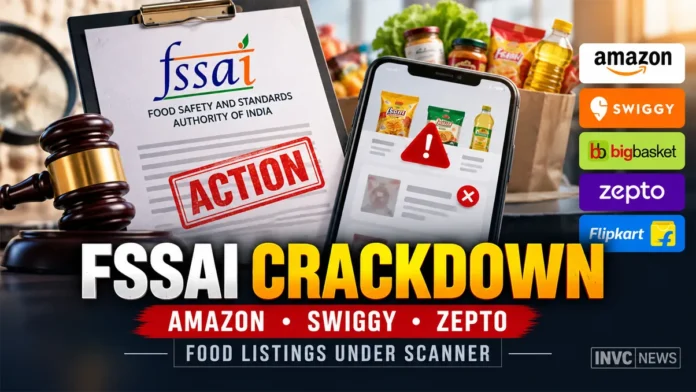
The FSSAI e-commerce crackdown has put some of India’s biggest online shopping and quick-commerce platforms under regulatory pressure, with the food safety authority initiating penal action against Amazon, Swiggy Instamart, BigBasket, Flipkart India and Zepto over alleged violations ranging from misleading product claims to the online display and sale of prohibited food articles.
The Food Safety and Standards Authority of India said it has launched a major enforcement drive against the five platforms after identifying multiple instances of regulatory non-compliance.
The allegations include misbranding, misleading claims, incomplete or non-compliant product information and the listing of products that should not have been offered as food.
One of the most serious cases involves Dhatura fruits and seeds, which FSSAI identified as a prohibited or poisonous food article.
Five Major Platforms Face Penal Action
FSSAI has initiated penal proceedings involving:
Amazon
Swiggy Instamart
BigBasket
Flipkart India
Zepto
The regulator has not accused every platform of exactly the same violation.
Instead, its action covers different products and different types of non-compliance across the platforms.
That distinction matters because the enforcement drive ranges from allegedly misleading marketing claims to a much more serious prohibited-product listing issue.
Happilo Date Bites Claims Under Scanner
FSSAI has initiated action against all five platforms over claims associated with Happilo Premium Date Bites – Zesty Orange.
The regulator said the online product presentation contained claims that did not comply with applicable food regulations.
For consumers, this part of the case raises an increasingly important question: should a product description on an online marketplace be treated with the same regulatory seriousness as a label printed directly on a food packet?
FSSAI’s answer is becoming increasingly clear.
When consumers buy food through an app or website, the information displayed online must also comply with food-safety and labelling rules.
Swiggy Instamart and BigBasket Face Dairy Product Action
FSSAI has separately initiated action against Swiggy Instamart and BigBasket over the online presentation of certain Milky Mist products.
The products named in the regulatory action include:
Milky Mist Fresh Low Fat Cream
Milky Mist Farm Fresh Curd
Milky Mist Greek Yoghurt
According to the regulator, the issue involves allegedly misleading claims and non-compliant product information.
The enforcement action signals that online platforms cannot simply reproduce promotional material without ensuring that food information meets regulatory requirements.
Dhatura Listing Raises the Most Serious Concern
The most striking part of the crackdown involves Dhatura fruits and seeds.
FSSAI found Amazon Seller Services, Swiggy Instamart and BigBasket non-compliant with provisions of the Food Safety and Standards Act, 2006 relating to the online sale, display or offer for sale of Dhatura as a food product.
Dhatura is associated with toxic substances and is not an ordinary edible food product.
FSSAI categorised the issue among cases involving prohibited or poisonous food articles.
That takes the matter beyond routine packaging or advertising compliance.
For an online marketplace, the case raises questions about how prohibited products enter food catalogues in the first place and what checks take place before a listing becomes visible to customers.
Why E-Commerce Platforms Are Also Responsible
One of the biggest lessons from the latest action is that responsibility does not end with the manufacturer.
Online marketplaces and quick-commerce companies increasingly act as the digital shop shelf through which consumers discover, compare and purchase food.
Product names, ingredient descriptions, health claims, nutrition information and photographs can directly influence buying decisions.
Therefore, inaccurate online information can affect consumers even when the physical product label itself contains different wording.
FSSAI’s enforcement push makes clear that digital sellers must monitor the food products appearing on their platforms.
Quick Commerce Has Made the Challenge Bigger
India’s quick-commerce sector has expanded rapidly.
Consumers can now order milk, yoghurt, snacks, packaged foods, fruits, supplements and thousands of grocery products for delivery within minutes.
That convenience has also created a massive compliance challenge.
Platforms can carry thousands of products across numerous warehouses and cities.
Listings can change rapidly.
Sellers can upload new products, promotional claims and descriptions at scale.
However, speed does not remove regulatory responsibility.
A product reaching a consumer in 10 minutes must still meet the same food-safety requirements as one purchased from a traditional supermarket.
FSSAI Has Intensified Enforcement in Recent Months
The latest action is not an isolated event.
Over the past six months, FSSAI has increased scrutiny of food business operators and e-commerce platforms.
The regulator has also become more public about enforcement action, using consumer-facing communication to highlight alleged violations.
Recently, FSSAI also initiated proceedings involving major food companies over labelling, nutritional standards and promotional claims.
The message to the industry is becoming harder to ignore: online food sales will face the same regulatory scrutiny as offline sales.
What Consumers Should Check Before Buying Food Online
Consumers should not assume that every claim displayed prominently on an app has received independent regulatory approval.
Before buying packaged food online, shoppers can check the product name, manufacturer, ingredients, nutritional information, expiry or best-before information and applicable FSSAI details.
Consumers should also be cautious when a listing makes unusually strong health or nutrition claims.
If the information displayed online appears inconsistent with the physical package delivered, the discrepancy deserves attention.
The current enforcement drive highlights why product information matters as much as delivery speed or discounts.
Will Products Be Removed From the Platforms?
FSSAI has announced penal action, but that does not mean every product connected with the investigation will automatically disappear permanently from every platform.
The outcome will depend on the specific proceedings, corrective action taken by companies and regulatory decisions.
Platforms can also update listings, remove prohibited products or correct information as part of compliance measures.
At the time the enforcement action was reported, the platforms had not provided immediate public responses to media queries.
Further responses or regulatory orders could therefore add new details to the case.
Bigger Message for Amazon, Zepto, Swiggy and Others
India’s online grocery battle has traditionally focused on price, delivery speed and selection.
Food safety is now becoming another competitive and regulatory battleground.
FSSAI’s latest move indicates that large platforms cannot treat product listings as passive digital noticeboards.
If a platform displays a food product, promotional claim or nutrition statement to millions of consumers, regulators can hold that platform accountable for compliance.
That changes the equation for marketplaces.
The fastest delivery will mean little if the underlying listing fails food-safety rules.
And after the latest crackdown, Amazon, Swiggy Instamart, BigBasket, Flipkart and Zepto now face a clear warning: online food shelves are under the regulator’s microscope.










[…] accountable for their listings, not just the sellers. One commentary observed that FSSAI’s move indicates large platforms cannot treat product listings as passive digital noticeboards, as they display […]
Comments are closed.