WASHINGTON, United States | September 24, 2026 —
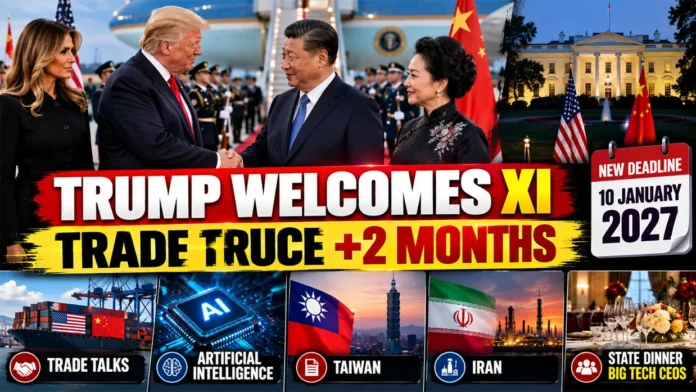
A red carpet at a military airfield, two presidential couples exchanging handshakes, fighter aircraft on display and some of the world’s most powerful technology executives preparing for a White House dinner.
But behind the ceremony surrounding the Trump-Xi Meeting 2026 lies a far more consequential story: the United States and China have bought themselves another two months to prevent their trade confrontation from heating up again.
US President Donald Trump and First Lady Melania Trump personally welcomed Chinese President Xi Jinping and Peng Liyuan at Joint Base Andrews after the Chinese leader arrived for a three-day state visit.
The airport greeting was itself unusual. American presidents rarely travel to the airfield to welcome visiting foreign leaders.
Yet the symbolism was only the opening act.
Before Trump and Xi began their main White House negotiations, US Treasury Secretary Scott Bessent announced that Washington and Beijing had agreed to extend their existing trade truce until January 10, 2027.
The previous deadline was November 10.
That does not mean the United States and China have reached a new comprehensive trade agreement.
It means the two sides have given their negotiators more time to try.
And that distinction could shape everything from tariffs and rare earths to artificial intelligence, Taiwan, agricultural trade and even the Iran crisis.
This Is a Trade Truce — Not a Grand Trade Deal
The most important thing to understand about the latest announcement is what it does not do.
Washington and Beijing have not resolved their major economic disputes.
They have extended an existing framework intended to prevent a renewed escalation while negotiations continue.
Bessent said the two countries agreed to continue what US officials call the Busan Agreement until January 10.
The arrangement had been due to expire in November.
The extension therefore acts like a temporary bridge.
It keeps the current negotiating structure alive while officials explore whether a broader economic agreement is possible.
For global markets and businesses, that reduces one immediate risk: a sudden return to another aggressive round of tariffs.
But it does not remove the disputes waiting underneath.
Why Did Washington and Beijing Add Only Two Months?
Because neither side appears ready to make all the concessions required for a sweeping settlement.
The United States wants progress on Chinese purchases of American goods, including agricultural products, and seeks more reliable access to critical minerals and rare-earth supplies.
Washington also maintains restrictions designed to limit Chinese access to some advanced technologies.
China, meanwhile, wants greater certainty over US tariffs and fewer barriers affecting technology and trade.
Those disagreements are not simple technical issues.
They are tied to national security, industrial policy and competition between the world’s two largest economies.
Two extra months give negotiators room to keep talking without requiring either government to declare that the underlying dispute has been solved.
Trump’s Airport Welcome Sends Its Own Message
The choreography surrounding Xi’s arrival was designed to be noticed.
Trump and Melania Trump met Xi and Peng Liyuan on the tarmac at Joint Base Andrews.
The two presidents stood together during the ceremonial welcome, with military elements accompanying the arrival.
The gesture gave Xi’s visit a level of personal attention that visiting leaders do not routinely receive.
That does not mean political differences have disappeared.
Rather, the reception shows that both governments are willing to create a diplomatic atmosphere in which negotiations can continue.
For China, the visit offers an opportunity to present the relationship as one that should be managed through dialogue rather than permanent confrontation.
For the Trump administration, the meeting creates a chance to pursue economic concessions while maintaining pressure on technology, trade and security issues.
State Dinner Brings Big Tech Into the Diplomatic Spotlight
The White House state dinner may look ceremonial, but its expected guest list tells another story.
US officials and Reuters reporting have identified a group of leading technology and business executives expected to attend.
Among them are:
Jeff Bezos — Amazon
Sundar Pichai — Alphabet
Sam Altman — OpenAI
Tim Cook — Apple
Elon Musk — Tesla
Jensen Huang — Nvidia
Michael Dell — Dell Technologies
Reuters has also reported that financial leaders including JPMorgan Chase CEO Jamie Dimon and Citigroup CEO Jane Fraser are expected to attend.
Pfizer CEO Albert Bourla is also among the reported guests.
The final guest list can still change until the White House formally confirms attendance.
But even the expected lineup shows why this summit matters far beyond traditional diplomacy.
Why Technology CEOs Matter to Trump-Xi Talks
The US-China relationship now runs through technology almost as much as it runs through trade.
Nvidia sits at the centre of the global AI-chip industry.
Apple depends on complex international manufacturing networks.
Tesla has major commercial interests in China.
Google, OpenAI and other US companies are competing in an increasingly strategic global AI race.
So when the United States talks to China about advanced chips, artificial intelligence, supply chains and technology restrictions, these companies are not watching from the sidelines.
Their businesses can be directly affected by the decisions governments make.
The state dinner therefore becomes more than pageantry.
It brings many of the companies most exposed to US-China competition into the same diplomatic orbit as the two presidents.
Rare Earths Could Be One of the Most Important Economic Issues
Rare-earth minerals may become one of the summit’s most consequential subjects.
China plays a dominant role in processing several critical minerals used in electronics, electric vehicles, defence technology, renewable energy and advanced manufacturing.
The United States wants greater certainty that these materials will continue flowing through global supply chains.
China, meanwhile, has its own concerns about American restrictions on advanced technologies.
That creates leverage on both sides.
Washington holds advantages in certain high-end technologies and semiconductor systems.
Beijing holds substantial influence in critical-mineral supply chains.
Any compromise in these areas could matter to companies around the world.
AI Has Moved From Silicon Valley Into Presidential Diplomacy
Artificial intelligence is another major issue.
US and Chinese officials have already discussed the possibility of creating a direct communication channel for serious AI-related concerns.
The concept is still at the discussion stage.
No binding AI safety agreement has been announced.
The difficulty is obvious.
Washington and Beijing both recognise potential risks from increasingly powerful AI systems.
At the same time, they are competing intensely for technological leadership.
That makes cooperation possible in narrow safety areas while broader strategic competition continues.
Taiwan Remains the Most Sensitive Political Flashpoint
Economic negotiations may produce compromises.
Taiwan is far harder.
Beijing considers Taiwan part of China and opposes US military support for the island.
Washington does not maintain formal diplomatic relations with Taiwan but continues to support Taiwan’s ability to defend itself under US policy and law.
Chinese officials are expected to raise US weapons sales and Washington’s broader Taiwan policy during the visit.
No major policy change has been announced by the United States.
That means Taiwan will likely remain an area where both sides may seek stability without resolving their underlying disagreement.
Iran Could Enter the Trump-Xi Conversation
The Middle East adds another layer.
China maintains important economic ties with Iran, including energy links.
The Trump administration wants Beijing to use its economic influence in ways that Washington believes could increase pressure on Tehran.
China has historically opposed unilateral US sanctions and has resisted attempts to let Washington dictate its commercial relationships.
That means Iran could connect two otherwise separate areas of diplomacy: US-China relations and the wider Middle East crisis.
Any discussion would be significant, but there is no confirmed agreement between Washington and Beijing on Iran at this stage.
What Could the Two-Month Trade Extension Actually Change?
The immediate effect is not dramatic.
Existing tariffs and restrictions do not suddenly disappear.
Companies do not wake up today to a completely new trading system.
The real benefit is reduced uncertainty.
Businesses that depend on US-China supply chains now have additional time before the next deadline.
Negotiators can continue discussing tariffs, export restrictions, agricultural purchases and critical minerals without an automatic November rupture hanging over them.
But January 10 creates another deadline.
If major differences remain unresolved then, trade tensions could return.
Boeing and Agricultural Purchases Will Be Watched Closely
Washington has also been seeking commercially significant commitments from China.
Agricultural purchases remain politically important in the United States.
Aircraft sales have also been discussed.
However, expectations around a major new Boeing commitment have recently become less certain, according to people familiar with those negotiations.
That is another reason the summit should not be treated as a guaranteed package of large deals.
Some announcements may emerge.
Others may remain unfinished.
Why India Should Watch This Summit Closely
India is not sitting at the negotiating table, but the outcome can still affect Indian economic interests.
A prolonged US-China trade confrontation can accelerate companies’ efforts to diversify manufacturing outside China.
India has been one of the countries seeking to benefit from that shift.
If Washington-Beijing relations become more stable, companies may reassess how quickly they diversify supply chains.
Rare-earth negotiations also matter for India’s electric-vehicle, electronics and renewable-energy industries.
AI and semiconductor policies affect India’s ambitions in advanced technology.
And any understanding involving China and Iran could influence oil markets, which matter directly to India as a major crude importer.
The Dinner Is Spectacular — The Negotiations Are Harder
Trump’s welcome gives Xi’s visit powerful images.
The red carpet sends a message.
The state dinner will bring global corporate leaders into the White House.
The two-month trade-truce extension removes one immediate source of tension.
But none of that means the US-China rivalry has disappeared.
Tariffs remain.
Technology restrictions remain.
Rare-earth leverage remains.
Taiwan remains unresolved.
AI competition is accelerating.
And geopolitical disagreements involving Iran add another layer of complexity.
That is why the most important outcome of Xi’s visit may not be one dramatic deal.
It may simply be whether the United States and China can keep competition from turning into another uncontrolled economic confrontation.
For now, Washington and Beijing have achieved one clear result:
They have moved the next trade deadline from November 10 to January 10 — buying two more months to find out whether a bigger agreement is actually possible.