NEW DELHI, India | September 24, 2026 —
A new self-employment opportunity is opening in Delhi’s transport sector, but applicants need to understand one important detail before rushing to apply:
The government is not giving away free e-autos.
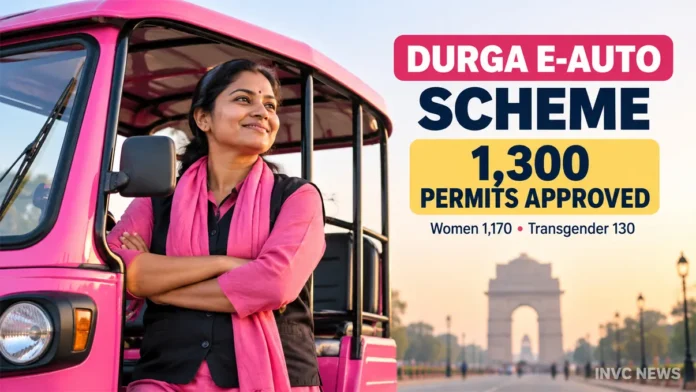
Under the newly approved DURGA E-Auto Scheme 2026, eligible women and transgender applicants will get access to reserved electric-auto permits along with financial support designed to make vehicle ownership easier.
The Delhi Cabinet, chaired by Chief Minister Rekha Gupta, has approved the first phase of the scheme with 1,300 pink electric-auto permits.
Of these:
1,170 permits will be reserved for women
130 permits will be reserved for transgender beneficiaries
The scheme is designed to expand self-employment opportunities, increase participation in public transport and strengthen cleaner last-mile connectivity across the capital.
For thousands of potential applicants, however, the most important questions are practical:
Who can apply?
How much financial help will be available?
Will applicants need to buy the e-auto themselves?
What documents will be required?
And what happens if applications exceed the available permits?
Here is the full breakdown.
What Is the DURGA E-Auto Scheme?
DURGA stands for:
Driving Upliftment and Rozgar for Women/Transgender Green e-Auto
The scheme aims to help eligible women and transgender persons become owners and drivers of electric autos in Delhi.
The vehicles will carry distinctive DURGA branding and are expected to operate as part of Delhi’s wider last-mile transport network.
The first phase will allocate 1,300 permits.
The government plans to distribute them across Delhi’s revenue districts instead of concentrating them in only a few areas.
How Many E-Auto Permits Will Each District Get?
Under the approved structure, each revenue district can receive a maximum of:
90 e-autos for women
10 e-autos for transgender beneficiaries
That gives the government a mechanism to spread opportunities geographically across Delhi.
Actual allocation will depend on applications and final implementation rules.
Who Can Apply? Eligibility for Women
Women applying under the DURGA E-Auto Scheme must meet several conditions.
The applicant must:
Be between 20 and 40 years of age
Be a resident of Delhi
Hold a valid voter ID
Hold a valid Light Motor Vehicle driving licence
Possess a Public Service Vehicle badge
The family’s annual income must not exceed:
₹5 lakh
There is another important ownership condition.
Neither the woman applicant nor a member of her family should already own a registered transport vehicle or three-wheeler.
The eligibility rules also state that a woman with more than three children will not qualify under the current scheme conditions.
Applicants should check the final portal notification carefully when applications officially open because documentary requirements will determine eligibility.
What Are the Rules for Transgender Applicants?
Transgender applicants are also included in the scheme.
They will need to satisfy the prescribed age, Delhi-residency, driving-licence and PSV-badge requirements.
In addition, a transgender applicant will need a valid transgender certificate issued through a Delhi District Magistrate’s office.
A total of 130 permits have been reserved for transgender beneficiaries in the first phase.
Will the Government Give a Free E-Auto?
No.
This is one of the most important points for applicants.
The scheme does not provide a completely free electric auto.
Selected beneficiaries will have to purchase the vehicle.
However, the government plans to reduce the financial burden through incentives and financing support.
Reported provisions include an incentive of up to ₹50,000, along with access to loan and interest-support mechanisms available under Delhi’s electric-vehicle framework.
The exact final benefit available to each applicant should be confirmed from the official application notification before purchase.
Why Financial Support Matters
An electric auto represents a substantial investment for a low-income household.
Even when operating costs can be lower than those of conventional fuel-powered vehicles, the initial purchase cost can remain difficult for many applicants.
That is why the combination of:
Purchase incentive
Loan availability
Interest assistance
can become central to whether the scheme succeeds as a livelihood programme.
The stated objective is to make e-auto ownership more accessible to people who may not otherwise be able to finance a commercial vehicle easily.
How Will Applications Be Submitted?
Applications will be accepted through a dedicated online portal that will be created for the DURGA scheme.
The government has not yet announced the final opening date for applications.
Applicants should therefore avoid unofficial websites or agents claiming to guarantee permits.
Once the official portal goes live, applicants will likely need to provide identity, residence, income, driving and category-related documents.
The government is expected to publish detailed application instructions before registrations begin.
What If More Than 1,300 People Apply?
Demand could easily exceed the number of available permits.
If eligible applications cross the sanctioned quota, beneficiary selection may be conducted through a lottery system.
That means meeting eligibility conditions alone may not guarantee a permit if applications substantially exceed availability.
The final selection procedure will be detailed in the implementation notification.
Three-Year Lock-In: You Cannot Immediately Sell the Auto
The scheme includes a significant safeguard.
Vehicles allocated under DURGA will have a mandatory three-year lock-in period.
During those three years, beneficiaries will not be allowed to sell or transfer the e-auto to another person.
The rule is intended to prevent permits or subsidised vehicles from being acquired primarily for resale.
It also keeps the programme focused on actual self-employment.
Pink E-Autos Will Carry DURGA Identity
The vehicles are expected to be pink and carry distinctive DURGA identification.
That branding serves two purposes.
First, it makes participating vehicles easy for passengers to recognise.
Second, it creates a visible transport category associated with women and transgender drivers.
The government says the initiative is intended to support cleaner mobility and expand participation in Delhi’s public-transport ecosystem.
Charging Could Be Linked With Metro Stations
Charging infrastructure will be critical if 1,300 additional electric autos enter Delhi’s road network.
According to officials, the Delhi Metro Rail Corporation has already identified charging space in parking areas at 70 metro stations.
That could become especially useful if DURGA vehicles are integrated with metro stations for first-mile and last-mile passenger services.
For drivers, charging availability can directly affect daily income because long waiting periods at chargers reduce working hours.
Why Last-Mile Connectivity Matters
Delhi has one of India’s largest Metro and bus systems.
Yet a common challenge remains the final stretch between a transport hub and a passenger’s home, office, school or market.
E-autos already play an important role in filling that gap.
The DURGA scheme seeks to connect livelihood creation with that transport requirement.
If implemented effectively, drivers could generate income while passengers gain another local mobility option.
Scheme Could Create Jobs Beyond Driving
The employment impact may not stop with 1,300 drivers.
Officials expect additional demand in connected sectors such as:
EV charging
Vehicle servicing
Battery maintenance
Repair
Battery recycling
As Delhi’s electric commercial-vehicle fleet expands, these supporting services could also grow.
What Applicants Should Prepare Now
The application portal is not yet live, but interested applicants can begin checking whether they meet the basic conditions.
Keep the following ready:
Valid voter ID
Delhi residence documents
LMV driving licence
PSV badge
Income proof
Relevant family vehicle details
For transgender applicants, the prescribed transgender certificate
Applicants should also check the validity of their licence and PSV documentation now instead of discovering an expired document after registrations open.
Do Not Pay Anyone for a ‘Guaranteed Permit’
Whenever a government permit scheme receives high public interest, unofficial agents can appear promising guaranteed approval.
Applicants should be cautious.
Selection will take place through the official process.
If applications exceed the available permits and a lottery is used, no private agent can legitimately guarantee selection.
Use only the government’s authorised application system once it becomes operational.
DURGA Scheme: The Key Numbers
Total permits: 1,300
For women: 1,170
For transgender beneficiaries: 130
Women applicant age: 20–40 years
Maximum annual family income: ₹5 lakh
Maximum per district: 90 women + 10 transgender beneficiaries
Vehicle transfer restriction: 3 years
Application mode: Online
Selection if oversubscribed: Lottery may be used
Vehicle type: Pink electric auto
The Biggest Question Now: When Will Applications Open?
The Cabinet approval clears the biggest policy hurdle.
The next step is operational.
Delhi’s Transport Department will need to launch the application portal, publish detailed documentation requirements and clarify the final process for vehicle purchase, incentives, financing and permit allocation.
That application date will become the most important update for potential beneficiaries.
Until then, eligible applicants should prepare their documents rather than depend on unofficial claims.
For Delhi residents who meet the conditions, the DURGA E-Auto Scheme could create something more valuable than a transport permit:
a route into self-employment through ownership of an electric commercial vehicle.