MUMBAI, India | September 24, 2026 —
For devotees still asking one question — “Ganesh Visarjan 2026 kab hai?” — the confusion can finally end.
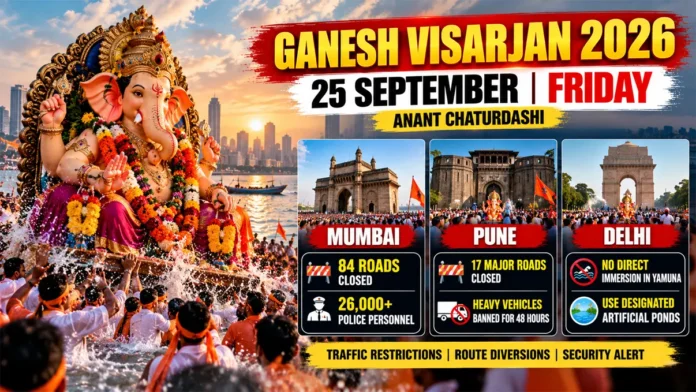
The grand farewell to Lord Ganesha on Anant Chaturdashi will take place on Friday, September 25, 2026.
The final day of Ganeshotsav is expected to bring massive immersion processions, devotional crowds and major traffic restrictions across several Indian cities, with Mumbai and Pune preparing for especially intense movement.
Delhi has also made separate arrangements for immersion, including designated artificial ponds, because direct idol immersion in the Yamuna remains prohibited.
For devotees, September 25 will be a day of chants, drums and emotional farewells.
For commuters, however, it could also be a day of road closures, diversions, parking restrictions and long delays.
Ganesh Visarjan 2026 Date: September 25 Confirmed
Anant Chaturdashi falls on Friday, September 25 this year.
According to traditional Panchang calculations, Shukla Chaturdashi begins at around 11:18 PM on September 24 and ends at around 11:06 PM on September 25.
That makes September 25 the main Anant Chaturdashi Ganesh Visarjan day.
Families and mandals may have already performed immersion after one-and-a-half, three, five or seven days according to their traditions.
However, the largest public processions traditionally take place on Anant Chaturdashi.
That is why authorities expect September 25 to see the highest pressure on roads, beaches, immersion ghats and public transport.
Mumbai Prepares for Its Biggest Ganesh Visarjan Day
Mumbai will once again become the centre of the country’s biggest Ganesh Visarjan celebrations.
Large community Ganpati idols from Lalbaug, Parel and other parts of the city will move toward major immersion points through the day and deep into the night.
Girgaon Chowpatty is expected to attract some of the heaviest crowds.
Dadar, Juhu, Versova, Mahim, Powai and other designated immersion locations will also see significant activity.
Mumbai authorities have prepared an extensive security and traffic-management operation for the occasion.
More Than 26,000 Police Personnel on Mumbai Streets
Mumbai Police are deploying a massive security force for Anant Chaturdashi.
More than 26,000 police personnel and officers, along with specialised security units, are expected to be part of the bandobast.
Authorities are also using:
CCTV surveillance
AI-enabled monitoring systems
Drones
Quick Response Teams
Specialised armed units
Dedicated teams for missing children
Women police officers
Emergency medical arrangements
The scale reflects the enormous crowds expected across Mumbai on the final day of Ganeshotsav.
Mumbai: 84 Roads Set to Close
Traffic will be one of the biggest challenges.
Authorities have announced that 84 roads and road stretches will be closed to general traffic, while around 20 roads will operate with one-way restrictions.
Other routes will face parking bans and temporary diversions as immersion processions advance.
Areas around Lalbaug, Parel, Girgaon Chowpatty and Dadar deserve particular attention.
Restrictions can also change dynamically depending on the movement of processions.
Motorists travelling between north and south Mumbai should therefore avoid assuming that their regular route will remain open throughout Friday.
Public transport could be the easier option.
Mumbai Gets Special Local Train Arrangements
The suburban railway network is also preparing for the festival rush.
Special late-night suburban services have been planned around the final immersion period.
Additional arrangements are expected for passengers travelling toward major immersion destinations, especially around Girgaon.
People travelling late at night should still check station-level announcements because crowd-control measures can alter entry and exit arrangements.
Mumbai Has Hundreds of Artificial Immersion Ponds
The city has significantly expanded artificial immersion facilities.
Hundreds of artificial ponds and designated natural immersion locations have been prepared.
Under current arrangements, smaller idols — including specified idols up to six feet — are directed toward designated artificial immersion facilities.
Larger idols can use authorised natural water-body locations subject to applicable civic and environmental rules.
Devotees should use only authorised immersion sites.
Pune Faces Major Road Shutdown From Early Morning
Pune’s traffic restrictions are also extensive.
The city’s main Ganesh Visarjan procession will move through traditional central-city routes on September 25.
Pune Traffic Police have announced phased closure of 17 important roads.
Restrictions will begin as early as 5 AM in some locations and expand as the processions move through central Pune.
The traditional procession network includes:
Laxmi Road
Tilak Road
Kumthekar Road
Kelkar Road
Other major roads including Shivaji Road, Bajirao Road, Jangli Maharaj Road, Fergusson College Road and parts of Satara and Solapur roads will also face restrictions at different stages.
Heavy Vehicles Barred in Pune for 48 Hours
One of the toughest Pune measures concerns heavy vehicles.
Their entry into the city will remain restricted for about 48 hours, beginning shortly after midnight on September 25 and continuing through September 26.
The aim is to prevent large vehicles from blocking procession routes, ambulances and emergency traffic.
Police have also identified alternative routes around central Pune.
Residents who do not need to enter the main immersion corridors should avoid them.
Pune Launches Live Traffic Tracking
Pune Police have also activated a dedicated digital system for real-time Ganesh Visarjan information.
The system provides updates covering:
Procession movement
Road closures
Traffic diversions
Parking locations
Emergency medical points
Alternative routes
It also allows citizens to follow the movement of major Ganpati processions.
This can be particularly useful because a road may be open in the morning and closed later when a procession approaches.
Delhi: Do Not Take Ganesh Idols Directly Into Yamuna
Delhi’s biggest rule is environmental.
Direct idol immersion in the Yamuna is prohibited.
Authorities have instead arranged artificial immersion ponds at multiple locations across the capital.
Temporary facilities have been created in areas across east, west, north, south and southwest Delhi.
Devotees should use designated artificial ponds rather than attempting direct immersion in the river.
This distinction is especially important for families planning their Visarjan journey on Friday.
Delhi Traffic Could Tighten Around Immersion Locations
Delhi does not experience the same citywide Ganesh Visarjan scale as Mumbai or Pune, but local congestion can still become heavy near major immersion locations.
Movement around designated ponds and procession routes could slow during the afternoon and evening.
Residents should avoid unnecessary travel near crowded immersion points and follow local traffic-police instructions.
Because arrangements can vary by district, devotees should confirm their nearest authorised immersion location before leaving home.
Ganesh Visarjan Muhurat on September 25
Devotees who prefer to follow traditional Choghadiya-based timings have several windows available through the day.
For Mumbai, commonly listed auspicious windows include approximately:
Morning: 6:28 AM to 10:59 AM
Afternoon: 12:30 PM to 2:01 PM
Evening: 5:02 PM to 6:32 PM
Night: 9:31 PM to 11:01 PM
Some immersion processions can continue well after midnight because large public mandals may take many hours to reach the sea.
Families should remember that local traditions can differ.
Before Leaving for Visarjan, Do These Five Things
Check the latest road status before leaving.
Prefer Metro, local trains or other public transport where practical.
Do not park on procession corridors.
Use only authorised immersion locations.
Keep children and older family members close in heavy crowds.
Carrying drinking water and keeping emergency contact numbers accessible can also help during long processions.
Why September 25 Will Be Different From a Normal Friday
Ganesh Visarjan does not simply create one procession.
Thousands of idols, mandals, vehicles and devotees can enter the road network at different times.
A route that appears clear in the morning can become completely restricted by afternoon.
That is particularly true in central Mumbai and Pune.
Friday commuters should therefore build extra travel time into their plans.
People heading to airports, railway stations, hospitals or important appointments should leave considerably earlier than usual.
Ganpati Bappa’s Final Farewell
For millions of devotees, however, September 25 is ultimately not about traffic.
It is the emotional final chapter of Ganeshotsav.
After days of prayers, aartis, celebrations and community gatherings, devotees will carry Bappa toward immersion with the familiar chant:
“Ganpati Bappa Morya, Pudhchya Varshi Lavkar Ya.”
Mumbai’s streets will fill with drums.
Pune’s historic Ganpati mandals will move through their traditional routes.
Families across Delhi and other cities will gather at designated immersion sites.
The festival will end with a farewell — and a promise to welcome Bappa again next year.