NEW DELHI, India | September 24, 2026 —
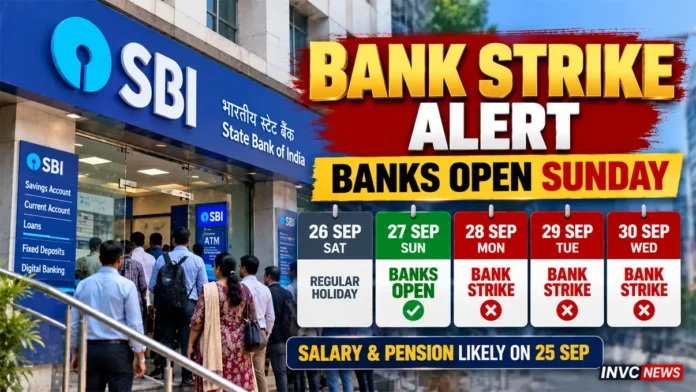
Bank Strike September 2026 could disrupt branch-based banking services across India from September 28 to September 30, but customers have received an important relief ahead of the proposed three-day nationwide action.
Public Sector Banks and Regional Rural Banks will remain open and function normally on Sunday, September 27, after authorities approved special banking operations to prevent customers from facing an extended disruption around the weekend and strike dates.
There is another major development for millions of families.
Central Government employees and pensioners may receive their September salary, wages and pension on Friday, September 25, instead of waiting until the usual month-end payment cycle.
The government has taken the step because the proposed strike coincides with the closing days of September and could affect banking transactions.
For customers with cheques, cash deposits, branch work, loan documentation or other time-sensitive banking requirements, the message is clear: finish important branch transactions before the strike begins.
When Is the Bank Strike?
The United Forum of Bank Unions has called for a nationwide strike on:
Monday, September 28
Tuesday, September 29
Wednesday, September 30
The action follows an earlier one-day strike held on September 11.
As of the morning of September 24, the September 28–30 action remains proposed after discussions involving unions, the government and banking representatives.
Customers should therefore continue monitoring updates because negotiations can still affect whether the strike proceeds exactly as announced.
Are Banks Closed on September 26?
September 26 falls on the fourth Saturday of the month.
Under the normal banking calendar, banks remain closed on the second and fourth Saturdays.
Therefore, regular branch banking would ordinarily remain unavailable on Saturday, September 26.
That initially raised fears of an effective five-day interruption covering September 26, 27, 28, 29 and 30.
The government has now moved to break that sequence.
Banks Will Open on Sunday, September 27
This is the most important update for customers.
Public Sector Banks and Regional Rural Banks have been asked to function normally on Sunday, September 27.
The special opening creates a banking window between Saturday’s scheduled holiday and the proposed three-day strike.
Bank branches, offices, ATM-linked branches and currency chests covered by the arrangement are expected to remain operational.
Therefore, customers who cannot complete important branch work by Friday will have another opportunity on Sunday.
Does Sunday Opening Apply to Every Bank?
Customers should pay attention to an important distinction.
The announcement specifically concerns Public Sector Banks and Regional Rural Banks.
It should not automatically be interpreted as an instruction that every private-sector bank branch in India will open on September 27.
Customers of private banks should check instructions issued directly by their respective banks before planning a Sunday branch visit.
Why Have Bank Unions Called the Strike?
The dispute has centred on demands raised by bank employee unions.
One of their principal demands is implementation of a five-day banking week.
Unions have argued that an understanding regarding five-day banking was reached earlier with the Indian Banks’ Association, with working hours on weekdays to be adjusted accordingly.
However, implementation requires further government action.
Another major dispute involved a Performance Linked Incentive scheme.
The government has subsequently kept that scheme in abeyance.
The five-day banking demand therefore remains a key unresolved issue behind the proposed strike.
Government Appeals to Unions
The government has appealed to bank employees and unions to avoid disruption and continue discussions.
Conciliation meetings have involved representatives of the unions, Indian Banks’ Association, Department of Financial Services and bank managements.
The government says dialogue should continue while banking services for customers remain protected.
Unions, meanwhile, continue to press for resolution of their outstanding demands.
The next few days will determine whether negotiations produce any further change before September 28.
Central Government Salary May Arrive on September 25
The strike has also prompted a significant decision involving government employees.
September salary and wages of eligible Central Government employees may be drawn and disbursed on Friday, September 25.
The arrangement includes employees in areas such as Defence, Posts and Telecommunications.
Industrial employees covered by the Central Government arrangement may also receive September wages early.
This is not an additional salary payment.
It is an advance disbursement of the September payment because of the possibility of banking disruption toward the end of the month.
Pensioners Also Get Relief
Central Government pensioners are also covered by the advance-payment arrangement.
Their September pension may be disbursed through banks or Pay and Accounts Offices on September 25.
Any necessary adjustment after calculation of the complete month’s entitlement can subsequently be made according to the applicable government instructions.
The measure aims to ensure pensioners do not face unnecessary delays because of the strike period.
Will ATMs Work During the Bank Strike?
ATM services are generally designed to remain available even when bank branches are closed.
Banks have been asked to prepare for possible disruption and maintain cash availability.
However, customers should not assume every ATM will have cash throughout a prolonged period of heavy withdrawals.
Demand can rise sharply before and during bank strikes.
People who require cash for essential expenses may therefore prefer to withdraw a reasonable amount in advance rather than waiting until the final day.
There is no need for panic withdrawals.
Will UPI Work During the Bank Strike?
Digital services such as UPI, mobile banking, internet banking and card payments are generally expected to remain available, because these services do not depend on normal branch counters remaining open.
However, some services that involve manual processing, branch authorization or banking staff could face delays.
Customers should therefore distinguish between digital payments and branch-dependent transactions.
Routine UPI payments may continue, while a cheque-clearing or documentation request could take longer.
Which Banking Services Could Be Affected?
If the strike proceeds, the biggest effect is likely to fall on activities requiring physical staff or branch processing.
These can include:
Cheque clearing and processing
Cash deposits or withdrawals at branches
Demand drafts
Loan documentation
Account-service requests
Certain settlement operations
Government and institutional banking work
Branch-based customer-service requests
Digital services could reduce the impact for ordinary day-to-day payments, but they cannot replace every banking function.
SBI and Other Customers Should Plan Ahead
Customers of large Public Sector Banks should avoid leaving important work until September 28.
If a transaction requires a branch employee, original documents, verification, a banker’s cheque or another manual procedure, completing it before the strike window can reduce the risk of delay.
Businesses should pay particular attention because September 30 also marks an important financial closing period.
Payroll, vendor payments and time-sensitive settlements should therefore be reviewed before the weekend.
Bank Strike and September 30 Closing
The timing makes this strike especially significant.
September 30 falls at the end of the month and also coincides with an important accounting and banking closing period.
Banks normally handle substantial reconciliation, treasury, settlement and operational work around these dates.
A three-day strike during the same period could therefore create a larger operational burden than a routine one-day strike.
That explains why authorities are taking precautionary measures before the weekend.
What Bank Customers Should Do Before September 28
Customers do not need to panic, but a little planning can prevent unnecessary trouble.
Complete urgent branch transactions before the strike begins.
Deposit important cheques early.
Keep enough cash for essential needs, without making excessive withdrawals.
Activate mobile and internet banking if you have not already done so.
Check that your UPI and debit or credit cards work properly.
Businesses should review salary, supplier and scheduled payment requirements.
Customers with urgent work at a Public Sector Bank or Regional Rural Bank can also use the special Sunday opening on September 27.
Could the Strike Still Be Cancelled?
Yes.
A strike announcement does not mean disruption is absolutely certain until the action actually begins.
Negotiations and conciliation can continue before September 28.
The government has appealed for the proposed action to be deferred, while unions continue to seek resolution of the five-day banking issue.
Customers should therefore check the latest announcement from their bank before making travel arrangements specifically for the strike period.
Bank Strike September 2026: Key Dates to Remember
September 25, Friday: Central Government salary, wages and pensions may be paid early.
September 26, Saturday: Fourth Saturday; regular scheduled bank holiday.
September 27, Sunday: Public Sector Banks and Regional Rural Banks to open under the special arrangement.
September 28, Monday: Proposed nationwide bank strike begins.
September 29, Tuesday: Proposed strike Day 2.
September 30, Wednesday: Proposed strike Day 3.
The special Sunday opening means customers are not currently facing an automatic five-day continuous shutdown of Public Sector Banks and Regional Rural Banks.
That distinction is crucial.
For anyone with important banking work due around the end of September, September 25 and the special September 27 opening are the two dates worth remembering most.