WASHINGTON, United States | September 24, 2026 —
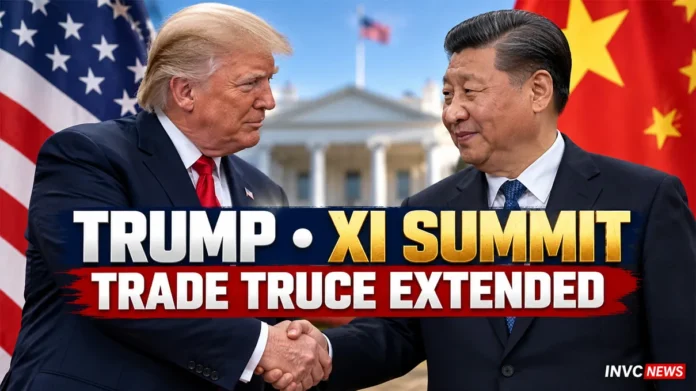
Trump-Xi Summit Today puts the world’s two largest economies at the centre of global attention as US President Donald Trump prepares to hold White House talks with Chinese President Xi Jinping on Thursday.
Xi arrived in the United States on Wednesday for a three-day state visit from September 23 to 25.
In an unusual diplomatic gesture, President Trump personally welcomed Xi at Joint Base Andrews in Maryland.
The two leaders now head into talks covering trade, tariffs, rare-earth minerals, advanced technology, artificial intelligence, Taiwan and China’s economic relationship with Iran.
One significant development has already emerged before the formal summit.
US Treasury Secretary Scott Bessent said Washington and Beijing agreed to extend their existing trade truce until January 10, 2027.
That agreement reduces the immediate risk of another sharp tariff escalation, although several major economic and geopolitical disputes remain unresolved.
Trump Personally Welcomes Xi in Maryland
Xi’s arrival received a high-profile ceremonial welcome.
Trump met the Chinese president at Joint Base Andrews after his aircraft landed in the Washington area.
Trump and Xi shook hands and spoke briefly before posing for photographs.
Their arrival ceremony also included a military band and other formal elements associated with the state visit.
Xi’s trip marks his first visit to the United States in nearly three years.
China’s Foreign Ministry has described the visit as an opportunity for the two countries to strengthen dialogue, manage disagreements and expand areas of cooperation.
US-China Trade Truce Extended Until January 10
The first concrete development surrounding the visit concerns trade.
Treasury Secretary Scott Bessent said the United States and China agreed to extend their existing tariff truce until January 10.
The arrangement had previously been due to expire on November 10.
The extra two months give negotiators more time to work on broader economic disagreements.
The United States and China imposed sharply higher tariffs on each other’s goods during their earlier trade confrontation before agreeing to pause parts of that escalation.
For global companies, investors and supply chains, extending the truce reduces one immediate source of uncertainty.
However, it does not amount to a comprehensive trade settlement.
Tariffs and Trade Remain at the Centre
Trade will remain one of the most closely watched parts of today’s Trump-Xi meeting.
Washington wants progress on Chinese purchases of American agricultural products and other goods.
The United States has also pushed China to reduce non-tariff barriers affecting American companies.
Aircraft purchases could enter the discussion as well.
US officials have previously said China was making progress on a commitment involving Boeing aircraft, although no major new order has been formally announced ahead of the summit.
China, meanwhile, wants greater certainty over American tariffs and technology restrictions.
That leaves both sides with economic demands they want addressed.
Rare Earths Could Become One of the Toughest Issues
Critical minerals and rare earths sit close to the centre of the US-China economic relationship.
China holds a dominant position in several stages of the global rare-earth supply chain.
These materials play important roles in electric vehicles, electronics, defence systems, renewable energy equipment and advanced manufacturing.
Washington wants Beijing to ease restrictions affecting exports of rare earths and critical minerals.
China, however, has pressed the United States over restrictions that limit Chinese companies’ access to advanced American technologies.
That creates a difficult negotiation.
The United States has leverage through advanced semiconductor technology, while China has significant leverage through critical-mineral supply chains.
Taiwan Will Remain a Sensitive Issue
Taiwan is likely to remain one of the most sensitive subjects in the talks.
Beijing claims Taiwan as part of China and opposes official relations or military support that it believes strengthens Taiwanese independence.
Taiwan’s government rejects Beijing’s sovereignty claim.
The United States does not maintain formal diplomatic relations with Taiwan but provides defence support under US law and remains Taiwan’s most important international security partner.
China has repeatedly objected to US arms sales to Taiwan.
Washington, meanwhile, has publicly stressed the importance of peace and stability across the Taiwan Strait.
No change in formal US policy toward Taiwan has been announced ahead of today’s meeting.
Iran Could Enter Trump-Xi Talks
Iran adds another complicated dimension.
China maintains substantial economic links with Iran and remains a major buyer of Iranian oil.
The Trump administration wants Beijing to use its economic influence to encourage changes in Tehran’s behaviour amid the continuing conflict involving Iran.
US officials have also raised concerns about financial links between China and Iran.
China has opposed unilateral sanctions that lack United Nations Security Council authorization and has maintained its own approach toward Tehran.
That means Trump and Xi enter the Iran discussion with significantly different positions.
Whether the talks produce any practical agreement on Iran remains unclear.
Artificial Intelligence Moves Onto Diplomatic Agenda
Artificial intelligence represents one of the newer elements of US-China diplomacy.
The two countries compete intensely in advanced AI systems, semiconductors and computing infrastructure.
At the same time, officials on both sides have explored whether communication could reduce the risk of a serious AI-related security incident.
Before the summit, US and Chinese officials discussed establishing a dedicated AI dialogue.
American officials have also floated a notification mechanism that could allow Washington and Beijing to communicate during major AI incidents with national-security implications.
No binding AI agreement has been announced.
Today’s meeting could show whether that proposal moves toward a more formal process.
Chips and Advanced Technology Remain Major Fault Lines
Semiconductors are closely connected to the AI dispute.
Washington restricts the export of some advanced chips, manufacturing equipment and technology to China.
US officials argue that restrictions involving sensitive technology protect national-security interests.
Beijing has repeatedly criticised American technology restrictions and argues that they hinder Chinese companies and distort normal economic activity.
China has sought greater access to advanced technologies, while Washington has continued to defend controls on strategically sensitive products.
Neither side has indicated that this fundamental disagreement has disappeared.
Business Leaders Also Watching Closely
The summit matters well beyond diplomacy.
Technology, manufacturing, agriculture, automotive and financial companies all have significant exposure to US-China relations.
Reports indicate that senior executives from major technology companies are expected around events connected with Xi’s visit.
Companies are particularly interested in developments involving tariffs, rare-earth supplies, chip restrictions and market access.
Even a limited agreement in one of those areas could affect global supply chains.
No Single Deal Expected to Resolve Every Dispute
The summit covers too many complicated issues for one meeting to settle them all.
Trade, Taiwan, semiconductors, rare earths, Iran and artificial intelligence involve different strategic interests and negotiating tracks.
Instead, today’s talks may show whether Washington and Beijing can prevent individual disputes from triggering a broader breakdown in relations.
The extension of the trade truce provides one early sign that both governments are willing to keep negotiations running.
The details of any additional agreements will matter more than ceremonial statements.
Why India Will Watch the Trump-Xi Meeting Closely
The summit also carries implications for India.
India trades extensively with both the United States and China.
Any major change in US-China tariffs can alter global supply chains, manufacturing investment and commodity flows.
Rare-earth policy matters for India’s electronics, electric-vehicle and clean-energy industries.
Changes in semiconductor restrictions could also affect global technology supply chains in which India is seeking a larger role.
Meanwhile, developments involving China, Iran and energy markets can influence crude-oil prices and broader geopolitical conditions relevant to India.
For New Delhi, the summit therefore matters economically as well as strategically.
Trump-Xi Summit Today: What to Watch
Several developments could emerge from today’s talks.
The first is confirmation and detail of the trade-truce extension.
The second is any agreement covering tariffs, agricultural purchases or other trade barriers.
Rare-earth exports and technology controls will provide another important signal.
Taiwan-related language will attract close scrutiny across Asia.
Any announcement on an AI communication mechanism would mark a new area of bilateral engagement.
Finally, statements concerning Iran could show whether the two countries have found any common ground on one of today’s major geopolitical conflicts.
Xi’s arrival has already produced one tangible outcome: more time for trade negotiations.
What comes next will show whether Washington and Beijing can turn that temporary stability into agreements on the harder issues separating them.