NEW DELHI, India | September 22, 2026 —
Honda QC3 India has officially entered the electric-scooter battle with a simple promise: give families enough range for daily commuting, enough storage for real-world use and enough technology to make an ordinary city ride easier.
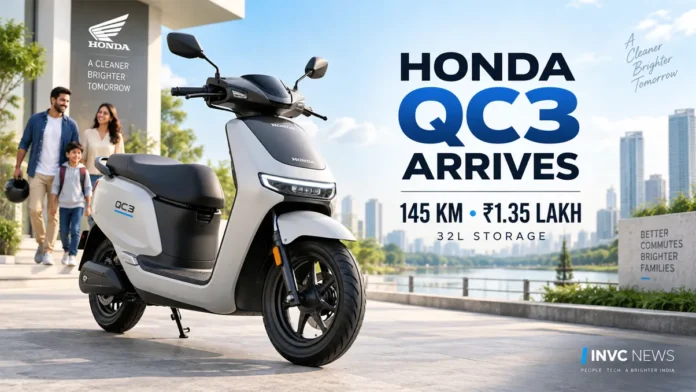
Honda Motorcycle & Scooter India has launched the new QC3 at ₹1.35 lakh ex-showroom, New Delhi. The electric scooter packs a 3.0kWh battery, 145 km certified IDC range and a massive 32-litre underseat storage compartment.
And that combination could make the QC3 far more interesting than its understated design initially suggests.
Honda is not pitching this as a flashy performance EV.
It is pitching it as the scooter a family may actually use every single day.
₹1.35 Lakh Price Puts Honda Straight Into the EV Fight
The Honda QC3 carries an introductory ex-showroom price of ₹1,35,000 in New Delhi.
Bookings have opened with a ₹5,000 token amount, and Honda will initially sell the scooter in five cities:
Delhi
Agra
Cuttack
Surat
Kollam
Sales will begin through select Honda RedWing dealerships.
That limited-city launch suggests Honda is taking a measured approach before expanding availability further.
But at ₹1.35 lakh, QC3 immediately enters one of India’s most fiercely contested electric two-wheeler segments.
145 Km Range: Enough to Forget the Charger for Days?
This is where the QC3 begins making a strong family-use case.
Honda claims a certified 145 km IDC range on a full charge from its fixed 3.0kWh battery.
Real-world range can vary with speed, traffic, rider weight, weather and riding style, so buyers should not treat the IDC figure as a guaranteed everyday number.
Still, 145 km on paper gives the QC3 useful breathing room.
A rider commuting 20–30 km each day may not necessarily need to plug it in every night.
For a family scooter, that convenience may matter more than blistering acceleration figures.
32-Litre Boot Could Be Its Secret Weapon
Range gets the headline.
But 32 litres of underseat storage may be the feature families appreciate every single day.
Honda says the QC3 offers the largest underseat storage space in its current EV range.
That space can become useful for:
a helmet,
office bag,
groceries,
children’s essentials,
rainwear,
or everyday shopping.
This sounds ordinary.
That is precisely the point.
Family scooters succeed when they make ordinary tasks easier.
0–80% Charge in 2 Hours 40 Minutes
Honda says the QC3 can charge from 0 to 80% in around 2 hours and 40 minutes.
A full charge takes approximately four hours.
For buyers with access to home charging, that makes overnight charging straightforward.
Even a shorter top-up during the day could provide enough battery for routine urban travel.
Unlike Honda’s battery-swapping Activa e:, the QC3 uses a fixed battery approach, making it a more conventional plug-in EV proposition.
Honda Has Given It the Tech Families Will Actually Use
Honda has avoided turning the QC3 into a gadget showcase merely for the spec sheet.
Instead, the main connected features focus on everyday usability.
The scooter gets a 5-inch TFT display with Honda RoadSync, including connected functions and turn-by-turn navigation.
It also gets Honda’s Smart Key, allowing keyless convenience for routine use.
That means riders can get navigation information directly on the scooter instead of constantly checking a phone mounted on the handlebar.
Four Colour Options
Honda is offering the QC3 in four colour choices:
Matte Photon Grey Metallic
Pearl Precious White
Pearl Shallow Blue
Pearl Siren Blue
The palette keeps the scooter firmly in the family-premium zone rather than giving it an overly aggressive appearance.
Why Honda Calls It a ‘Smart Family EV’
The phrase “family EV” can easily become marketing language.
In the QC3’s case, however, the hardware explains the positioning.
Look at the combination:
145 km certified range
32-litre storage
Smart Key
5-inch connected TFT
Turn-by-turn navigation
around four-hour full charging
None of these specifications alone sounds revolutionary.
Together, however, they answer many of the questions a family asks before replacing a petrol scooter with an EV.
Where will we keep our things?
How often will we charge?
Can it handle office commuting?
Can another family member use it easily?
Will navigation work without constantly handling a phone?
That is where Honda appears to have concentrated its effort.
QC3 Could Be More Important to Honda Than It Looks
Honda already has enormous brand recognition in India’s petrol-scooter market.
But electric scooters are a different battle.
Established EV players and traditional manufacturers have already spent years building products, charging ecosystems and customer familiarity.
Honda therefore needs more than its badge to win buyers.
QC3 gives the company a relatively conventional electric scooter that customers can understand immediately.
No complicated proposition.
Charge it.
Ride it.
Put your bag under the seat.
Come home.
Repeat.
That simplicity could become one of its strongest advantages.
What About Range Anxiety?
For many people considering their first electric scooter, this remains the biggest concern.
A 145 km IDC claim looks reassuring, but actual usable range will inevitably be lower in some real-world conditions.
Therefore, buyers should calculate their own daily travel instead of focusing only on the headline figure.
Someone travelling 25 km per day has a very different requirement from someone travelling 80 km.
The important number is not necessarily the maximum claimed range.
It is whether the scooter comfortably completes your routine without forcing you to think constantly about the battery.
And on paper, the QC3 appears to have enough buffer for many urban commuters.
Limited Launch Could Be the Biggest Catch
There is one obvious limitation at launch.
Availability.
Honda is initially restricting QC3 sales to Delhi, Agra, Cuttack, Surat and Kollam.
So buyers elsewhere may have to wait until Honda expands the RedWing rollout.
The company has not yet announced a nationwide availability date in the sources reviewed.
For interested buyers outside those cities, that may be more important than any specification.
Honda QC3: Key Specifications
| Feature | Honda QC3 |
|---|---|
| Price | ₹1.35 lakh ex-showroom, New Delhi |
| Battery | 3.0kWh |
| Certified Range | 145 km IDC |
| 0–80% Charging | Around 2 hr 40 min |
| Full Charging | Around 4 hours |
| Underseat Storage | 32 litres |
| Display | 5-inch TFT |
| Connectivity | Honda RoadSync |
| Key | Smart Key |
| Initial Cities | Delhi, Agra, Cuttack, Surat, Kollam |
| Booking Amount | ₹5,000 |
The ₹1.35 Lakh Question
Honda has not tried to make the QC3 look like an electric superbike.
That may turn out to be exactly why people notice it.
A family scooter does not need to win a drag race.
It needs to start every morning.
Carry bags.
Handle school or office runs.
Offer enough range.
Fit everyday life.
And cost enough that a buyer can realistically consider putting one in the parking space.
At ₹1.35 lakh, with 145 km claimed range and 32 litres of storage, Honda has given the QC3 a straightforward sales pitch:
less range anxiety, more room for real life.
Now the real test begins — whether Indian families believe that promise strongly enough to switch from petrol to plug.