NEW DELHI, India | September 22, 2026 —
The tablet in your medicine strip may look perfectly normal. The packaging may carry a familiar brand name. The batch number may be printed neatly.
But what happens when the medicine inside fails a government quality test — or worse, the brand itself is being used by an unauthorised manufacturer?
India’s latest drug-quality surveillance has delivered an uncomfortable reminder.
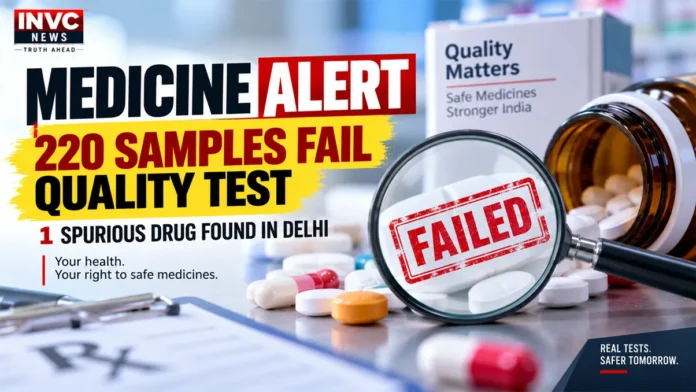
Government laboratories identified 220 drug samples as Not of Standard Quality, or NSQ, during August 2026, while authorities also detected one spurious drug sample in Delhi.
Of the 220 NSQ samples, Central Drugs Laboratories identified 29, while State Drugs Testing Laboratories reported 191.
And then came the more disturbing finding.
A drug sample collected in the National Capital Territory of Delhi was classified as spurious, with regulators saying it had allegedly been manufactured by unauthorised operators using a brand name belonging to another company.
The case is now under investigation.
First Understand This: 220 Failed Samples Are Not 220 Fake Medicines
This distinction is critical.
An NSQ medicine and a spurious medicine are not the same thing.
When a sample is classified as Not of Standard Quality, it means the tested product failed one or more specified quality parameters.
That does not automatically mean the medicine was deliberately counterfeited.
It also does not mean every strip, bottle or batch sold under that brand name is defective.
The finding applies primarily to the specific sample and batch tested.
A spurious medicine is a much more serious category.
It can involve a product pretending to be another medicine or falsely claiming to have been manufactured by a company that did not actually make it.
The Delhi Case Is What Should Make Consumers Pay Attention
The single spurious sample detected in Delhi stands apart from the 220 NSQ findings.
According to the regulatory alert, unauthorised manufacturers allegedly used a brand name belonging to another company.
Think about what that means for an ordinary consumer.
The box can look familiar.
The brand name can look genuine.
The patient may have bought that medicine before.
Yet the company named on the package may not have manufactured that product at all.
That is why counterfeit medicine is particularly dangerous: the deception can begin before the patient even opens the pack.
How Can Fake Medicines Enter the Market?
There is no single route.
The Delhi finding points to one of the clearest methods: an unauthorised manufacturer allegedly producing a drug while using another company’s brand identity.
India’s drug law recognises several situations in which a medicine may be considered spurious.
These include a drug manufactured under the name of another drug, an imitation likely to deceive buyers, a product falsely presented as belonging to another manufacturer, or a medicine substituted wholly or partly with another substance.
In simple language, the packaging may be telling you one story while the product’s real origin tells another.
A Famous Brand Name Can Become the Bait
Counterfeiters do not necessarily need to create a new brand.
A familiar name can itself become the attraction.
If consumers, pharmacists and doctors already recognise a popular medicine, copying that identity can make an unauthorised product easier to sell.
This is exactly why traceability matters.
The challenge for regulators is not only testing what is inside a tablet.
They must also establish:
Who manufactured it?
Where was it manufactured?
Which batch did it come from?
Who distributed it?
Does the packaging match the genuine manufacturer’s records?
When that chain breaks, the risk increases.
What Does NSQ Actually Mean?
A medicine can fail quality testing for different reasons depending on the product and the parameter examined.
Government testing can examine whether a medicine meets prescribed requirements relating to its composition, strength and other quality specifications.
If a particular sample fails the required parameter, it can be declared NSQ.
Again, this should not be misunderstood.
An NSQ result is serious enough to trigger regulatory attention, but it is not automatically evidence of counterfeiting.
That is why CDSCO publishes NSQ and spurious-drug alerts separately.
Why Are So Many Samples Being Found?
There is another side to the 220 figure.
India has substantially intensified drug testing and regulatory surveillance.
The government says more than one lakh drug samples are being tested annually, while CDSCO and state authorities have conducted risk-based inspections of more than 960 manufacturing units since December 2022.
Those inspections resulted in more than 860 regulatory actions, including show-cause notices, stop-production orders, warnings and suspension or cancellation of licences.
So a high number of identified samples also reflects a surveillance system actively looking for problems.
The alarming outcome is not that laboratories are finding defective medicines.
The much more dangerous situation would be if nobody were testing them at all.
Government Is Tightening the Digital Trail
Authorities are increasingly turning to technology to make counterfeiting harder.
Manufacturers of major medicines are already subject to barcode or QR-code requirements under India’s traceability framework.
In June 2026, the Health Ministry expanded that framework further to cover additional categories including vaccines, antimicrobials, anti-cancer drugs and narcotic and psychotropic medicines under phased implementation.
These codes can store information such as:
the product identity,
brand and generic name,
manufacturer details,
batch number,
manufacturing date,
expiry date,
and manufacturing licence number.
The objective is simple:
A medicine should leave a digital trail that can be checked.
Regulators Have Also Targeted Fake Data
The problem does not end with fake packaging.
In August 2026, the Union Health Ministry announced stricter rules allowing licensing authorities to debar applicants who submit fake or fabricated information in regulatory applications.
Authorities can already reject applications or cancel licences in such cases.
The move reflects a wider effort to make manipulation anywhere in the pharmaceutical approval or manufacturing chain more difficult.
What Should Patients Do?
Patients should not stop taking prescribed medicines simply because a brand appears in a quality alert or because reports say hundreds of samples failed.
A medicine should not be abandoned abruptly without medical advice, particularly for chronic or serious conditions.
Instead, consumers can take practical precautions.
Buy medicines from licensed and established pharmacies.
Check the pack for unusual printing, spelling mistakes, damaged seals or suspicious changes in appearance.
Look at the batch number and expiry date.
Where a QR or barcode authentication system is available, use it.
Keep the bill, particularly for expensive or critical medicines.
And if a tablet, packaging or medicine suddenly looks different from what you normally receive, ask the pharmacist or prescribing doctor before using it.
Do Not Turn One Failed Batch Into Panic Over an Entire Brand
This point deserves repeating.
The August alert does not establish that 220 medicine brands are fake.
It identifies 220 tested samples as failing specified quality requirements.
The regulator itself says the result relates to the product batch tested and should not automatically create concern about every other medicine sold in the market.
The Delhi spurious-drug case is a separate and more serious finding.
That investigation is still underway.
But One Fake Medicine Is Still One Too Many
Medicines are different from most consumer products.
If a fake shirt reaches the market, somebody loses money.
If a fake or seriously substandard medicine reaches a patient, the stakes can involve health and potentially life.
That is why the August numbers matter.
220 samples failed quality requirements.
One suspected fake medicine surfaced in Delhi.
And regulators are now trying to establish who made it and how it entered the supply chain.
For patients, the message is not to panic.
It is to become harder to fool.
Because when medicine comes in a familiar box, the most important question is not simply what the label says.
It is whether the medicine inside is really what that label promises.