NEW DELHI, India | September 22, 2026 —
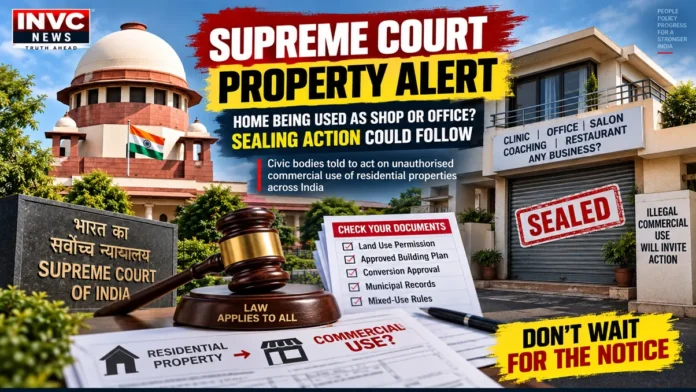
The Supreme Court on Tuesday directed municipal and civic authorities across India to prioritise action against the commercial use of residential properties where such activity violates applicable building or land-use rules.
A Bench of Justices Ahsanuddin Amanullah and R. Mahadevan said authorities should inspect cases where residential properties are being used for unauthorised commercial purposes and seal premises wherever violations are clearly established.
At the same time, the Court drew an important distinction.
Where the permitted land use of an area is unclear — whether residential, commercial or mixed — authorities must first examine the legal status of the area. The Court said no coercive action should be taken in such cases for the time being.
The direction could have implications for cities across India where houses and residential plots are frequently converted into shops, offices, clinics, coaching centres, restaurants, warehouses or other businesses without appropriate land-use permission.
Supreme Court Warns Against Selective Action
The Bench also issued a strong warning to municipal authorities against selective enforcement.
The Court made it clear that civic bodies must undertake the exercise uniformly and without discrimination.
If authorities act only against selected properties while ignoring other similarly situated violations, the Supreme Court indicated that it would view such conduct seriously.
This part of the direction is significant because disputes over unauthorised construction and commercial misuse frequently involve allegations that authorities enforce building rules against some properties while overlooking others.
The Court wants municipal bodies to apply the rules consistently.
What Happens to Residential Properties Used Commercially?
The direction does not mean that every business operating from a residential property will automatically be sealed.
The crucial question will be whether that commercial activity is permitted under the applicable master plan, zoning regulations, municipal rules, mixed-use provisions or other local laws.
Where commercial activity is clearly prohibited but continues inside a residential property, civic authorities have been asked to take action.
Where commercial or mixed use is legally permitted, the property would have to be examined under the relevant local rules.
Therefore, homeowners and business operators need to distinguish between commercial use of a residential building and unauthorised commercial use.
That legal distinction will determine whether enforcement action applies.
Areas With Unclear Land Use Get Temporary Protection
The Supreme Court separately addressed another category of properties.
Some localities may not have a clearly established classification showing whether they are meant exclusively for residential use, commercial activity or mixed use.
The Bench directed authorities to examine such areas too.
However, it said authorities should not immediately take enforcement action in those cases until the land-use position becomes clear.
This safeguard could become important in older colonies, rapidly urbanised settlements and areas where development patterns have changed faster than formal planning regulations.
Case Started With Illegal Construction Dispute in Chennai
The nationwide direction emerged while the Supreme Court was hearing a matter concerning alleged illegal construction in Chennai.
During earlier proceedings, the Court had expressed concern about widespread violations of building regulations and land-use norms.
The Bench had noted that unauthorised construction was not confined to one city or one state.
It therefore widened the scope of scrutiny.
The Court subsequently examined situations where houses and plots in residential colonies were allegedly being put to unauthorised commercial use.
Tuesday’s directions now place responsibility on civic authorities across the country to identify and address such violations.
Why the Supreme Court Is Focusing on Land-Use Rules
Urban planning rules divide land into different categories for a reason.
Residential, commercial, industrial and mixed-use areas often have different requirements relating to traffic, parking, fire safety, sanitation, building density and public infrastructure.
When a residential property begins handling commercial activity that its location was never designed to support, it can create pressure on roads, parking, water supply and neighbourhood infrastructure.
However, India’s cities have also evolved significantly.
Many residential areas legally permit certain categories of shops, professional services or mixed-use activities.
That is why the exact local rule will matter.
The Court’s order focuses on violations of approved land use rather than treating all commercial activity inside residential neighbourhoods as automatically illegal.
Shops, Offices and Clinics Should Check Local Rules
The direction could be particularly relevant to property owners who have converted residential premises into commercial establishments.
Depending on local municipal regulations, affected uses could include:
shops, offices, restaurants, coaching centres, warehouses, salons, clinics or other commercial operations.
However, the legality of each activity will depend on the rules applicable to that property and locality.
A business operating legally under an approved mixed-use provision cannot automatically be treated in the same way as a business operating in clear violation of residential zoning.
Similarly, property owners may have obtained conversion permission or paid applicable conversion charges under local regulations.
Municipal authorities will therefore have to verify the legal status before taking action.
Civic Bodies Told to Act on Priority
The most important part of the Supreme Court’s direction is the emphasis on enforcement.
Municipal bodies cannot simply keep violations pending indefinitely where the law clearly prohibits the activity.
Authorities have been asked to identify such properties and act on a priority basis.
Where violations are established, sealing can follow in accordance with the applicable legal process.
At the same time, the Court’s warning against selective enforcement places an additional responsibility on municipal officials.
They will have to demonstrate consistency.
Could Your Property Be Affected?
Property owners should first check the sanctioned use of their premises.
A residential property being used entirely or partly for commercial activity may fall into one of several categories:
Permitted use: Local rules specifically allow the activity.
Mixed use: Residential and certain commercial activities are allowed subject to conditions.
Converted use: The owner has obtained permission to change the sanctioned use.
Unauthorised use: Commercial activity is prohibited but is still being carried out.
Unclear classification: The applicable land-use category itself remains disputed or uncertain.
The Supreme Court’s latest direction primarily targets the fourth category, while authorities have been told to examine the fifth category without taking immediate coercive action.
Nationwide Enforcement Could Now Gather Pace
The order places the issue squarely before municipal corporations, development authorities and other local bodies across India.
The immediate impact will depend on how individual cities implement the direction and what their own master plans and building rules permit.
Delhi, Mumbai, Chennai, Bengaluru, Hyderabad, Kolkata and other large cities all have their own land-use and mixed-use regulations.
Therefore, the practical consequences will differ from city to city.
What remains common is the Supreme Court’s broader message:
clear violations cannot be ignored, but enforcement must be uniform, lawful and non-discriminatory.
For property owners and businesses operating from residential buildings, the safest immediate step is to verify the sanctioned land use and applicable municipal permissions rather than assume that an activity is legal simply because it has operated for several years.