
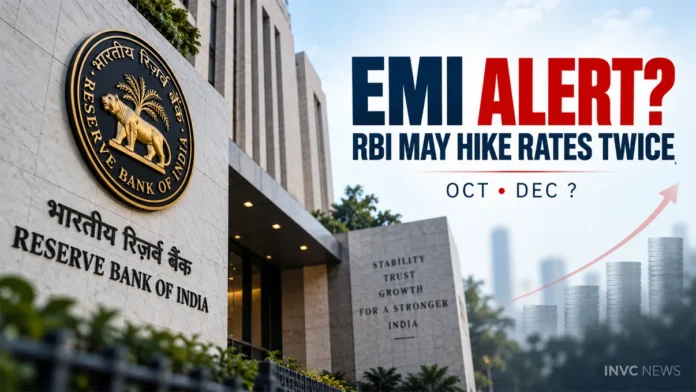
NEW DELHI, India | September 22, 2026 — Home loan borrowers, car buyers and businesses hoping that interest rates will stay where they are may want to watch the next two Reserve Bank of India meetings very closely.
Global financial-services firm Nomura expects the RBI to raise interest rates in both October and December, arguing that India’s strong economic growth is now being accompanied by a fresh inflation threat.
Rob Subbaraman, Nomura’s Head of Global Macro Research, said the firm expects India’s economy to grow around 7% in FY 2026-27, but inflation could move above 6% in the coming months.
That combination could put the RBI in an uncomfortable position:
growth is strong enough to tolerate tighter policy — but inflation may become too hot to ignore.
Two RBI Meetings, Two Possible Rate Hikes?
Nomura’s base case is striking.
The firm expects the RBI to raise rates in October and again in December.
This is a forecast, not an announced RBI decision.
The RBI’s policy repo rate currently stands at 5.25%.
If Nomura’s view proves correct, India could be heading into a fresh monetary-tightening cycle after a period in which borrowers had hoped the rate environment would remain relatively stable.
And that is where the story moves from economists’ spreadsheets to household budgets.
What Could an RBI Rate Hike Mean for Your EMI?
When the RBI raises the repo rate, borrowing costs across the banking system can eventually move higher.
For borrowers with loans linked to external benchmarks, including some floating-rate home loans, lenders may pass on part or all of the increase.
That could mean:
higher home-loan EMIs,
longer loan tenures,
more expensive car loans,
higher borrowing costs for businesses,
and potentially costlier fresh personal loans.
The exact impact would depend on the lender, the loan structure and how quickly any policy-rate change is transmitted.
So there is no reason to panic over an EMI increase today.
But borrowers now have a reason to watch the October policy decision.
Why Would RBI Raise Rates When India Is Growing So Fast?
Normally, strong growth sounds like good news.
And it is.
Nomura expects India to grow around 7% in FY27, broadly reinforcing the increasingly upbeat assessment of the Indian economy.
Moody’s recently raised its own FY27 growth forecast from 6% to 7%, citing India’s resilience despite the Middle East conflict and high energy risks.
The problem is that an economy can sometimes become strong enough for inflationary pressures to build.
If demand remains robust while food, fuel and other costs accelerate, policymakers may worry that inflation becomes harder to control.
That is why strong GDP growth can actually give a central bank more room to raise rates.
The thinking is simple:
if the economy can absorb tighter money, the RBI may have greater freedom to attack inflation.
The Number That Could Worry RBI: 6%
Nomura expects inflation to cross 6% in the coming months.
That would be significant because the RBI’s inflation framework operates around a 4% target with a tolerance band.
Recent inflation has already been moving higher.
And global energy prices remain a major wildcard.
India imports large quantities of crude oil, which means an extended period of expensive energy can work its way through transport costs, manufacturing, logistics and eventually consumer prices.
That is why what happens thousands of kilometres away in the Middle East can ultimately matter to an Indian household’s monthly budget.
RBI Is Already Draining Excess Liquidity
There is another clue markets are watching.
The RBI has been aggressively reducing excess liquidity in the banking system.
Reuters reported that surplus liquidity has fallen by about 55%, from ₹11.16 trillion to ₹4.92 trillion, following bond sales, foreign-exchange operations and other measures.
That does not itself guarantee a rate hike.
But tighter liquidity can make future monetary-policy tightening more effective.
And Nomura is not alone in expecting higher rates.
Reuters reported that several economists and institutions have begun positioning for an October hike, while ANZ expects a sequence of increases that could eventually take the repo rate higher.
Suddenly, the question in the market is changing.
A few months ago it was:
Will RBI cut?
Now it is increasingly:
How many times could RBI hike?
India Still Has a Big Global Investment Opportunity
Subbaraman’s message was not bearish on India.
Far from it.
He believes India has substantial potential to attract global capital and capture a larger share of international value chains.
That becomes especially important as companies rethink manufacturing locations, supply chains and geopolitical exposure.
India has opportunities across several industries.
However, Subbaraman also highlighted one area where competition could become intense:
artificial intelligence.
If the AI investment boom remains heavily concentrated in the United States and Northeast Asia, India could struggle to capture the same scale of investment in selected high-end technology segments.
So the opportunity is enormous.
But so is the competition.
Money Is Still Coming Into India
Nomura also sees scope for stronger capital inflows.
Subbaraman pointed to better-than-expected flows into FCNR-B deposits and the possibility of a strong balance-of-payments surplus.
That matters because strong foreign-currency inflows can provide support to India’s external position.
However, the rupee, oil prices and foreign portfolio flows remain closely connected to global interest-rate expectations.
And that brings us to the other central bank keeping markets awake.
US Federal Reserve Is Not Finished Either
The US Federal Reserve raised its benchmark federal funds target range by 25 basis points to 3.75%-4.00% on September 16.
Nomura expects at least one more increase this year, most likely in December.
The Federal Reserve’s own September projections underline that hawkish tilt.
Of 18 policymakers, 12 projected one additional hike in 2026, four projected two further hikes and only two projected no additional increase.
That is an unusually clear signal.
The world’s most influential central bank is still worried about inflation.
And if US rates stay higher, emerging economies including India must factor those global financial conditions into their own policy calculations.
Trump-Xi Summit Adds Another Layer
Interest rates are not the only event markets are watching.
Diplomacy is becoming another major market variable.
Investors are closely tracking developments around the UN General Assembly as well as an upcoming meeting between US President Donald Trump and Chinese President Xi Jinping in Washington.
Trade, artificial intelligence, Taiwan and geopolitical tensions are among the issues surrounding the summit.
Markets hope diplomatic progress could reduce some trade restrictions and geopolitical risk.
If that happens, energy prices and long-term bond yields could ease.
If tensions escalate instead, inflation risks could move in the opposite direction.
Iran and Oil Could Still Rewrite the Rate Story
The Middle East remains the biggest unpredictable piece.
Iran has indicated that it could reopen the Strait of Hormuz to Gulf shipping if certain conditions involving US military pressure and port restrictions are met. That possibility helped Brent crude drop below $100 on Tuesday.
But the situation remains fluid.
Subbaraman argued that high energy costs are already putting pressure on the US economy and downstream oil businesses.
If oil surges again, the inflation problem facing both the Fed and RBI could become more difficult.
If diplomacy pushes oil materially lower, central banks could gain breathing room.
One geopolitical headline could therefore change the entire interest-rate calculation.
Strong Growth Is Good News — Higher Rates Are the Catch
India currently finds itself in an unusual economic position.
GDP growth is strong.
Global institutions are upgrading forecasts.
Capital inflows could improve.
Manufacturing opportunities are expanding.
But inflation is knocking on the door again.
And that creates the twist in the story.
The stronger India grows, the easier it may become for the RBI to justify tighter monetary policy if inflation refuses to cooperate.
For borrowers, that means the next few months may matter far more than expected.
October Is Now the Month to Watch
Nothing has been decided yet.
Nomura’s October-and-December call remains an economic forecast.
The RBI’s Monetary Policy Committee will make its own decisions based on inflation, growth, liquidity, currency conditions and incoming data.
But the direction of the debate has clearly changed.
Inflation could cross 6%.
India could still grow around 7%.
The Fed has already raised rates.
Nomura expects RBI to follow.
For an economy running strongly, that is the uncomfortable trade-off.
The growth engine is humming.
But if prices heat up too quickly, the RBI may decide it is time to press the brake.
And for millions of borrowers, the next question will be brutally simple:
Will your EMI be the next number to rise?