TEHRAN, Iran | September 22, 2026 — Iran’s international aviation network is facing one of its toughest tests in years as sweeping US sanctions begin rippling through airports, fuel suppliers and aviation companies far beyond American borders.
Washington has warned that from September 23, foreign businesses continuing to provide key services to sanctioned Iranian airlines could themselves face US penalties.
And the impact is already becoming visible.
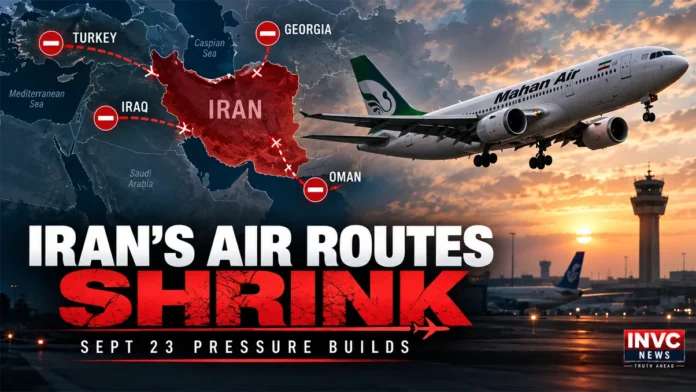
Iraq is moving to suspend operations by US-sanctioned Iranian airlines, while Iran’s major private carrier Mahan Air has halted flights to Turkey and Georgia following decisions by aviation authorities there.
Oman had already forced Mahan Air’s Muscat route to stop earlier this month.
For Tehran, the problem is no longer simply that its airlines are sanctioned.
The bigger danger is this:
Will foreign airports still be willing to fuel them, handle them, sell their tickets or let them land?
September 23 Could Become the Real Pressure Point
US Treasury Secretary Scott Bessent has warned that Iranian airlines could become effectively unable to operate internationally once the latest sanctions regime fully bites.
The United States is targeting not merely aircraft operators but the wider ecosystem that keeps international aviation running.
That can include:
airports,
fuel suppliers,
ground-handling companies,
ticketing agents,
maintenance providers,
and other businesses serving sanctioned Iranian carriers.
Companies continuing such support could risk US secondary sanctions or restrictions involving the dollar-based financial system.
That is why September 23 matters.
The US does not need to physically close another country’s runway.
If servicing an Iranian aircraft becomes financially dangerous enough, airlines can find that runway effectively closed anyway.
US Treasury Sanctioned 27 Iranian Airlines
The pressure campaign began earlier this month.
On September 8, the US Treasury’s Office of Foreign Assets Control announced sanctions against 36 targets linked to Iran’s aviation sector, including 27 Iranian airlines that Treasury said were operating in the country’s aviation sector.
The list included Iran Airtour, Iran Aseman Airlines, Kish Airlines, Qeshm Air, Sepehran Airlines, Taban Airlines and Zagros Airlines, among others.
Mahan Air was not a newly sanctioned airline in that action because it had already been under US sanctions since 2011.
But the latest measures targeted companies and service networks that help Iranian aviation operate abroad.
That distinction is crucial.
A sanction on an airline hurts.
A sanction network that scares away its fuel suppliers, sales agents and airport partners can hurt far more.
Iraq Becomes a Major Blow
Iraq’s decision could be especially painful for Tehran.
Two Iraqi government sources told AFP that Baghdad would suspend flights by Iranian airlines covered by US sanctions.
Iraq is one of Iran’s most important regional travel markets, particularly for religious tourism involving Najaf and Karbala.
That means this is not simply a diplomatic inconvenience.
It could affect:
pilgrims,
business travellers,
families,
airline revenue,
and commercial links between two neighbouring countries.
For Iranian carriers, losing easy access to Iraq removes one of the closest and most strategically important international destinations.
Turkey: Mahan Air Routes Stop
Turkey represents another major pressure point.
Mahan Air announced that its flights connecting Iran with Istanbul and Ankara would stop from September 21 until further notice.
The airline attributed the suspension to decisions taken by Turkish aviation authorities.
Turkey has traditionally been one of the most accessible international destinations for Iranian travellers.
That makes the loss of those routes more than symbolic.
Istanbul in particular acts as a major gateway connecting passengers onward to Europe and other global destinations.
When that door narrows, Iran’s aviation isolation becomes much more visible.
Georgia Route Goes Too
Mahan Air’s Georgia flights were also suspended from September 21.
Again, available reporting points specifically to Mahan Air routes rather than evidence that Georgia has imposed a blanket prohibition on every Iranian airline.
That distinction matters.
The sanctions story is moving rapidly, and headlines suggesting that every Iranian aircraft has already been banned across all three countries would go beyond the verified facts.
What is clear is that Iran’s available international route network is shrinking.
Fast.
Oman Had Already Moved
Before Turkey and Georgia, Oman had already acted.
Mahan Air’s Tehran-Muscat service was suspended from September 17 following a decision by Omani aviation authorities.
Put the developments together:
Muscat.
Istanbul.
Ankara.
Georgia.
And now Iraqi restrictions on sanctioned Iranian carriers.
One route after another is becoming more difficult.
But Iran Says This Is Not Yet a Total Shutdown
There is an important counterpoint.
Iran Air, the country’s national airline, said on Tuesday that it had not been informed of a blanket ban on flights to neighbouring countries.
Mahan Air has also stressed that the suspension of its own routes does not mean Iranian airspace has been closed or that every Iranian airline has stopped serving Turkey, Oman or other nearby destinations.
So the phrase “all Iranian airlines are already grounded worldwide” would be premature.
The more accurate picture is:
the operating environment is becoming so restrictive that international flying may become increasingly difficult for sanctioned Iranian carriers.
That is still a major escalation.
Why Aviation Sanctions Hurt More Than Airlines
Commercial aviation is an ecosystem.
A plane cannot simply fly because an airline owns it.
It needs:
aviation fuel,
landing rights,
airport slots,
maintenance,
spare parts,
ground crews,
insurance,
payment processing,
ticket sales,
and often access to international financial institutions.
Cut enough of those links and the aircraft may remain technically airworthy but commercially unusable.
That is what makes the latest US strategy particularly powerful.
Washington is trying to target the network around Iranian aviation rather than simply individual aircraft.
Ordinary Travellers Could Pay the Price
The geopolitical battle is fought between governments.
But disruption lands on ordinary passengers first.
Reduced international connectivity can mean:
fewer flights,
higher ticket prices,
longer journeys,
more connections,
and fewer options for Iranian families, students and business travellers.
Iran’s aviation sector has already spent decades dealing with restrictions on aircraft purchases, spare parts and maintenance.
The latest pressure comes on top of those longstanding problems.
Iran’s Trade Links Could Also Feel the Squeeze
Passenger travel is only one part of the equation.
Aircraft also move cargo.
Businesses depend on international aviation for high-value and time-sensitive goods.
If Iran becomes harder to reach by air, the effect can spread to:
trade,
logistics,
tourism,
corporate travel,
and investment.
That makes aviation sanctions another layer in the broader effort to isolate Tehran economically.
Tehran Is Running Out of Easy Air Corridors
This may ultimately be the most important part of the story.
Iran is not completely cut off from the sky.
Not yet.
But the map is becoming increasingly uncomfortable.
Mahan Air has lost important routes.
Iraq is moving against sanctioned carriers.
Foreign service providers face growing US pressure.
And September 23 brings another escalation in the sanctions environment.
For Tehran, the question is no longer simply whether Iranian aircraft are legally allowed to fly.
It is whether enough foreign airports and companies will still be willing to help those aircraft fly.
That is a much harder problem to solve.
Because an airline can survive being unwelcome in one country.
It becomes far more difficult when fuel, runways, banking and ground services start disappearing together.