By Team INVC | INVC NEWS
NEW YORK, United States | September 22, 2026 —
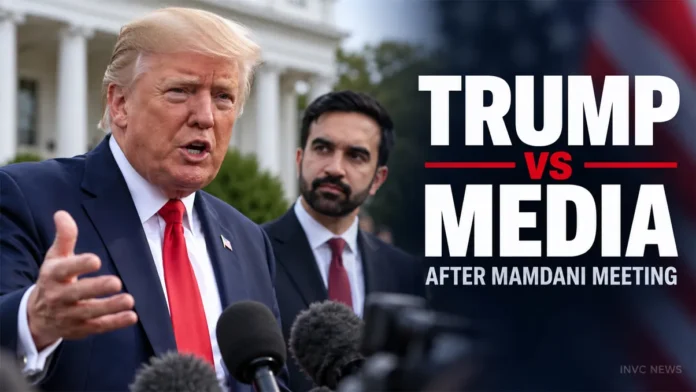
Donald Trump walked out of his latest meeting with New York City Mayor Zohran Mamdani and straight into another confrontation with the American media.
Asked about television networks pulling back coverage after the White House barred CNN, MS NOW and Politico, the US president brushed aside the idea that he had been successfully boycotted.
“They said they were gonna boycott me, but they never boycott me,” Trump told reporters at Gracie Mansion, pointing to the journalists gathered in front of him.
Then came the familiar Trump barrage.
He accused major news organisations of refusing to give his administration positive coverage, claimed that $21 trillion in investment was “pouring in” to the United States, praised his economic and foreign-policy record and turned abruptly to Iran.
His message on Tehran was equally unequivocal:
Iran, he said, would not get a nuclear weapon.
In less than two minutes, a question about press access had turned into a wider argument about the media, the economy, war and presidential power.
Trump says the boycott never really happened — but TV networks did stop pool coverage
Trump’s dismissal came against a very real disruption in White House media operations.
After the administration barred CNN, MS NOW and Politico from White House grounds, several major television networks declined to participate in the traditional television pool that provides shared footage of presidential events.
ABC, CBS, NBC, Fox News and other outlets were among those involved in suspending pool coverage. CNN, MS NOW and Politico have also sued the Trump administration, arguing that their exclusion violates constitutional protections. The administration says access to the White House is not an unrestricted right and has defended the action by accusing the outlets of unfair or false coverage.
So Trump’s statement that the media “never boycott” him reflected his own characterization of the situation rather than the literal absence of a boycott.
At Gracie Mansion, however, one thing was obvious: plenty of reporters were still present.
And Trump seized on that visual.
From press freedom to ‘I never get anything positive’
Trump argued that news organisations have an obligation to treat his administration fairly.
He said he had accomplished major things but rarely received favorable coverage.
Among his claims were that his administration had achieved historic economic numbers, settled eight wars and attracted $21 trillion in investment.
He then accused CNN and MS NOW of biased reporting and defended his decision to exclude outlets he regards as producing “fake news.”
The media organisations involved reject that characterization and argue that barring outlets because of their coverage amounts to retaliation against independent journalism. That dispute is now before a federal court.
The $21 trillion number is the claim that needs a closer look
Trump’s investment number was one of the most eye-catching lines of the exchange.
He said the United States had $21 trillion “pouring in.”
But that figure should not be treated as settled economic data.
Recent reporting found that Trump has repeatedly cited investment totals of around $20 trillion or more, while the investment commitments listed by his own White House have been substantially lower. Some of those commitments also stretch over many years and include prospective purchases or pledges rather than money already invested in the United States.
That does not mean no major investment has been announced.
The administration has publicised large commitments from companies and foreign governments.
But “$21 trillion already pouring in” is Trump’s claim, not an independently established total of completed investment.
That distinction is critical.
Then Trump abruptly turned to Iran
The exchange became more serious when Trump linked his complaints about media coverage to the war with Iran.
“We’ve done so well,” he said before adding that Iran was “not gonna have a nuclear weapon.”
He said he had meetings on Iran scheduled that day and claimed Tehran was “doing very poorly.”
The statement fits a position Trump has repeated throughout the confrontation with Iran: Washington will not accept an Iranian nuclear weapon.
The White House has previously described preventing a nuclear-armed Iran as a central objective of its maximum-pressure strategy.
What happens next, however, depends on diplomacy, military developments and Iran’s own decisions.
Trump’s statement is therefore a declaration of US policy and intent — not a guarantee of the eventual outcome.
Mamdani and Trump: political opposites, surprisingly warm meeting
The setting made the exchange even more unusual.
Trump had just completed another meeting with New York City Mayor Zohran Mamdani, a democratic socialist whose politics differ sharply from the Republican president’s.
Yet the two have developed a notably pragmatic relationship.
Their latest meeting at Gracie Mansion focused on issues including housing, affordability and city governance. Despite disagreements on immigration and other major policies, both have publicly stressed their willingness to cooperate where they believe New York could benefit.
When a reporter asked Mamdani whether he had challenged Trump over the White House media restrictions, the mayor said he had told the president that all members of the press would be welcome on the Gracie Mansion lawn.
Then Trump took the microphone.
And the fireworks began.
One press question opened three political battles
What made the exchange striking was how quickly one question touched three major controversies confronting the Trump administration.
First came the White House-media clash.
Then the $21 trillion economic claim.
Finally, Iran and nuclear weapons.
Those subjects may appear unrelated, but they are increasingly connected in Trump’s political messaging.
The president argues that his administration is producing achievements at home and abroad while hostile media coverage obscures them.
His critics and the news organisations suing the administration argue that disagreement over coverage cannot justify excluding journalists from access.
And against both arguments sits a much larger reality: the United States is simultaneously dealing with economic pressures and a dangerous conflict with Iran.
The contradiction Trump seems happy to embrace
There was an unmistakable visual tension in the scene.
Trump was standing in front of a large group of journalists while explaining why some journalists should not be allowed inside the White House.
He was dismissing a media boycott even as television networks had actually suspended parts of their pool coverage.
And he was criticising the press for challenging his achievements while making an enormous investment claim that itself requires scrutiny.
That is not merely a media spectacle.
It captures a larger fight over who gets to define political reality — the administration that makes the claims or the journalists who test them.
What happens next?
The legal dispute over White House press access is still unfolding.
CNN, MS NOW and Politico are seeking court intervention after their exclusion. Television networks have disrupted normal pool arrangements in solidarity, while Trump has shown no indication that he intends to soften his criticism of major media organisations.
At the same time, Iran remains one of the administration’s most consequential foreign-policy challenges.
So Trump’s few minutes outside Gracie Mansion ended up offering a snapshot of several battles at once:
Trump versus the press.
Trump’s economic record versus scrutiny of his numbers.
And Washington versus Tehran over Iran’s nuclear future.
The meeting with Mamdani may have been cordial.
The conversation that followed was anything but quiet.