By Team INVC | INVC NEWS
GAZA CITY, Palestinian Territories | September 20, 2026 —
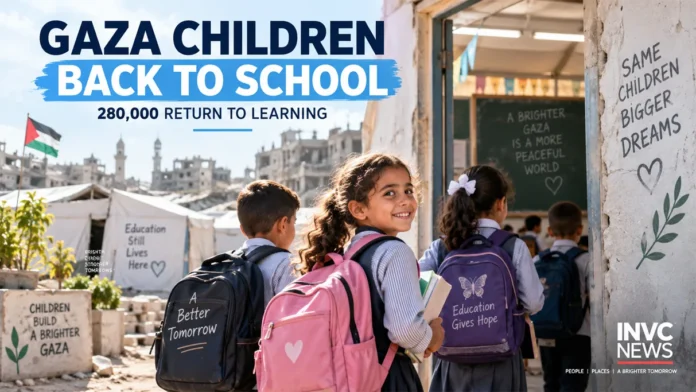
More than 280,000 children in Gaza are returning to education in tents and heavily damaged classrooms, even as fresh Israeli strikes killed three people and underscored how fragile daily life remains nearly a year after the latest ceasefire.
The new academic year began on September 19 under conditions that bear little resemblance to a normal school reopening.
At a UN-run school in Nuseirat in central Gaza, children lined up for classes while some rooms had no desks, forcing students to sit on blankets spread across the floor.
For many families, however, returning to lessons offers something that has become increasingly rare during years of conflict: routine.
More Than 280,000 Gaza Children Return to Learning
The United Nations Relief and Works Agency for Palestine Refugees, or UNRWA, says more than 280,000 children are participating in education across Gaza.
Classes are taking place through a mixture of temporary learning spaces, damaged school buildings and digital education programs.
UNRWA has previously said it uses digital learning tools to provide basic literacy and numeracy activities to more than 280,000 children, supported by approximately 7,500 teachers.
The return to school therefore represents much more than the start of another academic year.
It is an attempt to rebuild a basic structure of childhood amid widespread destruction.
Classrooms Without Desks
Conditions remain extremely difficult.
At the Nuseirat school visited by journalists, children entered classrooms where basic furniture was missing.
Some pupils sat on blankets instead of chairs.
Others studied in temporary spaces created because Gaza has lost a large portion of its functioning school infrastructure.
UNRWA education program chief Tawfiq al-Hourani said the agency operated 182 fully equipped schools three years ago and that around 95% of those facilities have since been lost or rendered unusable, according to AP’s reporting.
The scale of the damage means restoring normal education will require far more than reopening school gates.
Families Search for a Sense of Normal Life
For parents and children, the psychological meaning of school has also changed.
Years of conflict have repeatedly disrupted education, displaced families and turned school buildings into shelters.
Returning to a classroom—even a damaged one—can restore some sense of structure.
Parents interviewed in Gaza said school gives children a familiar daily routine after years dominated by war, displacement and uncertainty.
That makes education part of Gaza’s broader recovery challenge.
Children need textbooks, teachers and classrooms, but they also need safety, stability and psychological support.
Israeli Strikes Kill Three on the Same Day
The school reopening came as Israeli military operations continued.
Gaza’s Health Ministry and officials at Shifa Hospital said an Israeli strike killed one man in the Shijaiyah neighbourhood of Gaza City.
Another man was killed while walking in the Jabaliya refugee camp in northern Gaza.
The Israeli military said it had targeted several military operatives.
Later, Shifa Hospital officials reported that another Israeli strike hit a civilian vehicle in Gaza City, killing one person and wounding at least four others.
Israel’s military said that strike targeted a Hamas military operative.
INVC NEWS could not independently verify the identities or combatant status of those killed.
Ceasefire Reduced Major Fighting, But Strikes Continue
The heaviest fighting between Israel and Hamas subsided following a ceasefire reached in October 2025.
However, violence has not ended.
Gaza’s Health Ministry says Israeli fire has killed more than 13,780 Palestinians since that ceasefire, according to AP. Israel and Hamas have repeatedly accused each other of violating agreements reached during the conflict.
The continuing strikes mean families face the difficult task of rebuilding ordinary life while security conditions remain unstable.
Gaza’s Schools Carry the Scars of War
Education infrastructure has suffered extensive damage throughout the conflict.
Schools that once functioned as ordinary classrooms have served as shelters for displaced families.
Others remain partially destroyed.
UNRWA has therefore relied increasingly on temporary learning spaces and remote education.
Earlier UN reporting showed that tens of thousands of children were attending in-person activities inside hundreds of temporary classrooms, while more than 280,000 received digital learning support.
The new academic year expands that effort.
But reopening classes does not mean Gaza’s education system has recovered.
A Generation Faces Years of Lost Learning
Interrupted schooling creates consequences that can last long after fighting ends.
Children who miss years of education can struggle with literacy, mathematics and basic academic development.
Conflict also creates psychological stress that can make learning more difficult even when children return to classrooms.
That is why aid agencies increasingly combine education with psychosocial support.
The challenge is particularly severe in Gaza because displacement, damaged infrastructure and repeated security incidents continue simultaneously.
Rebuilding Schools Will Take More Than Concrete
The physical reconstruction challenge is enormous.
A recent Gaza City building collapse highlighted the dangers of damaged structures still being used because families have few alternatives.
AP reported that the collapse killed 21 people, including children, after families had continued living inside a building previously damaged during Israeli strikes.
The incident illustrates the wider problem facing schools, homes and public buildings.
Reconstruction requires safe buildings, construction equipment, materials, electricity, water and functioning transport networks.
Until those systems recover, temporary classrooms will remain central to education.
Children Return Despite Everything
The images from Nuseirat capture one of the starkest contrasts in Gaza today.
Children are carrying schoolbooks again.
Teachers are returning to lessons.
Families are trying to rebuild routines.
Yet many pupils are studying inside tents or damaged classrooms while military strikes continue only kilometres away.
For Gaza’s children, the beginning of the 2026 academic year is therefore not simply a return to school.
It is an attempt to reclaim part of childhood in a place where normal life remains extraordinarily difficult.