By Team INVC | INVC NEWS
MUMBAI, India | September 17, 2026 —
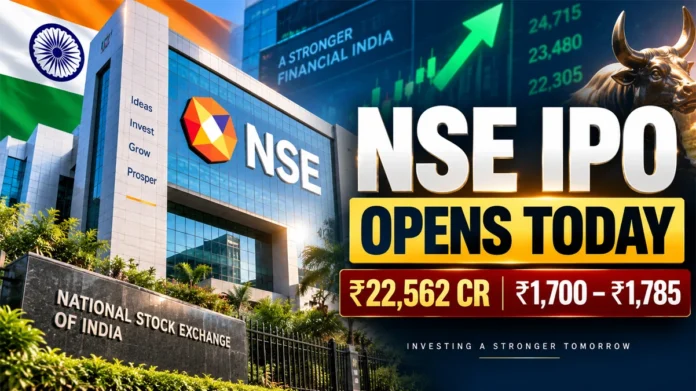
NSE IPO opens today, September 17, 2026, bringing one of India’s most closely watched public offerings to retail investors after years of regulatory delays and anticipation.
The National Stock Exchange of India has set the IPO price band at ₹1,700 to ₹1,785 per share. Investors can apply in lots of eight shares, putting the minimum retail investment at ₹14,280 at the upper end of the price band.
The public issue will remain open until September 21, while the shares are expected to list on the BSE on September 24, 2026.
With an issue size of approximately ₹22,561.57 crore, the NSE IPO is among the biggest public offerings India has seen.
NSE IPO: Key Details at a Glance
IPO Opens: September 17, 2026
IPO Closes: September 21, 2026
Price Band: ₹1,700–₹1,785 per share
Lot Size: 8 shares
Minimum Retail Investment: ₹14,280 at upper price band
Issue Size: About ₹22,561.57 crore
Shares Offered: About 12.64 crore equity shares
Allotment Expected: September 22
Credit to Demat: September 23
Expected Listing: September 24
Listing Exchange: BSE
NSE Will Not Receive Money From the IPO
An important detail separates the NSE IPO from many other public issues.
The offering is entirely an Offer for Sale, or OFS.
Existing shareholders are selling shares to investors. NSE itself is not issuing fresh shares and will not receive proceeds from the IPO.
Instead, the money raised through the offer will go to the selling shareholders.
That distinction matters for investors because IPO proceeds will not directly provide fresh capital for NSE’s expansion, technology investments or debt reduction.
Existing Investors Selling 12.64 Crore Shares
The IPO involves the sale of approximately 12.64 crore equity shares by existing shareholders.
Several major institutional shareholders reduced the number of shares they initially planned to sell before the final offer.
Among them are State Bank of India and other institutional investors.
The reduction brought the final issue size below earlier expectations of roughly ₹30,000 crore.
At the upper end of ₹1,785 per share, the IPO values NSE at approximately ₹4.42 lakh crore.
LIC Leads NSE Anchor Book
Institutional demand became visible even before the public subscription opened.
NSE allocated shares worth approximately ₹6,746 crore to anchor investors at ₹1,785 per share.
Life Insurance Corporation of India emerged as the biggest anchor investor, receiving shares worth around ₹400 crore.
Major international institutional investors also participated in the anchor book.
They included funds linked to the Abu Dhabi Investment Authority and Norway’s Government Pension Fund, along with other large global investors.
Anchor participation does not guarantee how the stock will perform after listing. However, it shows institutional interest before the public issue opens.
How Much Is Reserved for Retail Investors?
NSE has divided the offer among different investor categories.
Qualified Institutional Buyers: 50%
Retail Individual Investors: 35%
Non-Institutional Investors: 15%
Retail investors can apply for a minimum of one lot containing eight shares.
At ₹1,785 per share, one lot costs ₹14,280.
Investors applying at the lower price band of ₹1,700 would pay ₹13,600 for eight shares.
Final allotment will depend on demand within each investor category.
Why the NSE IPO Is Such a Big Deal
NSE sits at the center of India’s capital market.
Millions of equity, derivatives, currency and other financial-market transactions flow through its platforms.
The exchange operates the benchmark Nifty 50 index and commands a dominant position in several trading segments.
Its IPO is particularly notable because investors have waited years for NSE to enter the public market.
The exchange’s earlier listing plans faced regulatory and legal hurdles before the latest offer received clearance.
September 17 therefore represents an important milestone in NSE’s corporate history.
NSE Reported ₹10,302 Crore FY26 Profit
The exchange enters the IPO with substantial earnings.
For FY2025-26, NSE reported consolidated total income of approximately ₹18,713 crore and consolidated profit after tax of around ₹10,302 crore.
Those numbers highlight the profitability of the exchange business.
However, investors also need to examine where those earnings come from.
Trading activity, particularly derivatives, remains an important source of NSE’s revenue.
Changes in regulation or trading volumes can therefore affect future earnings.
Derivatives Slowdown Is a Key Risk
NSE’s dominance does not remove business risks.
Indian market regulators have introduced measures aimed at reducing excessive speculative activity in equity derivatives.
Those measures have affected options volumes.
Reuters reported that options trading volumes have fallen from their 2024 peaks, creating questions about how regulatory changes could affect NSE’s future revenue mix.
The exchange has been expanding into other areas to diversify its business.
These include new financial products and market infrastructure opportunities.
Still, the dependence on transaction-linked revenue remains one of the key factors investors need to understand.
What About NSE IPO GMP?
Grey market premium, commonly called GMP, has become one of the most searched terms around Indian IPOs.
Unofficial grey-market indicators ahead of the NSE issue have suggested demand above the IPO’s upper price band.
However, GMP is not an official exchange price.
It can move rapidly before listing and does not guarantee either the final listing price or subsequent returns.
Investors should therefore avoid treating grey-market activity as a substitute for the company’s financials, valuation, business prospects and stated risks.
NSE IPO vs NSE Shares Already in the Unlisted Market
NSE shares have traded in India’s unlisted market for years.
That created an unusual situation in which thousands of shareholders already owned NSE shares despite the company not being publicly listed.
The IPO now provides a formal path toward exchange listing and wider public ownership.
Once listed, NSE shares will trade through the regulated stock-market system like other listed companies.
Importantly, NSE will list its own shares on the BSE, not on NSE.
NSE IPO Timeline
Investors have five key dates to watch.
September 17: Public subscription opens
September 21: Subscription closes
September 22: Basis of allotment expected
September 23: Refunds and demat credit expected
September 24: NSE shares scheduled to list on BSE
Changes to the official timetable remain possible, so investors should rely on final exchange and registrar communications for allotment and listing updates.
What Investors Should Check Before Applying
The size and popularity of an IPO alone do not determine future returns.
Investors evaluating NSE may want to examine its earnings, valuation, regulatory exposure, dependence on derivatives trading, competitive position and future growth strategy.
Another consideration is the structure of the IPO.
Because this issue is entirely an OFS, existing investors receive the proceeds rather than NSE.
At the same time, NSE remains one of India’s most important market-infrastructure businesses, with a dominant trading franchise and substantial profitability.
Those factors explain why the IPO has attracted intense institutional and retail attention.
September 17 Starts a New Chapter for NSE
The opening of the NSE IPO brings a long-running market story closer to its conclusion.
Years of delays, regulatory scrutiny and speculation have now given way to an actual public offering.
For retail investors, the immediate numbers are straightforward: ₹1,700–₹1,785 price band, eight shares per lot and ₹14,280 minimum investment at the upper price.
What happens after September 24 will depend on market demand, valuation and NSE’s performance as a publicly listed company.
This report is for news and informational purposes and does not constitute investment advice. Investors should review the official offer documents and consider their own financial circumstances and risk tolerance before making an investment decision.