By Team INVC | INVC NEWS
GASTONIA, North Carolina, United States | September 17, 2026 —
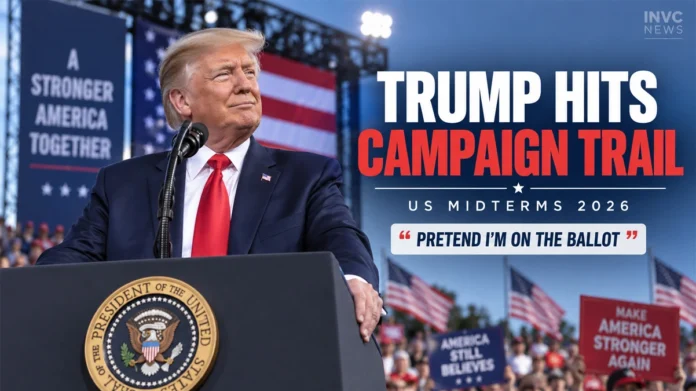
President Donald Trump has thrown himself directly into the 2026 US midterm election campaign, using a North Carolina rally to urge Republican voters to approach November’s congressional elections as though his own name were on the ballot.
Trump appeared in Gastonia on Wednesday alongside Republican Senate candidate Michael Whatley, the former Republican National Committee chairman, who is running against Democratic former North Carolina Governor Roy Cooper for an open US Senate seat.
The rally marked Trump’s first major campaign appearance since the Republican midterm convention in Dallas and offered a preview of how he plans to frame the final weeks before Election Day.
“In this election,” Trump told supporters, they should “pretend I’m on the ballot.”
The message was unmistakable: Trump wants Republican voters who turned out for him in presidential elections to show similar enthusiasm when congressional candidates—not Trump himself—appear on their ballots.
Trump Makes North Carolina Senate Race Personal
North Carolina has become an important stop in Trump’s midterm campaign because Republicans are defending an open Senate seat.
Whatley, a longtime Trump ally and former Republican National Committee chairman, has closely aligned his campaign with the president.
Cooper, meanwhile, served two terms as North Carolina governor and is campaigning as the Democratic nominee.
Recent publicly released surveys have shown different margins, though several have placed Cooper ahead at this stage. For example, a September Trafalgar Group survey of 1,084 likely voters reported Cooper at about 48% and Whatley at about 42%. Polls are snapshots of particular samples and should not be treated as predictions of the November result.
Trump Targets Crime, Immigration and Democrats
Trump used much of his Gastonia speech to attack Democrats over crime and immigration.
He portrayed Whatley as a supporter of stricter law enforcement policies and criticized Cooper’s record as governor.
Reuters reported that Trump accused Cooper of being too lenient on crime and linked Democrats more broadly with sanctuary-city policies and immigration positions that Republicans have made central to their campaign. Cooper and Democrats dispute Republican characterizations of their records and policies.
Immigration has remained one of Trump’s defining political issues during his second term.
The administration has expanded immigration enforcement, while its policies have also faced repeated legal challenges over deportations, visas and federal authority.
Affordability Could Be Just as Important
Although Trump emphasized immigration and crime, economic concerns also featured prominently.
AP reported that Trump acknowledged higher gasoline prices during his speech while defending his administration’s actions in the Iran conflict.
That creates a politically significant challenge for both parties because household costs, fuel prices and broader affordability concerns can shape voters’ assessments of economic policy.
Trump argued that his administration’s broader economic agenda would ultimately benefit Americans.
Democrats, meanwhile, have sought to connect Republicans with higher consumer costs and have focused their campaign messaging on affordability.
Those competing claims will remain central to the campaign, but their ultimate effect on voting cannot be determined from current polling alone.
Trump Again Raises $5,000 Rebate Proposal
One of the more striking parts of Trump’s campaign pitch was his renewed promise of a $5,000 rebate if Republicans retain control of Congress.
Reuters reported that Trump again promoted the proposal during his North Carolina appearance. However, the idea has not gained substantial support among Republican lawmakers, meaning its legislative path remains uncertain.
The proposal therefore remains a campaign pledge rather than an enacted benefit.
Any actual payment would require a legal and budgetary mechanism, including congressional action where required.
Why November 3 Matters
The United States will hold its midterm elections on November 3, 2026.
All 435 seats in the House of Representatives will be contested, along with 34 regularly scheduled Senate seats.
The results will determine the composition of Congress for the final two years of Trump’s current presidential term.
That matters because Congress controls legislation, federal spending and oversight while the Senate also plays a major role in confirming federal judges and senior administration nominees.
For that reason, Trump is expected to continue campaigning alongside Republican candidates around the country.
North Carolina Shows Trump’s Midterm Strategy
The Gastonia rally provides an early look at that strategy.
Trump is attempting to transfer the political enthusiasm of his own supporters to Republican congressional candidates.
At the same time, Whatley is presenting himself as an ally who would support much of Trump’s agenda in Washington.
Cooper and Democrats are taking the opposite approach, focusing heavily on the economy, household costs and their criticism of Trump administration policies.
Independent and unaffiliated voters are also significant in North Carolina, making appeals beyond each party’s core supporters an important part of both campaigns.
One Rally, Bigger National Message
Trump’s words in North Carolina suggest that his political role in the midterms will extend far beyond endorsements.
By asking supporters to behave as though he personally appears on the ballot, the president is tying congressional Republican campaigns closely to his administration and record.
Republicans may emphasize immigration, crime, national security and Trump’s economic agenda.
Democrats are expected to continue emphasizing affordability, economic management and opposition to administration policies.
The North Carolina contest will now receive increased national attention as both parties intensify campaigning ahead of November 3.
For voters, however, the choice remains between the candidates actually appearing on their ballots and the records, policies and priorities each presents.