By Team INVC | INVC NEWS
WELLINGTON, New Zealand | September 16, 2026 —
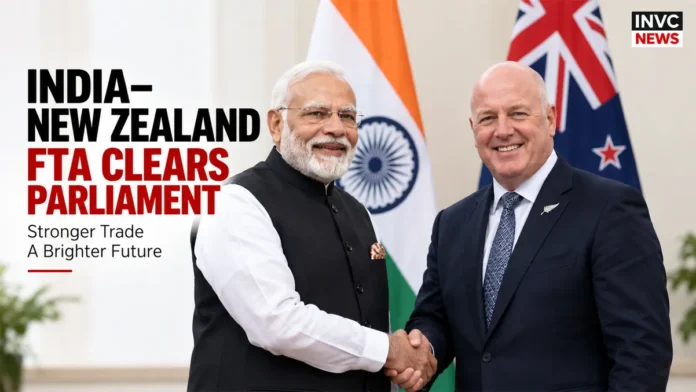
The India New Zealand FTA moved a decisive step closer to implementation on Wednesday after New Zealand Parliament passed legislation enabling the landmark trade agreement with India by a commanding 93–29 vote.
The legislation received support from New Zealand’s opposition Labour Party as well as the government, giving the agreement broad parliamentary backing. However, the trade pact has not yet entered into force. India and New Zealand must complete their respective ratification procedures before the agreement takes effect.
For India, one of the biggest gains is sweeping access to the New Zealand market. Under the agreement, 100% of Indian exports will receive zero-duty access across New Zealand’s tariff lines from entry into force, according to India’s Commerce Ministry.
That could improve the competitiveness of Indian textiles, clothing, leather, footwear, engineering products, processed foods and other export-oriented sectors.
New Zealand Parliament Passes India FTA by 93–29
New Zealand lawmakers approved the legislation on September 16 by 93 votes to 29, clearing one of the most important domestic hurdles before implementation.
Trade and Investment Minister Todd McClay said the agreement would open greater access to one of the world’s largest markets and support the two countries’ aim of expanding bilateral trade.
The agreement was signed in April 2026 after negotiations that had formally started in March 2025.
Those talks progressed unusually quickly. India’s Commerce Ministry says the negotiations concluded in December 2025 after five formal rounds.
Indian Goods Get 100% Duty-Free Access in New Zealand
For Indian exporters, the most important provision is New Zealand’s commitment to eliminate tariffs across 100% of its tariff lines for Indian goods when the agreement becomes effective.
That creates potentially valuable opportunities for Indian businesses competing in areas such as:
Textiles and clothing
Leather and footwear
Engineering goods
Agriculture and processed foods
Pharmaceutical and manufacturing-linked exports
MSME products
India’s Commerce Ministry says this market access is designed to improve export competitiveness in several labour-intensive and high-growth industries.
What Does New Zealand Get From India?
The agreement is not a blanket removal of Indian tariffs.
India has offered tariff concessions on roughly 70% of its tariff lines, while retaining protection for sensitive domestic industries. The arrangement covers approximately 95% of bilateral trade, according to India’s Commerce Ministry.
For New Zealand exporters, 57% of exports to India will become duty-free from the first day of implementation.
Once the agreement is fully phased in, tariffs will be eliminated or significantly reduced on around 95% of New Zealand exports to India, according to the New Zealand government.
New Zealand expects particularly significant opportunities in food, fibre, technology, education, tourism and professional services.
India Protects Dairy and Other Sensitive Sectors
India has deliberately kept several politically and economically sensitive products outside its tariff concessions.
The exclusion list includes major dairy products such as milk, cream, whey, yoghurt and cheese.
India has also protected products including onions, chickpeas, peas, corn, almonds, sugar, certain oils and other sensitive agricultural or industrial products.
That protection is significant because dairy has historically been one of the most sensitive issues in India’s trade negotiations.
The structure allows India to increase market access for New Zealand without fully opening sectors where policymakers have concerns about domestic farmers and producers.
$20 Billion Investment Commitment Adds Bigger Economic Dimension
The agreement goes beyond tariffs.
New Zealand has made an investment commitment of $20 billion in India over 15 years, according to Indian government documentation and Reuters.
India’s Commerce Ministry has said the investment can potentially benefit businesses across multiple Indian states rather than being limited to one region.
If those investments materialize at scale, the FTA could become as important for capital flows and business partnerships as it is for merchandise trade.
Services and Professionals Also Get New Opportunities
The India New Zealand FTA also contains substantial services provisions.
New Zealand has offered India market-access commitments across 118 services sectors and sub-sectors, while providing Most-Favoured Nation treatment across 139 sectors and sub-sectors, according to India’s Commerce Ministry.
The agreement also covers areas including IT and IT-enabled services, professional services, education and business services.
For students and skilled professionals, agreed provisions include work opportunities during study and extended post-study work pathways for certain STEM graduates.
These provisions could make the agreement particularly relevant to India’s services economy, which extends far beyond the traditional goods-and-tariffs discussion surrounding FTAs.
Bilateral Trade Already Near NZ$4 Billion
India and New Zealand recorded approximately NZ$3.99 billion, or about $2.29 billion, in two-way trade in the year to June 2026, according to Reuters.
India ranked as New Zealand’s ninth-largest goods and services export market during that period.
Both governments have set a goal of doubling two-way trade by 2030. New Zealand’s trade minister said the new agreement could help businesses develop new commercial relationships and expand sales between the two countries.
When Will the India-New Zealand FTA Start?
This remains the most important practical question.
Despite Wednesday’s parliamentary vote, businesses should not treat the FTA as already operational.
New Zealand’s government says the agreement will enter into force only after both countries complete their respective ratification procedures. Wellington currently expects the agreement to take effect during 2026.
Therefore, tariff reductions and other benefits will begin from the formal entry-into-force date rather than simply from the date of the parliamentary vote.
Why the India-New Zealand FTA Matters
The deal gives Indian exporters complete tariff-line access to the New Zealand market while preserving protections around several sensitive Indian sectors.
For New Zealand, the agreement sharply improves access to India’s much larger consumer market.
Meanwhile, the $20 billion investment commitment, services provisions and professional-mobility arrangements broaden the agreement beyond conventional merchandise trade.
Wednesday’s parliamentary vote does not complete the implementation process, but it removes a significant legislative hurdle.
The next milestone will come when India and New Zealand finish their remaining ratification requirements and formally announce the date on which the India New Zealand FTA enters into force.