By Team INVC | INVC NEWS
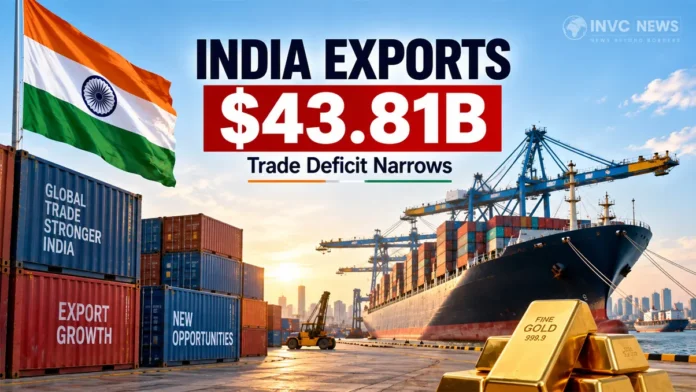
NEW DELHI, India | September 15, 2026 — India’s merchandise exports climbed 26.12% year-on-year to $43.81 billion in August 2026, while the country’s merchandise trade deficit narrowed sharply from the previous month to $26.86 billion, offering some relief at a time when expensive crude oil and a weaker rupee are putting pressure on the economy.
Merchandise imports stood at about $70.67 billion, compared with $61.96 billion in August 2025. The stronger export performance therefore helped prevent the trade gap from widening even further despite a substantial rise in imports.
However, the monthly picture requires some context.
Exports were slightly lower than July’s $44.24 billion, while imports fell much more sharply from July’s $76.22 billion. That decline in imports was a major reason the merchandise trade deficit improved from $31.98 billion in July to $26.86 billion in August.
For households, businesses and investors, the data matters because India’s trade balance can influence the rupee, inflation, borrowing costs, employment and even the domestic price of gold.
India’s August Trade Numbers at a Glance
The Commerce Ministry’s latest data show a strong year-on-year expansion in both goods and services trade.
Merchandise exports increased from $34.74 billion in August 2025 to $43.81 billion in August 2026, a rise of 26.12%.
Merchandise imports increased from $61.96 billion to $70.67 billion during the same period.
Meanwhile, services exports were estimated at $38.87 billion, compared with $31.19 billion a year earlier. Services imports rose to an estimated $21.42 billion from $15.59 billion.
When merchandise and services are combined, India’s overall exports for August were estimated at $82.68 billion, against $65.93 billion a year earlier.
Overall imports stood at an estimated $92.09 billion.
That left the combined trade deficit at roughly $9.41 billion, narrower than $11.62 billion in August 2025.
Why Is the Trade Deficit Important?
A trade deficit occurs when a country imports more goods than it exports.
A deficit is not automatically bad. A fast-growing economy often imports crude oil, machinery, electronics, components and raw materials to support consumption and investment.
However, a persistently large deficit increases demand for foreign currency, particularly the US dollar.
That can put pressure on the rupee.
For India, the issue becomes even more important when crude oil prices are high because the country relies heavily on imported energy.
Therefore, a narrower trade deficit can offer some support to the external sector, although one month of improvement does not establish a lasting trend.
Does the Export Surge Mean the Economy Is Getting Stronger?
The 26.12% year-on-year jump in merchandise exports is encouraging.
Stronger exports can support manufacturing, logistics, ports, engineering, textiles, pharmaceuticals, electronics and other export-oriented industries.
Companies that receive more overseas orders may increase production and, over time, create additional employment.
However, readers should distinguish year-on-year growth from month-on-month growth.
Exports were $43.81 billion in August compared with $44.24 billion in July. Therefore, shipments remained very strong compared with last year but eased slightly from the previous month.
This distinction provides a more balanced picture of India’s trade performance.
April-August Exports Cross $215 Billion
The broader fiscal-year trend also remains strong.
India’s merchandise exports during April-August 2026-27 increased to approximately $215.91 billion, compared with $183.21 billion in the same period a year earlier.
Merchandise imports climbed to about $363 billion, up from $307.09 billion.
Combined merchandise and services exports reached an estimated $399.27 billion during the first five months of the financial year, while overall imports reached $459.65 billion.
That means India is exporting significantly more than a year ago, but import growth remains strong as well.
US Remains India’s Biggest Export Market
The United States remained India’s largest export destination during April-August 2026-27.
Indian exports to the US reached about $42.79 billion, compared with $40.31 billion during the corresponding period last year.
The UAE followed at $13.59 billion, while exports to China reached $9.61 billion. Singapore, the Netherlands, the UK and Germany were also among the major destinations.
India is simultaneously working to diversify its export markets.
Its trade agreement with the United Kingdom is now in force, while a broader agreement with the European Union is moving toward implementation. Wider market access could help Indian exporters reduce dependence on a limited number of destinations.
China Remains India’s Biggest Import Source
China continued to dominate India’s import basket.
Imports from China reached approximately $65.49 billion during April-August 2026-27, up sharply from $51.56 billion during the same period a year earlier.
Russia ranked second at $41.44 billion, followed by the United States and UAE.
This remains an important structural issue.
India may achieve strong overall export growth while still running large bilateral trade deficits with countries from which it buys electronics, machinery, components, energy or industrial inputs.
Reducing that imbalance requires more domestic manufacturing rather than simply cutting imports.
What Is Happening With Gold Imports?
Gold remains particularly important because it can significantly influence India’s import bill.
The latest confirmed detailed monthly figure available before the August commodity breakdown showed that gold imports rebounded to $4.16 billion in July, more than double June’s $1.97 billion. The World Gold Council linked that recovery partly to inventory replenishment ahead of the festive season.
At the time of this report, the initial August trade release reviewed by INVC NEWS did not provide a separately confirmed August gold-import value.
Therefore, it would be premature to attach an unverified August number to gold imports.
However, India has already taken major steps to restrain bullion imports.
The effective customs duty on gold and silver was increased from 6% to 15% in May 2026. The government collected about ₹10,040 crore in customs duty on gold imports between May 13 and August 2, according to information presented in Parliament.
The World Gold Council has also warned that higher duties can increase incentives for unofficial or grey-market inflows.
Gold Jewellery Exports Tell a Different Story
While India imports large quantities of gold, it also exports value-added jewellery.
India’s gem and jewellery exports increased 3.14% year-on-year to $2.30 billion in August.
More importantly, studded gold jewellery exports jumped 51.22% to $642.85 million.
Overall gold jewellery exports, including plain and studded products, rose 11.81% to nearly $1 billion.
Plain gold jewellery exports, however, declined nearly 24% as elevated gold prices and higher input costs hurt competitiveness.
This contrast shows why policymakers increasingly prefer India to export finished jewellery rather than simply import bullion for domestic consumption.
What Does a Smaller Trade Deficit Mean for the Rupee?
A smaller deficit can reduce some demand pressure for dollars.
That may help the rupee at the margin.
However, currency movements depend on far more than trade data.
Crude oil prices, global interest rates, foreign investment flows, the US dollar and Reserve Bank of India intervention can all have a larger short-term impact.
Therefore, the August deficit numbers are supportive but do not guarantee that the rupee will strengthen.
Can It Help Control Inflation?
Potentially, but indirectly.
A smaller trade deficit can support currency stability. A more stable rupee makes imports relatively less expensive than they would be after a sharp depreciation.
That matters for crude oil, machinery, chemicals, electronic components and other imported goods.
However, India is currently facing considerable external price pressure.
Retail inflation rose to 4.82% in August, while elevated crude oil prices remain a major risk to the inflation outlook.
Therefore, stronger exports are positive, but expensive energy imports can still affect transport, manufacturing and household costs.
What Does This Mean for the Common Person?
For an average household, trade statistics may appear distant. In reality, they influence several everyday expenses.
A stronger export sector can support jobs. Engineering, manufacturing, textiles, pharmaceuticals, electronics, logistics and ports can benefit from overseas demand.
A lower trade deficit can support the rupee. A more stable currency can reduce imported inflation.
High imports can still push prices higher. Oil, electronics and industrial inputs ultimately feed into domestic costs.
Gold remains sensitive. High international prices, the rupee and import duties all influence jewellery prices.
Interest rates can also be affected indirectly. If imported inflation remains high, the RBI may have less room to keep monetary policy loose.
The Bigger Picture
India’s August trade numbers send two messages.
The first is encouraging: merchandise exports are expanding strongly year-on-year, services remain a major source of foreign exchange and the monthly goods trade deficit has narrowed significantly from July.
The second is a warning: India still imports substantially more merchandise than it exports, and costly energy, electronics, gold and industrial inputs remain important pressure points.
The next few months will therefore matter.
If exports stay strong while crude and other import costs moderate, India could see further improvement in its external balance.
If oil prices remain elevated and the rupee stays under pressure, however, the import bill could rise again quickly.
For now, $43.81 billion in merchandise exports and a $26.86 billion trade deficit mark an encouraging August — but not the end of India’s trade challenge.