By Team INVC | INVC NEWS
MUMBAI, India | September 15, 2026 — Indian stocks suffered a sharp reversal on Tuesday as an early rally collapsed under pressure from surging crude oil prices, rising global bond yields and renewed expectations of a US Federal Reserve rate increase.
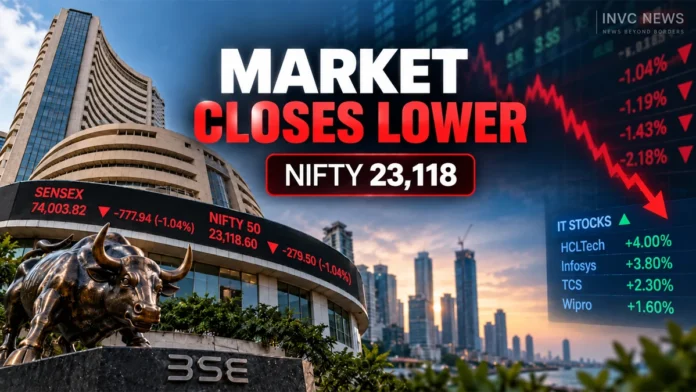
The BSE Sensex closed 777.94 points, or 1.04%, lower at 74,003.82, while the Nifty 50 fell 279.50 points, or 1.19%, to 23,118.60. The benchmarks had opened sharply higher before selling intensified through the afternoon.
The session produced a dramatic change in sentiment. The Sensex had opened at 75,369.63, while the Nifty started at 23,576.15 as investors initially bought technology stocks and HDFC Bank. However, rising oil prices and the US 10-year Treasury yield above 5% eventually overwhelmed the early optimism.
For investors, the message from Tuesday’s session was clear: technology stocks remained resilient, but macroeconomic risks dominated the broader market.
Sensex, Nifty Give Up Strong Opening Gains
Tuesday began on an upbeat note after Indian markets reopened following Monday’s Ganesh Chaturthi holiday.
The Sensex jumped nearly 600 points at the opening, while the Nifty moved above 23,500.
Technology stocks led the initial rally. Investors also bought HDFC Bank after developments surrounding the bank’s leadership succession.
That strength did not last.
Selling spread across financials, industrials, defence, real estate and several mid-cap counters as the trading session progressed.
By 3:15 PM, both headline indices were down close to 1%, erasing the entire morning rally.
The Nifty ultimately closed at 23,118.60, near the lower end of the day’s range.
What Caused the Stock Market to Fall Today?
Several pressures hit Indian equities simultaneously.
1. Brent Crude Moves Above $107
Crude oil remained one of the biggest concerns for Indian markets.
Brent crude rose to around $107.7 a barrel on Tuesday after attacks on Saudi Arabian energy infrastructure intensified concerns about global supplies. Oil prices have gained sharply this month.
High crude prices matter enormously for India because the country imports most of the oil it consumes.
When crude becomes more expensive, India’s import bill can rise. Higher oil costs may also add to inflation and increase demand for US dollars.
That combination can hurt the rupee, government finances and corporate margins.
2. US 10-Year Treasury Yield Crosses 5%
Global bond markets added another layer of pressure.
The benchmark US 10-year Treasury yield moved above the 5% level, raising concerns that borrowing costs could remain elevated for longer.
Higher US bond yields can make American fixed-income assets more attractive to global investors.
As a result, emerging markets such as India can face pressure from foreign portfolio flows.
Higher bond yields also reduce the relative appeal of richly valued equities.
3. Fed Rate-Hike Fears Return
Investors are now closely watching the US Federal Reserve.
Recent inflation data have increased expectations that the Fed could raise interest rates by 25 basis points. That possibility has strengthened the dollar and added pressure to global risk assets.
A higher US policy rate can affect India through several channels, including foreign portfolio flows, the rupee, bond yields and equity valuations.
The Fed’s upcoming policy decision therefore remains one of the most important global triggers for Indian markets.
4. Rupee Weakens Toward 96 per Dollar
The currency market also sent a warning signal.
The Indian rupee weakened about 0.4% to 95.92 against the US dollar, its weakest level in more than a month. The fall was partly contained by dollar sales through state-run banks that traders linked to the Reserve Bank of India.
A weaker rupee becomes particularly uncomfortable when crude oil prices are also rising.
India then faces a double cost: it pays more dollars for oil and requires more rupees to buy each dollar.
That increases concerns about imported inflation.
IT Stocks Defy the Sell-Off
Technology stocks emerged as the clear bright spot.
HCL Technologies closed 4% higher at ₹1,253.70, making it the top Nifty 50 gainer.
Infosys gained 3.8% to ₹1,077, while Tata Consultancy Services rose 2.3% to ₹2,251.
Tech Mahindra also advanced 2.3% to ₹1,575.90, while Wipro added 1.6%.
The technology rally followed a reassessment of concerns surrounding artificial intelligence and its potential impact on India’s traditional IT-services model.
Investors also found support in the weaker rupee because major Indian IT companies earn a substantial share of their revenue in foreign currencies.
HCLTech Leads the Market
HCLTech received an additional stock-specific boost after expanding its partnership with CrowdStrike.
The partnership aims to integrate CrowdStrike’s security technology with HCLTech’s AI security and resilience services. HCLTech shares jumped as much as 7% during the session before closing with a 4% gain.
That performance was particularly notable because the broader market fell sharply.
HDFC Bank Ends Higher Despite Banking Sell-Off
HDFC Bank also managed to stay positive.
The stock closed 1.2% higher at ₹716.60, even as the broader Bank Nifty came under significant pressure.
Earlier in the day, HDFC Bank gained after reports that the lender had shortlisted candidates as part of its leadership succession process.
However, strength in the heavyweight stock was not enough to protect the wider banking index.
Bank Nifty Falls More Than 800 Points
Financial stocks were among the major weak spots.
The Bank Nifty dropped 811.80 points, or 1.43%, to 55,794.75.
The Nifty Midcap Select index fell 318.35 points, or 2.18%, to 14,266.35, highlighting much deeper weakness outside the handful of large technology stocks that supported the headline indices.
The divergence matters.
When a few heavyweight stocks rise while banks, mid-caps and other sectors decline, the overall market can look stronger than the underlying breadth suggests.
Tuesday’s session instead showed significant risk aversion beneath the surface.
Which Stocks Gained at the Close?
Among prominent Nifty 50 gainers:
- HCL Technologies: +4.0%
- Infosys: +3.8%
- TCS: +2.3%
- Tech Mahindra: +2.3%
- Wipro: +1.6%
- ONGC: +1.5%
- HDFC Bank: +1.2%
- Tata Motors Passenger Vehicles: +0.8%
- Hindustan Unilever: +0.6%
- Tata Steel: +0.4%
Technology companies dominated the gainers’ list.
Broader Market Bears the Brunt
The pressure was not limited to the Sensex and Nifty.
Mid-cap shares weakened sharply, while financial, defence, industrial and several interest-rate-sensitive counters saw selling.
Shriram Finance, Bharat Electronics and Grasim Industries were among the prominent Nifty laggards during the session. Broader-market names such as Solar Industries also suffered sharp losses.
The weakness indicates that investors were reducing exposure to risk even while selectively buying large IT companies.
From Strong Opening to Sharp Closing Loss: What Changed?
The day’s price action tells the story particularly well.
Markets began by focusing on company-specific positives and the IT rally.
As the session progressed, investors shifted attention to the macro picture:
Oil remained above $107.
US bond yields crossed 5%.
The rupee moved toward 96 per dollar.
Fed rate-hike expectations increased.
Geopolitical concerns remained elevated.
Together, those factors changed the risk-reward equation for equities.
The Sensex eventually finished almost 778 points lower despite beginning the day with a gain of nearly 600 points.
That represents a swing of well over 1,300 points from the early zone and shows how quickly sentiment deteriorated.
Why Expensive Oil Is Such a Big Risk for Indian Stocks
Crude oil remains the single most important external variable for India in the current environment.
Persistent oil prices above $100 can affect multiple parts of the economy.
They can increase India’s import bill, weaken the rupee, raise inflation risks and put pressure on corporate input costs.
Higher inflation can then reduce the Reserve Bank of India’s room to maintain supportive interest rates.
Therefore, the market is not simply reacting to the daily movement in Brent crude. Investors are trying to estimate how long expensive energy will persist and how deeply it could affect inflation and monetary policy.
What Should Investors Watch Next?
Four indicators now deserve particular attention.
First, Brent crude. A sustained fall in oil prices could offer immediate relief to Indian assets.
Second, USD/INR. The rupee’s movement around the 96 level will show how much external pressure the currency market is absorbing.
Third, US Treasury yields and the Federal Reserve. A hawkish Fed could keep pressure on global equity valuations.
Fourth, market breadth. A durable recovery would require participation beyond a handful of IT heavyweights.
Investors should also watch foreign institutional flows after FIIs remained net sellers in the previous trading session. On September 11, foreign investors sold ₹930.90 crore of Indian equities on a net basis, while domestic institutional investors bought ₹1,968.17 crore.
What Does Today’s Fall Mean for Retail Investors?
A single weak session does not by itself establish a long-term trend.
However, Tuesday’s market action sends an important signal.
India’s domestic growth story may remain relatively resilient, but global oil prices, currency weakness and high interest rates can still dominate short-term market direction.
Investors therefore need to distinguish between company-specific opportunities and broader macroeconomic risk.
The strong rally in IT shares alongside heavy selling in other sectors is a good example.
One part of the market can outperform even while the headline indices decline.
Market Closing Verdict
Tuesday turned into a difficult session for Dalal Street.
The Sensex lost 777.94 points to close at 74,003.82, while the Nifty dropped 279.50 points to 23,118.60. Bank and mid-cap stocks suffered heavier selling, although HCLTech, Infosys, TCS and other IT names provided a significant cushion.
The next direction will depend less on Tuesday’s closing number and more on what happens to crude oil, US bond yields, the rupee and the Federal Reserve’s rate outlook.
Until those pressures ease, volatility is likely to remain the defining feature of the Indian stock market.
Disclaimer: This report is for informational purposes only and does not constitute investment advice. Market investments involve risk, and readers should evaluate their financial circumstances or consult a qualified adviser before making investment decisions.