By Team INVC | INVC NEWS
WASHINGTON, United States | September 17, 2026 —
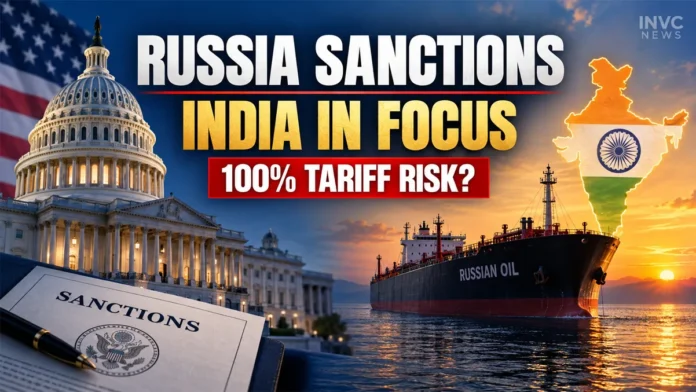
US Russia sanctions bill 2026 has moved to the White House after the US House of Representatives approved sweeping legislation designed to increase economic pressure on Moscow over the Ukraine war, potentially putting India’s Russian oil purchases under sharper scrutiny.
The House passed the Lindsey O. Graham Sanctioning Russia and Iran Act of 2026 by a 262-159 vote on Wednesday. The Senate had already approved the legislation, meaning the bill now goes to President Donald Trump.
The measure targets Russian officials, banks, defense-linked entities, energy revenues and vessels accused of helping Moscow circumvent sanctions.
However, one provision could have implications far beyond Russia.
The legislation gives the US president authority to impose tariffs of up to 100% on countries that continue significant purchases of Russian energy, including major buyers such as India and China.
Does This Mean a 100% US Tariff on India Starts Immediately?
No.
The legislation authorizes the US president to impose tariffs under specified circumstances. It does not automatically place a 100% tariff on Indian goods simply because Congress approved the bill.
That distinction is crucial.
The White House would first need to implement the relevant provisions after the legislation becomes law, and the measure includes presidential discretion and waiver mechanisms.
Reuters reported that the legislation allows tariffs of up to 100% against countries that continue major Russian energy purchases, while also giving the president flexibility over how the sanctions regime operates.
Therefore, the immediate development is the creation of a potentially powerful trade tool—not the automatic imposition of a new 100% India tariff.
Why India Is in the Spotlight
India became a major purchaser of discounted Russian crude after Western countries imposed sanctions and restrictions following Russia’s full-scale invasion of Ukraine in 2022.
New Delhi has repeatedly framed its energy purchases around national energy security, affordability and the needs of its large population.
India and Russia have also continued expanding their broader economic relationship. During recent talks in New Delhi, Prime Minister Narendra Modi and Russian President Vladimir Putin discussed strengthening trade and their strategic partnership, with both sides targeting bilateral trade of $100 billion by 2030.
The new US legislation creates another variable in that relationship.
If Washington uses the tariff authority aggressively, energy trade with Russia could become linked more directly to India-US trade negotiations.
Bill Targets Russia’s Energy Revenue
Supporters of the sanctions legislation argue that reducing Moscow’s oil revenue could limit the resources available to finance the war in Ukraine.
The measure targets Russia’s energy sector and its so-called shadow fleet—a network of older tankers used to transport Russian oil despite Western restrictions.
The legislation also expands sanctions against Russian financial and defense interests.
Its sponsors have described energy exports as a central source of revenue for Moscow.
Russia, however, has repeatedly criticized Western sanctions and trade restrictions and has argued that they disrupt global markets.
House Vote Reveals Political Divisions
The bill passed with bipartisan support, but the House debate also exposed disagreements over the extent of presidential tariff authority.
The final vote was 262 in favor and 159 against. Reuters reported that 203 Republicans and 58 Democrats supported the legislation. Some opponents argued that granting the president broad tariff powers could create economic risks for US allies and consumers.
Supporters said the measure would strengthen US leverage against Russia.
These disagreements concern the design and possible use of the sanctions powers rather than whether Congress should respond to the Ukraine conflict.
Russia-Ukraine Fighting Continues
The congressional move comes as fighting continues inside Ukraine.
Russian air strikes hit Kyiv and Odesa early Thursday, injuring at least 13 people, according to Ukrainian officials cited by Reuters.
Ten people were reported injured in Kyiv, while three people, including a child, were injured after a strike hit a residential building in Odesa.
The latest attacks underline the gap between ongoing diplomatic efforts and battlefield conditions.
Energy Truce Remains Fragile
Separately, Washington has pushed Moscow and Kyiv toward limiting attacks on energy infrastructure.
The Kremlin recently welcomed US President Donald Trump’s proposal for a mutual halt to attacks on energy facilities but linked broader progress to other issues, including sanctions relief and maritime security.
Ukraine has also indicated that it could pause attacks on Russian territory if Moscow commits to protecting Ukrainian critical infrastructure.
No comprehensive peace agreement has emerged from those discussions.
What Happens Next?
Attention now shifts to the White House.
President Trump must decide whether to sign the legislation into law. After that, the key question for India will be how the administration chooses to use its new tariff authority.
Three issues will matter most: whether Washington targets specific countries, what conditions trigger additional tariffs, and whether exemptions or waivers apply.
For New Delhi, the development connects three sensitive areas—Russian oil, India-US trade and the Ukraine war.
Until the White House announces implementation measures, reports claiming that India has already been hit with a new 100% tariff would overstate what Congress has done.