By Team INVC | INVC NEWS
WASHINGTON, United States | September 16, 2026 —
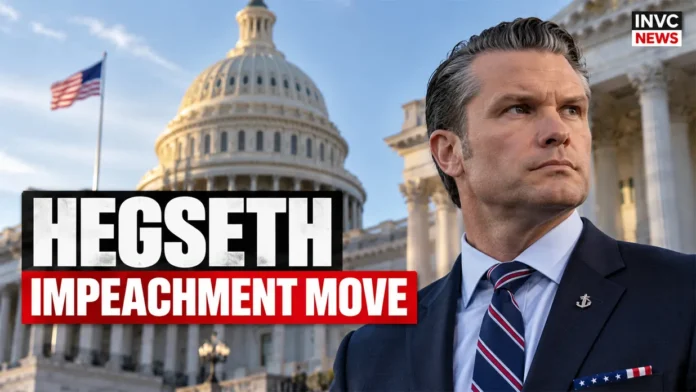
Republican Representative Thomas Massie has introduced eight articles of impeachment against U.S. Defense Secretary Pete Hegseth, accusing him of violating congressional war powers during the continuing conflict with Iran and committing a series of other constitutional and legal violations.
Massie introduced the privileged resolution on the House floor Tuesday, September 15, setting up a required House response within the chamber’s procedural timetable. The Kentucky Republican’s office said he intends to force lawmakers to vote on the impeachment effort.
The move opens a new congressional confrontation over the Iran war, presidential military authority and the role of Congress in approving prolonged U.S. hostilities overseas.
Massie Files Eight Articles Against Hegseth
Massie’s resolution contains eight separate articles covering U.S. military actions in Iran, Yemen, Venezuela and maritime operations involving suspected drug-trafficking vessels.
Three of the articles focus specifically on the War Powers Resolution of 1973.
Massie argues that Hegseth continued U.S. military operations against Iran without a formal declaration of war or specific congressional authorization and continued hostilities after statutory time limits had expired.
Massie’s office says the articles accuse Hegseth of acting contrary to Sections 2(c), 5(b) and 5(c) of the War Powers Resolution.
These are allegations contained in the impeachment resolution. Hegseth has not been convicted or removed from office, and Congress has not adopted Massie’s allegations as findings of fact.
Iran War Sits at Center of Impeachment Fight
The confrontation centers heavily on U.S. military operations against Iran.
The current conflict began with joint U.S.-Israeli strikes on Iran on February 28, 2026, and has continued through subsequent rounds of military action.
Massie argues that U.S. forces have remained engaged in hostilities for longer than permitted under the War Powers Resolution without new authorization from Congress.
The 1973 law requires the executive branch to notify Congress when U.S. armed forces enter hostilities without a declaration of war. It generally establishes a 60-day period for unauthorized military involvement, followed by a potential 30-day withdrawal period.
The Trump administration has disputed congressional attempts to restrict its military authority and has argued that the president retains broad constitutional powers to conduct military operations.
Massie Says Congress Has Been Bypassed
Massie says his central objection is not simply to the policy of fighting Iran but to how military authority has been exercised.
He argues that Congress never enacted a declaration of war or specific statutory authorization covering the continuing hostilities.
The impeachment resolution also cites earlier congressional efforts aimed at requiring the removal of U.S. forces from unauthorized operations.
Massie maintains that continuing the Iran campaign despite those actions represents a violation of Congress’s constitutional role in decisions involving war.
The administration has contested that interpretation of presidential authority.
Pentagon Defends Hegseth
The Pentagon rejected the political thrust of the impeachment effort and publicly backed the defense secretary.
Pentagon Press Secretary Kingsley Wilson described Hegseth as a “transformative leader” and said the department remained united behind his leadership and priorities.
The Pentagon response did not adopt Massie’s legal interpretation of the War Powers Resolution.
That leaves Congress and the administration in a continuing dispute over where presidential commander-in-chief authority ends and Congress’s war-making authority begins.
Resolution Goes Beyond Iran
Although the Iran war dominates the political debate, Massie’s resolution contains several additional accusations.
Article IV alleges that Hegseth failed to comply with laws intended to minimize civilian casualties.
Article V challenges U.S. military strikes against vessels suspected of involvement in drug trafficking. Massie alleges those operations resulted in at least 221 deaths and amounted to unauthorized extrajudicial killings.
Article VI accuses Hegseth of using Defense Department authority to retaliate against Democratic Senator Mark Kelly over speech questioning potentially unlawful military orders.
These remain allegations advanced by Massie and have not been established through an impeachment trial.
Venezuela and Yemen Also Included
Two additional articles concern U.S. operations outside Iran.
Massie’s Article VII challenges Hegseth’s role in the military operation that captured former Venezuelan President Nicolás Maduro and Cilia Flores, arguing that the operation lacked proper constitutional and legal authority.
Article VIII targets U.S. military action in Yemen under Operation Rough Rider.
Massie argues that the Yemen campaign began without congressional authorization or an imminent threat to the United States and alleges failures to comply with congressional war-powers reporting requirements.
The inclusion of multiple military operations turns the resolution into a broader challenge to the administration’s interpretation of executive military authority.
Why the House Must Deal With the Resolution
Massie introduced the impeachment measure as a privileged resolution.
That procedural status gives individual House members greater ability to force the chamber to address an impeachment proposal rather than allowing leadership to leave it indefinitely without action.
CBS News reported that the House must deal with Massie’s motion within two legislative days.
House Republican leaders could respond through different procedural routes, including allowing debate or seeking to table the resolution.
Therefore, the next congressional step matters almost as much as the filing itself.
Massie Is Challenging His Own Party’s Administration
The confrontation also carries an unusual intra-party dimension.
Massie is a Republican challenging a Republican defense secretary serving under President Donald Trump.
He has frequently broken with the administration on overseas military interventions and has opposed continued U.S. involvement in the Iran conflict.
Massie also lost his Republican primary earlier this year to Ed Gallrein, a Trump-backed former Navy SEAL, meaning he is not seeking another term after the current Congress.
That background does not determine the legal merits of his impeachment articles, but it forms an important part of the political context surrounding the confrontation.
Iran War Cost Reaches $38 Billion, CBO Says
The impeachment move arrives as Congress is also confronting the financial cost of the Iran conflict.
A Congressional Budget Office analysis reported by Reuters estimated that U.S. military operations connected with the Iran war had cost approximately $38 billion, with additional spending projected at roughly $3 billion per month if current operations continue.
The CBO analysis also raised concerns about pressure on U.S. precision-guided missile inventories and the potential cost of replenishing weapons stocks.
The Pentagon disputes suggestions that the United States faces a readiness crisis and says the military remains prepared to meet its responsibilities.
Debate Revives Congress Versus President War Powers Fight
The dispute reaches far beyond Hegseth personally.
Under the U.S. Constitution, Congress holds powers that include declaring war and controlling military funding, while the president serves as commander in chief.
Successive administrations from both major parties have asserted significant presidential authority to conduct military operations without formal declarations of war.
Congress responded to similar disputes during the Vietnam era by adopting the War Powers Resolution in 1973.
The unresolved question remains how that law interacts with the president’s constitutional powers during prolonged modern military operations.
Massie’s impeachment resolution places that decades-old argument directly back before the House.
What Happens Next
The immediate development to watch is how House leaders handle Massie’s privileged resolution.
The House can consider procedural action on the measure within the required timetable. If articles of impeachment were adopted by the House, the constitutional process would then move to the Senate for consideration.
For now, however, Massie has introduced allegations rather than established findings.
The broader political fight will center on three questions: whether the Iran campaign requires additional congressional authorization, how far the War Powers Resolution constrains the administration, and whether lawmakers will use impeachment as the mechanism for resolving those disputes.
With U.S. military operations continuing in the Middle East, the argument over who holds the ultimate authority to sustain those operations is unlikely to disappear from Washington’s agenda.