By Team INVC | INVC NEWS
NEW DELHI, India | September 17, 2026 —
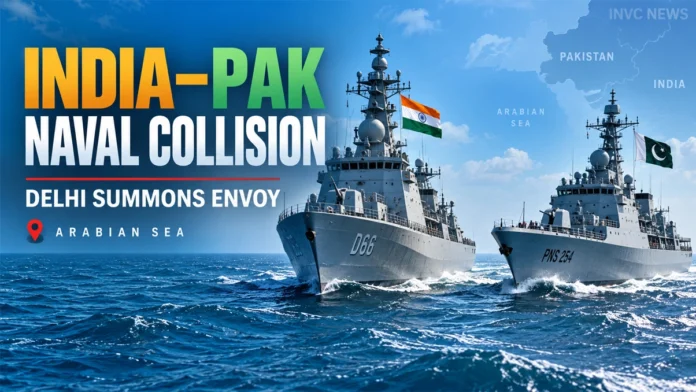
India Pakistan naval ship collision 2026 has triggered a fresh diplomatic protest after a Pakistani Navy vessel collided with an Indian Navy warship in international waters in the North Arabian Sea.
India summoned Pakistan’s Chargé d’Affaires in New Delhi on Wednesday and lodged what the Ministry of External Affairs described as a strong protest over the incident. New Delhi said the Pakistani naval unit acted in an “unacceptable and unprofessional” manner at sea.
The collision occurred on the evening of September 15, when the Pakistani naval ship PNS Hunain approached a frontline Indian Navy warship during a routine surveillance mission, according to Indian officials cited by The Indian Express.
No major damage was reported to the Indian vessel.
What Happened in the Arabian Sea?
According to Indian accounts, PNS Hunain closed in on the Indian warship at high speed and manoeuvred at close range before the two vessels made minor contact.
The incident took place in international waters in the North Arabian Sea, approximately 120 nautical miles from the Gulf of Oman, according to reporting based on Indian government sources.
The Indian Navy vessel remained operational and continued its surveillance mission.
PNS Hunain reportedly sustained damage and returned toward harbour.
Pakistan had not, in the sources reviewed here, publicly presented a detailed alternative account of the manoeuvring that led to the collision.
India Summons Pakistan’s Diplomat
The incident quickly moved from a naval encounter to a diplomatic issue.
India’s Ministry of External Affairs summoned Pakistan’s Chargé d’Affaires in New Delhi and formally protested what it described as unsafe conduct by Pakistani naval units. India also instructed its own Chargé d’Affaires in Islamabad to lodge a similar protest with Pakistan’s Ministry of Foreign Affairs.
New Delhi argued that encounters between military vessels require strict adherence to established procedures precisely because a navigation error or aggressive manoeuvre can produce consequences far beyond the original incident.
Why India Cited the 1991 Agreement
India says the encounter breached Article 10 of the 1991 Agreement between India and Pakistan on Advance Notice on Military Exercises, Manoeuvres and Troops Movements.
According to Indian officials, the provision requires naval ships belonging to the two countries to maintain a minimum separation of three nautical miles when operating in proximity to one another.
New Delhi therefore framed the episode not only as a navigation problem but as a breach of an existing bilateral confidence-building arrangement.
The agreement was designed to reduce the danger of military activities being misunderstood and escalating into a larger confrontation.
Why the Collision Matters
India and Pakistan operate military forces in strategically sensitive waters extending from the Arabian Sea toward the Gulf of Oman.
Naval vessels from both countries routinely conduct surveillance, exercises and other operational deployments.
When military ships operate close to one another, communication and predictable manoeuvring become particularly important. An unintended collision could otherwise be interpreted as deliberate action.
That makes bilateral confidence-building arrangements especially relevant during periods of political tension.
No Major Damage, but Diplomatic Stakes Are Higher
The collision itself did not cause major damage, according to the Indian government’s account.
However, the diplomatic reaction shows that New Delhi views the conduct surrounding the encounter as significant.
India has asked Pakistan to ensure that its naval units follow established bilateral protocols in future encounters.
The immediate focus is therefore less on physical damage and more on preventing another close-range encounter from producing a more serious incident.
Similar Maritime Friction Has Happened Before
Indian and Pakistani naval vessels have previously been involved in tense encounters at sea.
The Indian Express noted similarities with a 2011 episode involving a Pakistani vessel and an Indian frigate, illustrating how close-quarter manoeuvres can quickly become diplomatic disputes.
Those earlier incidents also underline why communication rules and minimum-distance protocols exist.
What Happens Next?
Three developments are worth watching.
First, Pakistan may issue a fuller public account of what happened and whether it disputes India’s description of the manoeuvring.
Second, naval commanders on both sides may review operating procedures to reduce the risk of another close encounter.
Third, diplomatic officials will watch whether the incident remains contained as a maritime safety dispute or becomes part of broader India-Pakistan tensions.
For now, both sides have avoided reporting any major escalation following the collision.
The central issue remains adherence to the naval protocols that India and Pakistan established specifically to prevent military encounters at sea from becoming larger crises.